
Buy a Thermax absorption chiller: a turnkey absorption chiller plant
In brief. We build chiller plants with Thermax absorption machines that make cooling from heat: steam, hot water, gas, exhaust gases. We check the heat source, calculate the payback, design, install and maintain. Since 2011 we have been the official and exclusive representative of Thermax in Russia and the CIS; we have installed more than 60 absorption chillers, and our share of the absorption chiller market in Russia is 65%.
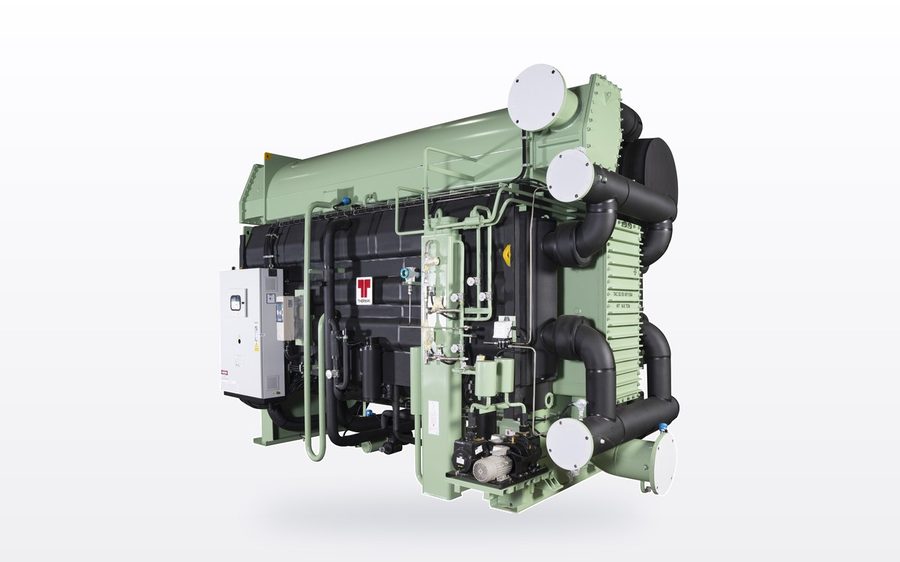
You can buy a Thermax absorption chiller from us: since 2011 Cold Energy (NCT) has been the official and exclusive representative of Thermax in Russia and the CIS. We have installed more than 60 lithium bromide absorption chillers, and our share of the absorption chiller market in Russia is 65%. The machine makes cooling from heat that is already available on site: steam, hot water from the boiler house, exhaust from gas engines (gas engine generator sets) and gas turbines. We build the chiller plant turnkey:
- we check the heat source;
- we calculate the payback;
- we design and supply the machines;
- we install, start up and maintain them.
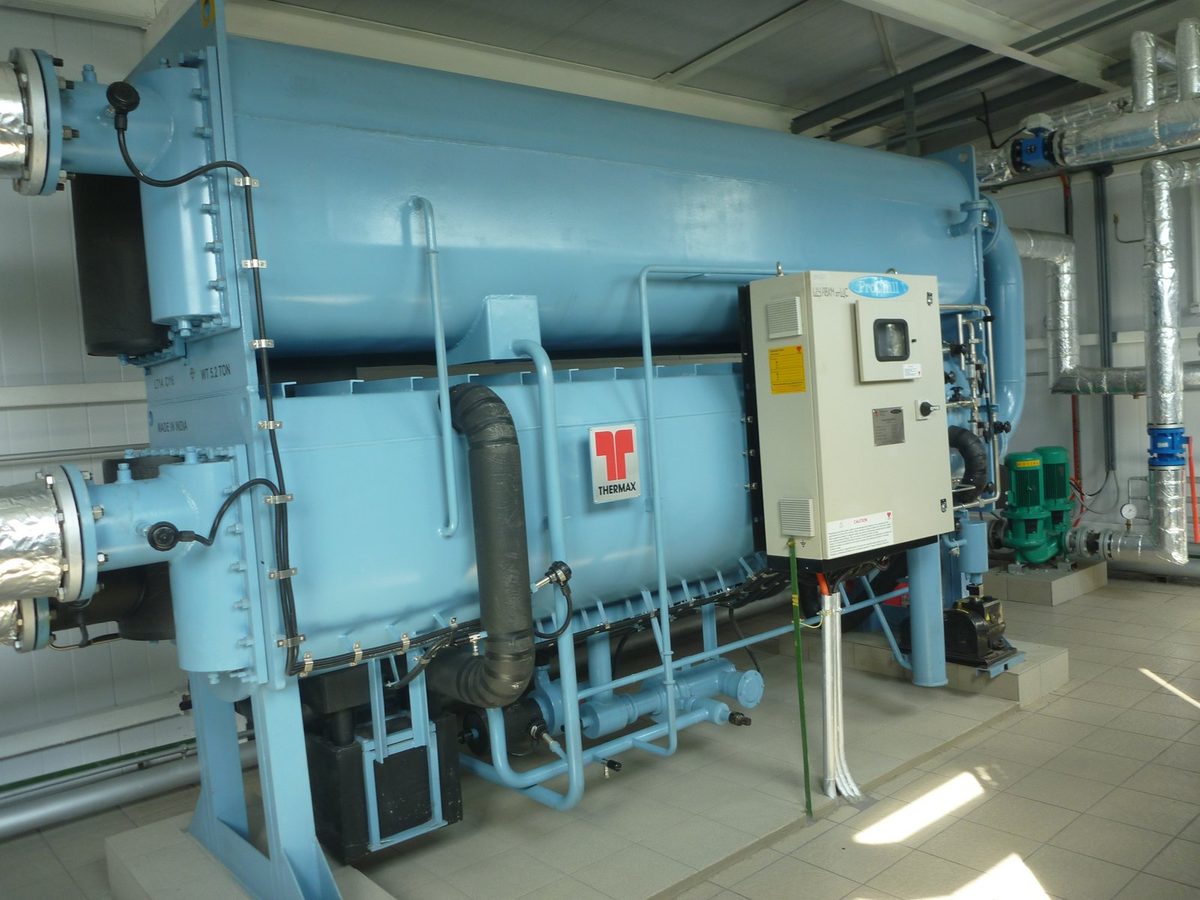
When is an absorption chiller more cost-effective than an electric vapor-compression chiller?
When the site has cheap heat or waste heat, or when electrical capacity is short. Operation costs up to 70% less than with Freon chillers; we calculate the payback for the specific site, with 3–5 years as a guideline. A compressor station needs about 300 kW per megawatt of cooling, a hot water driven absorption station 15–30 kW, only for the pumps and controls.
Four typical cases, with examples of each in the project table below:
- Waste process steam: fertilizer plants, petrochemicals, malt. A steam-driven machine can replace a vapor-compression one.
- Heat from your own power plant: hot water from gas engines, including from the cooling jackets, or from cogeneration (CHP).
- Turbine exhaust: cooling for gas turbine inlet air.
- Shortage of electrical capacity: hot water driven machines, even in the basement of a historic building.
How to choose a machine for your heat source is covered in the article How to choose an absorption chiller: a complete buyer's guide (in Russian).
How does an absorption chiller work?
The working pair is water and a lithium bromide solution; there is no compressor or Freon in the machine, and electricity is needed for the pumps and controls. The design, models and specifications are described at abxm-thermax.ru (in Russian); the types of machines and their limitations are below.
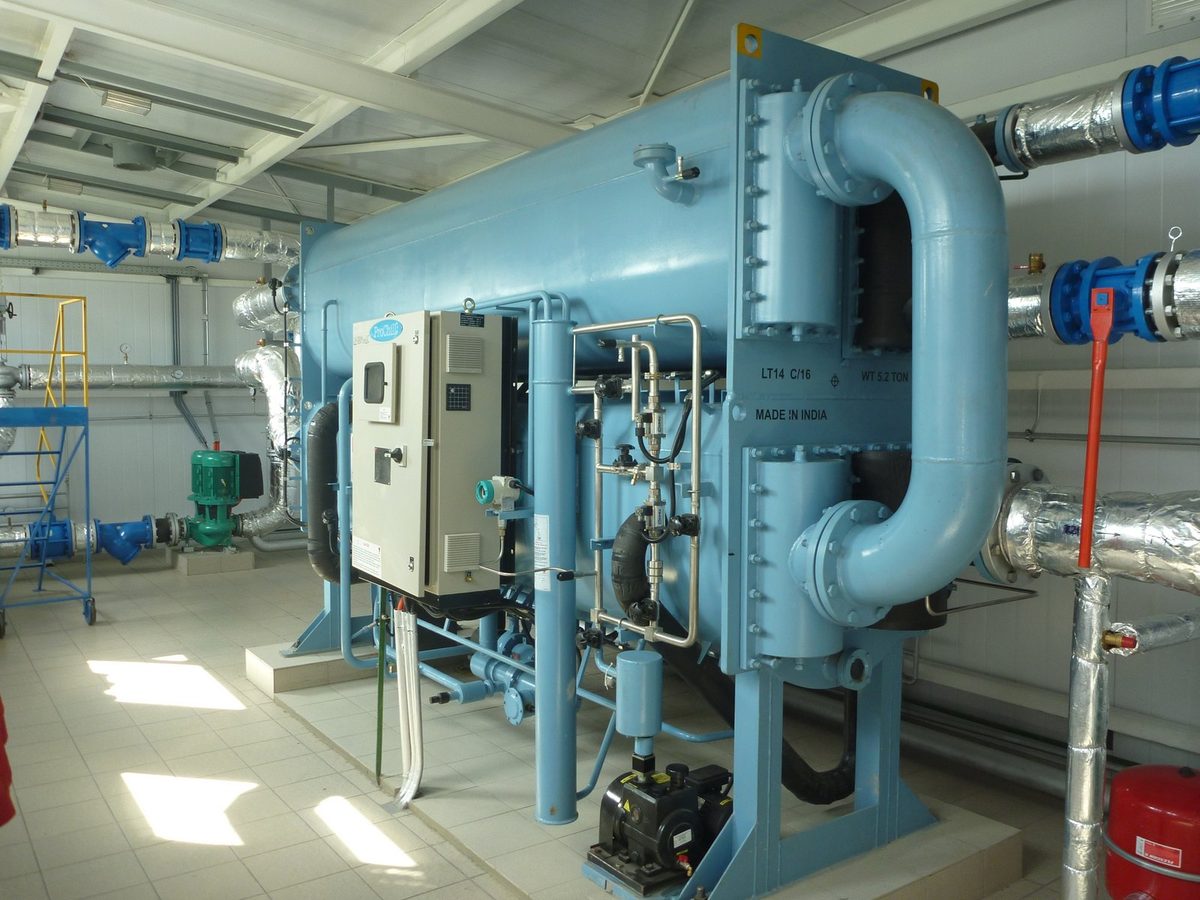
What types of absorption chillers are there?
The machines differ by heat source:
- Hot water driven: from a boiler house, gas engine cooling jackets, cogeneration. Simple design, the equipment is not subject to pressure vessel supervision, the price is lower than the others.
- Steam driven: waste or process steam. The design is simple; single-effect machines cost less than double-effect ones, and double-effect machines produce more cooling from the same steam.
- Gas fired (direct-fired): its own Oilon burner, 1 kW of gas yields 1.4 kW of cooling; as an option, the machine heats water and cools liquid down to −5 °C. The cooling tower needs less makeup water, is more compact and uses less electricity. If there is no boiler house on site, a gas-fired absorption chiller replaces building one.
- Exhaust gas driven: heat from gas turbine and gas engine exhaust, trigeneration (CCHP).
- Absorption heat pump: the same platform, but the task is the reverse: raise low-grade heat to 60–90 °C.
How much electricity does an absorption chiller need?
15–30 kW per 1 MW of cooling, versus about 300 kW for a compressor station. Electricity is used by the solution and refrigerant pumps, the vacuum pump (0.75 kW on the TCH G2 N4 XP machine), the controls and, on gas-fired machines, the burner. The cooling itself comes from heat.
| What we compare | Compressor station | Hot water driven absorption chiller |
|---|---|---|
| Electrical capacity per 1 MW of cooling | about 300 kW | 15–30 kW |
| Grid connection fee, guideline RUB 50,000–200,000 per kW | RUB 15–60 million | RUB 0.75–6 million |
Without power, the machine stops. It can ride through a dip of up to 3 minutes; longer than that, a solution dilution cycle is needed, so a UPS or a backup power feed is included in the design.
Where does an absorption chiller lose out?
First of all, where there is no cheap heat. Dimensions, manufacturing time, cooling tower winter operation and low load are also obstacles:
- No cheap heat. If heat has to be bought at full price, the payback goes beyond the project horizon. That is why we start the calculation with the source: type, temperature, flow rate, and how many hours a year it is available.
- Larger cooling tower. An absorption chiller rejects more heat into the cooling water than a compressor machine of the same capacity. We calculate the cooling tower and pumps together with the machine. A dry cooler instead of a cooling tower is used only if the chilled water leaving the absorption chiller is warmer than 17 °C.
- Weight and dimensions. The machine weighs 10–50 t and almost always travels as an oversized load. A foundation and a rigging path are needed.
- Not from stock. The factory makes the machine for your operating mode; the lead time is built into the project plan in advance.
- Cold cooling tower water and crystallization. In winter, the main danger is cooling water that is too cold. A three-way cooling tower bypass valve is needed, and the room must be no colder than +8 °C. The Thermax controller monitors the margin to crystallization in advance, but we do not promise to rule it out completely.
- Low load. The machine runs smoothly at 10–100% capacity; below 10% it suspends cooling production. At low load the coefficient of performance drops; we take this into account in the economics.
If the calculation shows that a vapor-compression chiller or a hybrid is more cost-effective, we will say so.
What does the customer get from a Thermax absorption chiller?
Below is what all machines have, and how gas-fired and exhaust gas driven machines differ.
All Thermax machines
| Feature | What it gives | Customer benefit |
|---|---|---|
| Remote monitoring | The factory monitors the machine's operating parameters | Fast response from specialists, less work for the operator, longer failure-free operation |
| Smooth 10–100% capacity control | At a constant coolant temperature | No large buffer tank needed |
| Absorbent operating temperature +50 °C | Margin to solution crystallization at +36 °C; when the margin is less than 8 °C, the controller takes action in advance | Crystallization is prevented rather than fixed: less downtime and lower service costs |
| Helium leak testing | High tightness of every machine shipped | Long service life, lower service costs |
| Stainless steel generator tubes | Last longer than copper ones, service life over 25 years | Long service life after the warranty |
| Custom design | The machine can be delivered knocked down | Easier to bring into place, no need to take apart load-bearing structures |
7 more features
| Feature | What it gives | Customer benefit |
|---|---|---|
| Sensors in all internal systems | Included as standard | A complete picture of the machine's operation in the controller |
| Working fluids are supplied with the machine | No need to look for substitutes locally | Confidence in quality and no risk of unplanned repairs |
| Corrosion inhibitor: lithium molybdate | Safer than the lithium chromate used previously | Less health risk for staff |
| Gravity feed of lithium bromide to the evaporator via trays | Passive protection of the distribution system against clogging | Less downtime, no need to clean the feed system |
| Insulation installed at the factory | Factory installation quality | No need to find and pay a contractor; the insulation will not come off |
| Isolation valves on the pumps | Pump maintenance without loss of vacuum | No need to drain the working fluids to repair the pumps |
| Teikoku pumps (Japan) | 50,000-hour service interval | Savings on pump maintenance |
Also:
- Brand-name components, for example Siemens;
- Free access for maintenance.
Gas-fired machines
| Feature | What it gives | Customer benefit |
|---|---|---|
| Oilon burners | Readily available burners of a well-known brand | The customer can contact the manufacturer directly; short lead time |
Other features of gas-fired machines are in the section "What types of absorption chillers are there?" above.
Exhaust gas driven machines
| Feature | What it gives | Customer benefit |
|---|---|---|
| Standby steam condenser | Condenses harmful substances from the gases when the valve is closed | The machine's internal components last longer |
What makes up the cost of a chiller plant?
The price of the machine, delivery, installation and commissioning. We calculate all of this and the payback period at your tariffs. For the calculation, send us:
- the type, temperature and flow rate of the heat source;
- the cooling load;
- for glycol, the solution concentration and the lowest temperature.
Glycol raises the price: a machine for it costs 10–20% more than the same machine for water. On water, Thermax machines go down to +1 °C; on glycol, down to −2 °C for hot water and exhaust machines and down to −5 °C for steam and gas-fired ones. At the Döhler food ingredients plant in Lobnya, a hot water-fired machine cools propylene glycol from 14 to 0 °C, and in the cold season dry coolers take over the circuit in free cooling mode.
You can make a rough estimate yourself in the absorption vs electric chiller calculator: for 1,000 kW of cooling with the default settings, a gas-fired absorption chiller spends RUB 1.01 million a year on energy and an electric chiller RUB 3.19 million. You set the tariffs, operating mode and load for your site: open the calculator on its page.
A Thermax absorption chiller running on waste heat costs from RUB 9,000,000; the price of a specific machine depends on the capacity and the heat source. Prices of individual machines are at abxm-thermax.ru (in Russian); all our items with prices are in the catalog (in Russian).
Where are Thermax absorption chillers used?
- petrochemicals and chemicals: cooling of reactors and processes (solutions for petrochemicals);
- food industry: for example, cooling milk to +5 °C (food processing);
- metallurgy;
- data centers (solutions for data centers);
- medical facilities, shopping and business centers (commercial real estate);
- trigeneration: cooling from the heat of turbines, boilers and engines (trigeneration);
- gas turbine and gas engine inlet air cooling (solution).
Absorption chillers work with open and closed-circuit cooling towers, including NCT cooling towers.
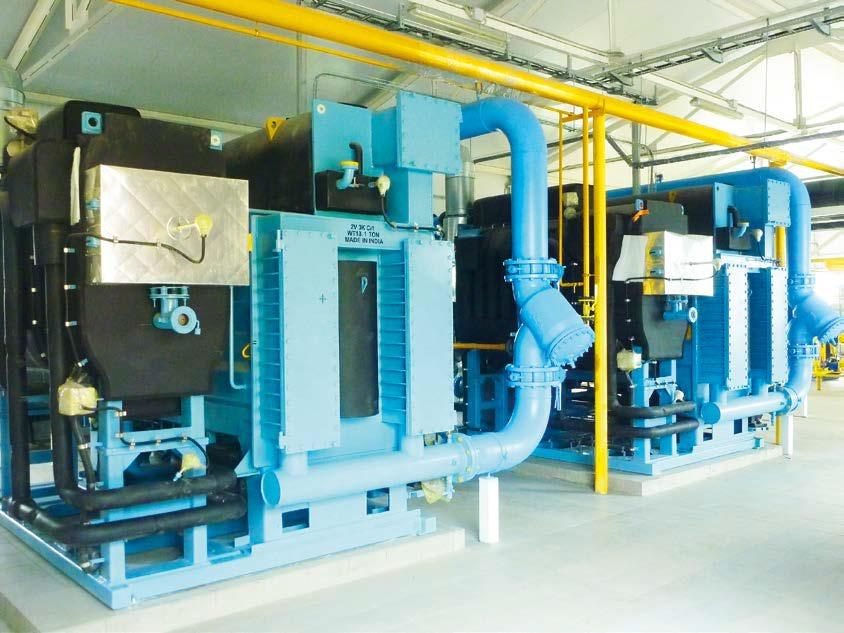
Which projects use our absorption chillers?
| Site | Model | Heat source | Cooling capacity and task |
|---|---|---|---|
| Gas turbine power plant (in Russian) | 2D 5M C | gas turbine exhaust gases | 3,150 kW, gas turbine inlet air cooling |
| Syry Kubani cheese and dairy plant (in Russian) | 5G 7L C | hot water from gas engines | 3,500 kW, water 12/2 °C |
| Mineral fertilizer plant, Cherepovets (in Russian) | 2 × 2B 5N C | waste steam | 3,766 kW in total, water 10/5 °C, air cooling in production |
| Vyborzhets agricultural complex (in Russian) | 2 × 5G 6LH | hot water | 3.8 MW in total |
| Volzhsky Pipe Plant (in Russian) | 2 × HS 50C-CU | hot water | 2 × 1,650 kW |
| Aktivny Komponent pharmaceutical plant (in Russian) | 2 × TAC L5 E3 | water from gas engine cooling jackets | 2 × 1,430 kW |
| Petrochemical plant, Blagoveshchensk (Bashkortostan) (in Russian) | SS 40A-CU | waste steam | 1,640 kW, replacement of a vapor-compression machine, process cooling |
| Kursky Solod malt plant (in Russian) | 2B 5K C | steam | 1,500 kW |
| Minvody Expo exhibition center (in Russian) | 2V 4M C and 2V 5K C | gas | 2,001 and 1,702 kW |
| Maskarad-2 shopping mall (in Russian) | 2V 3M C | natural gas | 1,350 kW |
| MOSGAZ engineering center (in Russian) | 2 × GD 20C TCU-S | natural gas | 1,200 kW in total, plus heating |
| Teplichnoye greenhouse complex (in Russian) | 2 × LT 12 C | hot water from gas engines and the boiler house | 2 × 400 kW, water down to +3.5 °C |
| Central Customs Administration (in Russian) | 2 × LT-14 C | hot water from microturbines | 2 × 500 kW, basement of a historic building in Moscow, shortage of electrical capacity |
| Belorusneft (in Russian) | LT 14C and LT 10C | hot water from a cogeneration unit | 651 and 280 kW |
| Moscow Region Government House (in Russian) | 3 × LT42 T | hot water from four Jenbacher modules totaling 12 MW | 6 MW in total, central air conditioning; the first trigeneration plant of this size in Russia |
| Fyffes Property Holding warehouse complex (in Russian) | 2 × TCH G2 E1 | natural gas | 2 × 1.2 MW, water 9/6 °C for banana degassing rooms; the same machines heat the warehouse |
| Tarkett-Sommer plant (in Russian), Mytishchi | HS-40D-CU | hot water from heat recovery boilers that burn sawdust, a production waste | 1.2 MW, industrial air conditioning |
And many others: the full list is in the Projects section.
How do delivery, installation and maintenance work?
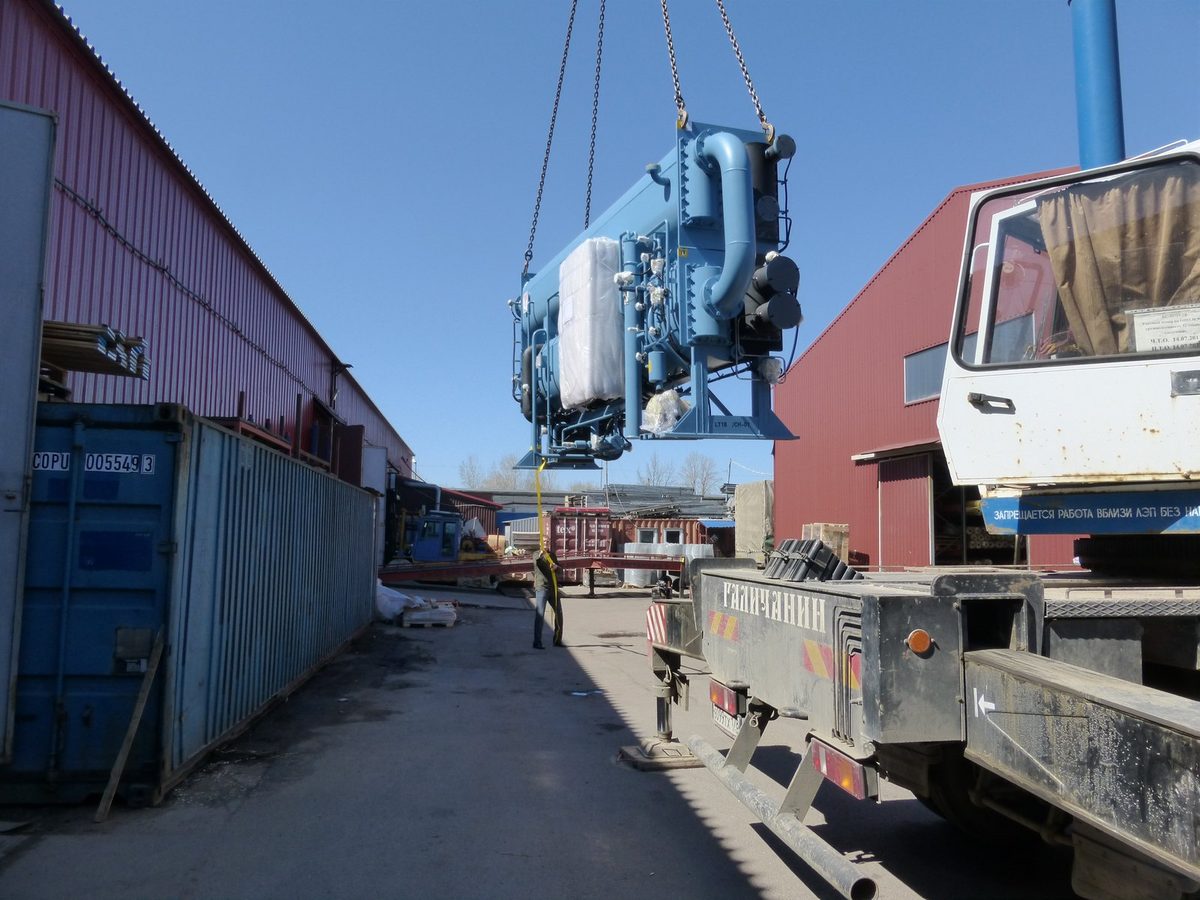
Delivery. An absorption chiller is almost always an oversized load: the machine does not fit into a standard container or onto an ordinary flatbed. It is shipped in factory packaging and, for safety, uncharged. If necessary, we deliver the machine knocked down.
Installation takes 2–4 weeks: a foundation for a weight of 10–50 t, steam or hot water piping, 380 V power supply. The room must be clean, with ventilation and drainage.
Commissioning: evacuation, LiBr solution check, start-up.
Maintenance: annual maintenance, solution density monitoring, tube cleaning every 2 years. The machine's operation can be monitored remotely.
Selection and calculation are free, and we prepare a feasibility study for your parameters in 2–3 days: submit a request or call +7 (800) 333-49-96.
Frequently asked questions
The system was commissioned by a third-party company. The absorption chiller delivers half its capacity, and the cooling tower runs at 40%. Can you restore it?
Yes, if the machine is a Thermax: we do not repair other brands. We start with an on-site inspection. We look at the whole chain: flows and temperatures in the circuits, control panels, water treatment pumps, the water and a solution sample. The cause often lies around the machine rather than in it. The scope of work is determined based on the inspection; a non-warranty case, including the site visit, is paid for by the customer. We agree on the visit date in advance: the plant may be shut down for the duration of the work. Have the fault log and the start-up report ready, if there is one.
Your absorption chiller is the most expensive of three offers. What am I paying for?
First, check whether the inputs match: chilled water temperatures, cooling tower water, heating medium parameters, the lower load limit. Three offers are rarely calculated for the same operating mode. Then compare the coefficient of performance and the price of 1 kWh of cooling in rubles on your heat, not the price of the machine. Find out whether the solution, installation supervision and commissioning are included, who does the analyses and where the spare parts come from. If another machine is cheaper with equal inputs, we will say so directly.
We need a 1 MW absorption chiller, with commissioning and delivery. Do you have one in stock?
As a rule, no: the factory makes the machine for your operating mode, and it usually cannot be supplied from stock. This applies especially to non-standard tasks, for example water at about +3 °C from hot water: a different tube material may be needed there, and that affects the price and weight. So build the lead time into the project plan in advance; we will give the exact date for the specific model.
The absorption chiller trips, and the staff reset it and cut power to the control panel. What can this lead to?
Machine failure. If the burner runs without control from the automation, no one watches the signals, and running equipment is de-energized to clear the alarm, the safety rupture disc may burst and the shell will lose its tightness. The machine can ride through a power dip of up to 3 minutes; longer than that, a dilution cycle is needed, otherwise crystallization is possible. That is why a UPS or a backup power feed is provided, and staff are trained to read the log. A recurring fault is passed to the service team, not reset.
There is not enough electrical capacity on site. Which is cheaper: buying more or installing an absorption chiller?
Calculate both lines; the grid connection fee often settles the argument. It costs from RUB 50,000 to 200,000 per kW. A compressor station needs about 300 kW per megawatt of cooling, a hot water driven absorption station 15–30 kW. On the connection alone, the difference comes to roughly RUB 14–57 million, one-off. This works if there is cheap heat and the machine runs enough hours. The absorption chiller does not cover the rest of the load growth: it only takes the cooling off the grid.
Watch: absorption chillers (in Russian)
How Thermax absorption chillers workLet us size a cooling system for your site
An engineer will select the equipment and send you a calculation. Free of charge, no obligation.