
Cooling for food processing: from calculation to service
In brief. We build turnkey cooling for food plants: recirculating cooling with NCT cooling towers, chilled water, cooling from heat with Thermax absorption chillers and hybrid stations with coolant below −5 °C. Our equipment works at dairy, cheese, juice and beverage plants in Russia, Belarus, Kazakhstan and Armenia.
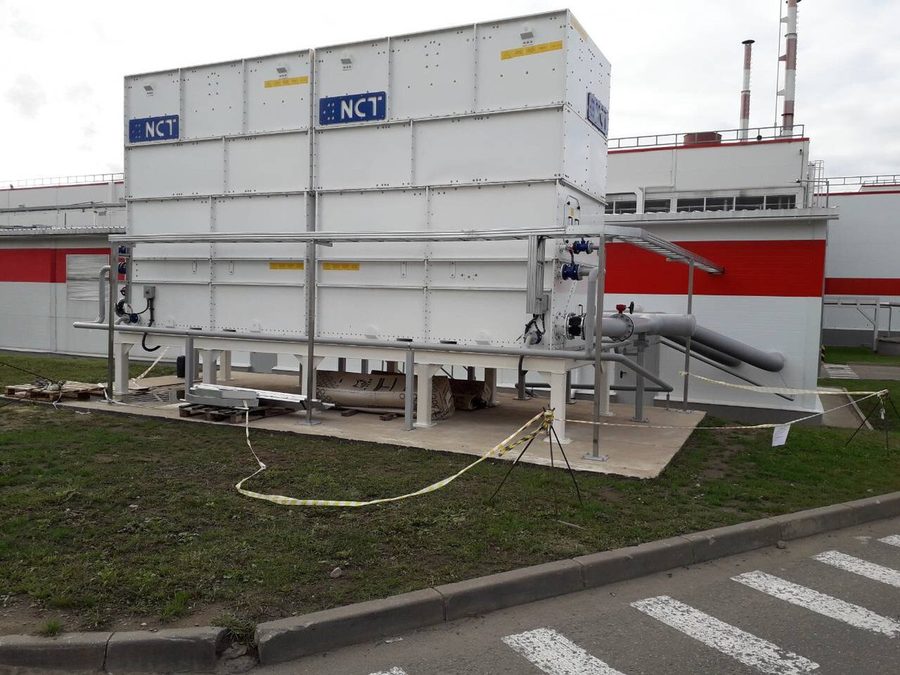
At food plants, cooling is part of the process: pasteurization, milk cooling, chilled water, air conditioning of the workshops. We select the scheme for the plant: recirculating cooling of the lines with NCT cooling towers, chiller plants with NCT chillers, and, where electrical capacity is short or heat is available, Thermax absorption chillers, which run on heat rather than on electricity.
Why does a food plant need an absorption chiller?
A lithium bromide absorption chiller produces cooling from thermal energy. The heat sources are:
- hot water;
- high- and low-pressure steam from a boiler house, a boiler or a process;
- exhaust gases from gas engines or gas turbines;
- natural gas and other fuels.
When there is not enough electricity, plants often install on-site generation. In that case an absorption chiller sharply reduces the costs of central air conditioning and industrial cooling: the cooling is made from available heat. The heat from the absorption chiller is rejected by wet evaporative cooling towers.
For a long time absorption chillers could not cool below +5 °C, and this held back their use in the food industry. In 2001 Thermax engineers removed this limitation, and since then absorption chillers have been used more and more widely in food production.
What schemes do we use?
Recirculating cooling of process lines with cooling towers
Pasteurizers, sterilizers, vacuum evaporators and condensers need cooled recirculating water. It comes from an NCT cooling tower with a pump skid, chemical water treatment and a control panel with variable frequency control. Examples are in the "Where our cooling towers work" section below.
Chiller plant with chillers
When the process needs water colder than a cooling tower can deliver, we install a chiller plant with NCT chillers, with a cooling tower, a dry cooler or free cooling.
Absorption chiller running on the plant's heat
The absorption chiller receives heat from gas engines, a boiler house, steam or process equipment and delivers chilled water for the process and air conditioning. This is how our sites listed below work.
Hybrid cooling station
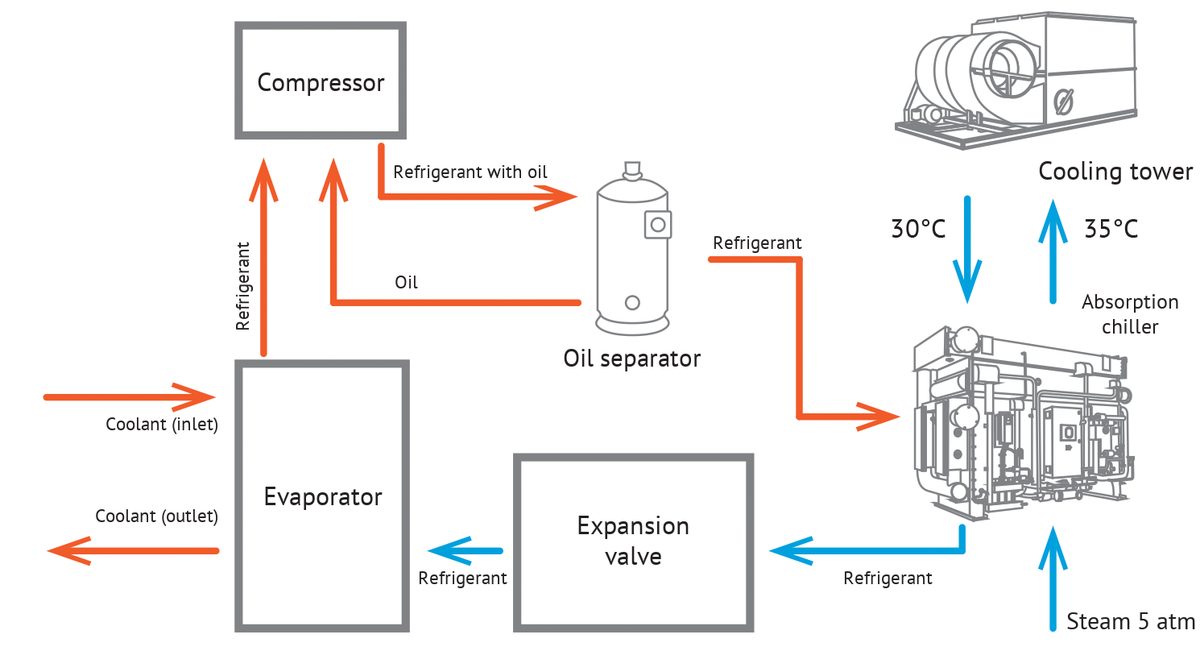
The idea is to use an absorption chiller and a vapor-compression chiller (VCC) at the same time. The absorption chiller lowers the condensing temperature of the compressor machine, and the cost of cooling falls. The scheme works both with direct expansion of the refrigerant and with an intermediate coolant at a temperature below −5 °C. The main advantage is that the compressor uses less electricity.
| Compressor part (VCC) | Absorption part (absorption chiller) | |
|---|---|---|
| Cycle | vapor-compression | absorption |
| Energy source | electricity, high consumption | thermal energy |
| COP | high | low |
| Low-temperature cooling | can produce it | cannot |
| Refrigerant | freon or ammonia | demineralized water |
How the hybrid station works:
- Heat from the consumer makes the freon boil in the VCC evaporator.
- The freon vapor is compressed in the VCC compressor to the condensing pressure and temperature.
- The compressed freon goes to the absorption chiller evaporator, which serves as the condenser for the VCC.
- There the freon gives off heat and condenses.
- In the absorption chiller evaporator, demineralized water boils at a pressure close to vacuum and a temperature of +3…+4 °C.
- The water vapor is absorbed by the lithium bromide solution in the absorber. The heat goes into the cooling water, which is cooled by the cooling tower.
- In the absorption chiller generator, the supplied heat (steam, flue gases, natural gas combustion, hot water) boils water off the weak lithium bromide solution.
- The water vapor condenses in the absorption chiller condenser and returns to the evaporator.
- The liquid freon passes through the thermostatic expansion valve into the VCC evaporator, and the cycle repeats.
The lower the required coolant temperature, the more cost-effective the scheme, because the coefficient of performance of the compressor part increases. A hybrid station is economically justified if:
- the site has a shortage of electricity;
- there is a waste or cheap heat source.
Where our absorption chillers work
| Site | Equipment | Task |
|---|---|---|
| Syry Kubani (in Russian), Vyselki stanitsa, Krasnodar Territory | Thermax 5G 7L C absorption chiller, 3,500 kW, driven by hot water from MTU gas engines; two NCT VR4 cooling towers with basin heating | chilled water 12→2 °C, air conditioning |
| Döhler food ingredients plant (in Russian), Lobnya | Thermax TZC L5 G4 absorption chiller, 1,500 kW, driven by gas engine heat; two NCT VR4 cooling towers | cooling of juice concentrate pasteurizers, 14→0 °C |
| Kursky Solod (in Russian), Kursk | steam-driven Thermax absorption chillers, 1,500 and 2,500 kW; NCT VR3 and VR2 cooling towers | air at 9–12 °C for barley germination, 8/3 °C mode |
| Chips and croutons plant (in Russian), Moscow Region | Thermax 5G 4L C absorption chiller, 1,000 kW, driven by hot water; NCT VR3 cooling tower | industrial cooling of the workshops |
| Kropotkin Dairy Plant (in Russian) MoloPromKuban | Thermax TZC L1 P1 absorption chiller, 0.5 MW, driven by gas engine heat; NCT SVA cooling tower | milk processing and storage, 7.7/2.7 °C |
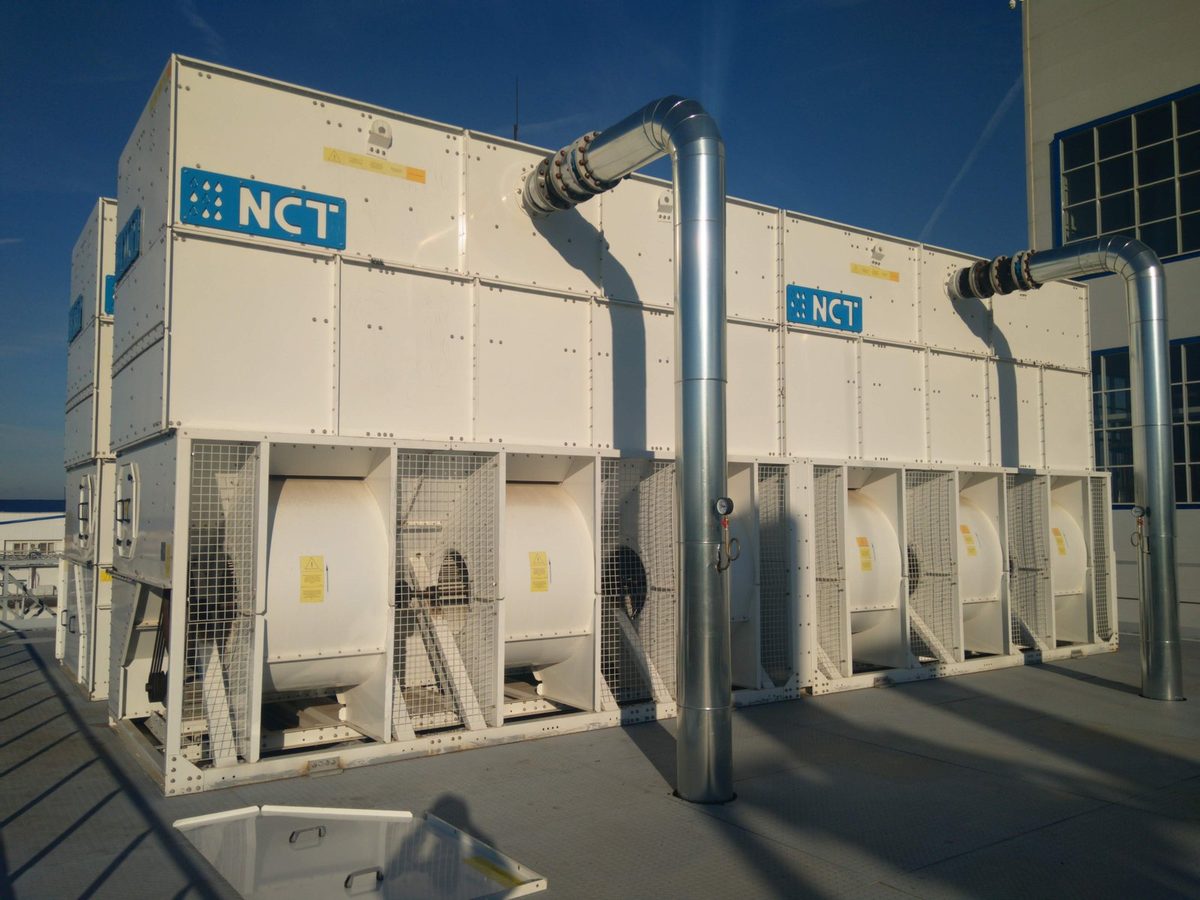
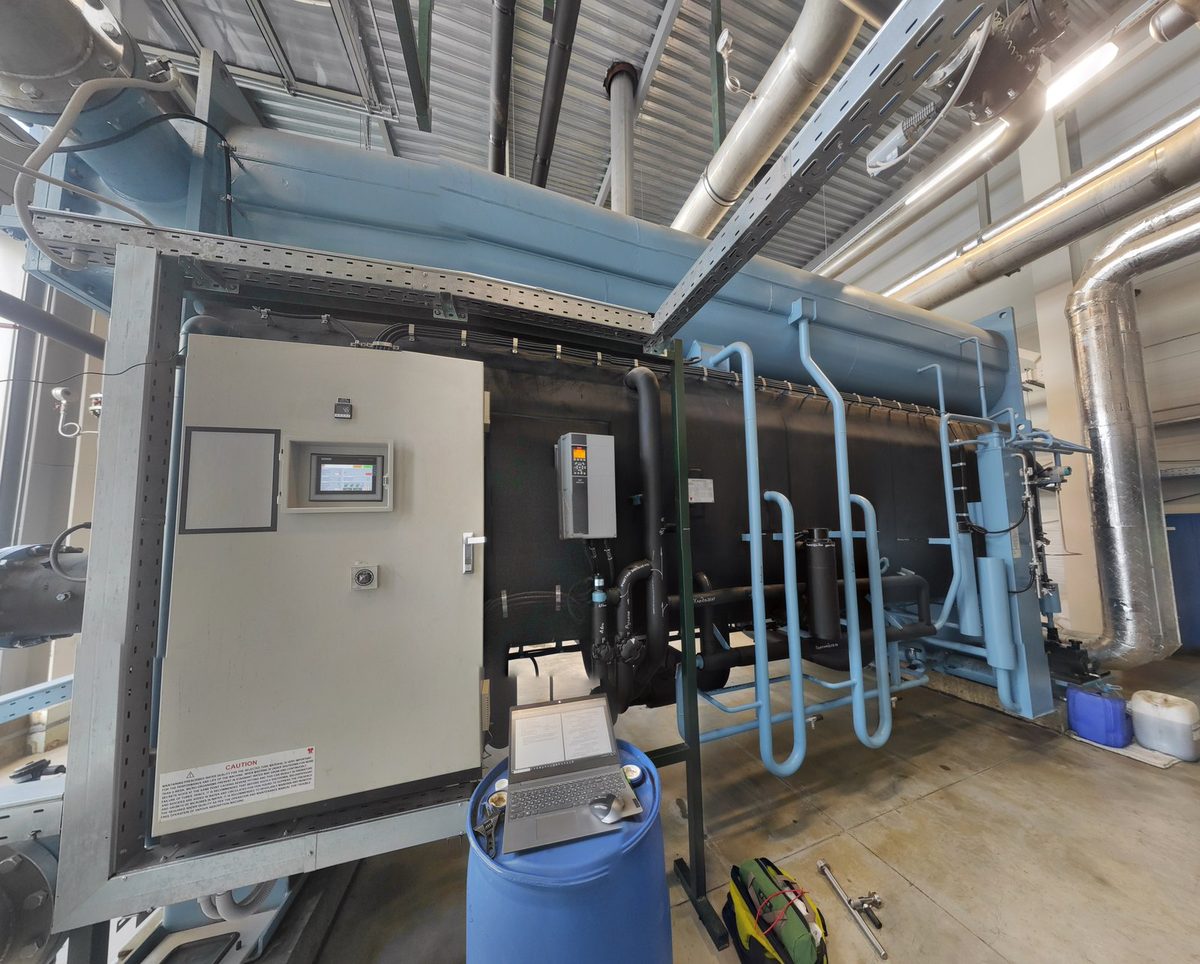
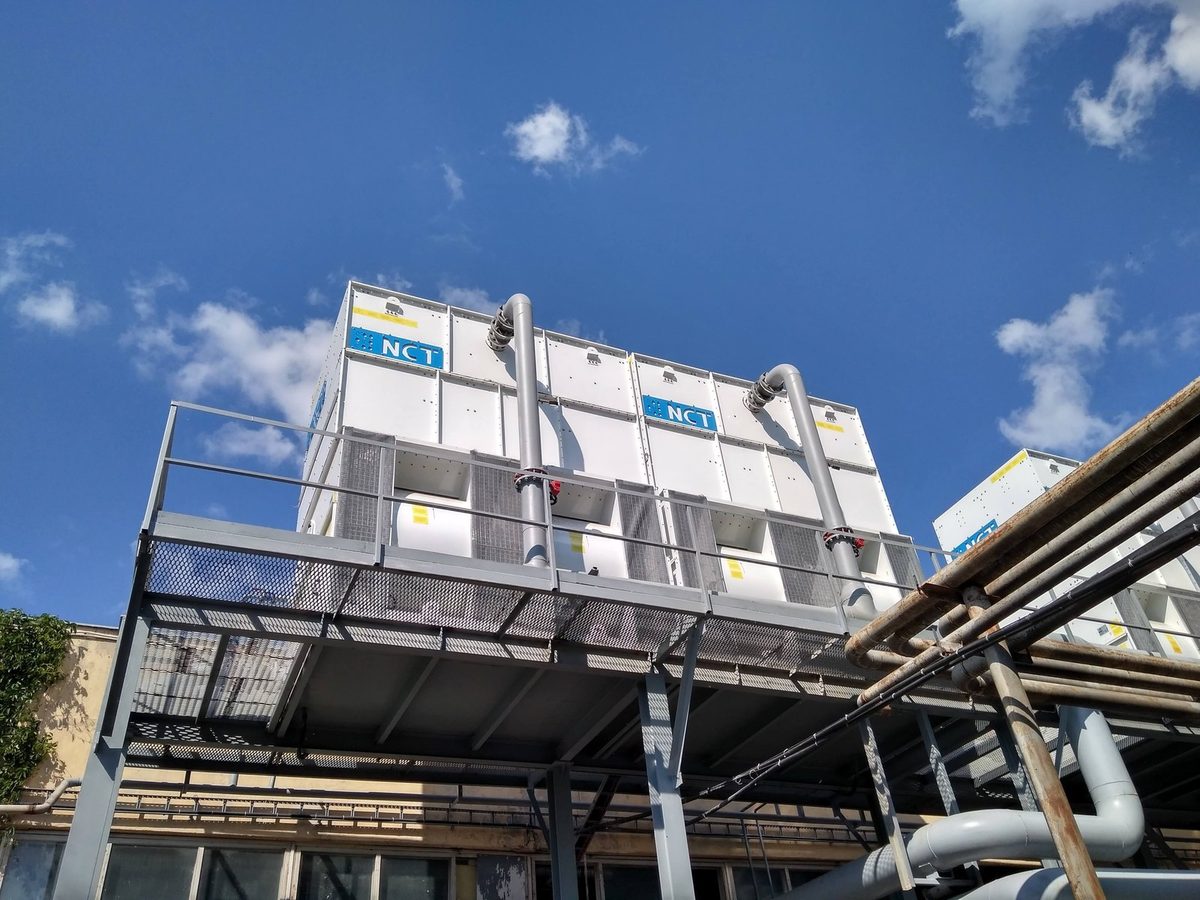
A few details:
- At the plant in Vyselki, the absorption chiller has proven its operation in two modes: 12→7 °C and 6→2 °C. This means a lithium bromide machine cools water to +2 °C and below.
- At the chips plant, the absorption chiller is heated by water from a heat recovery unit installed on the frying oven.
- In Kropotkin, when the load drops, the absorption chiller goes down to +1.5 °C and accumulates chilled water, which increases the efficiency of the complex. The SCADA system keeps parameter logs and sends alerts to the duty staff.
Where our cooling towers work
- Molochny Mir (in Russian), Grodno: an NCT VR1 cooling tower cools the water of vacuum evaporators from 45 to 25 °C;
- DEP LLP (in Russian), Kostanay: NCT VR1 cooling towers for units in condensed milk production;
- Bellakt (in Russian), Grodno: an NCT SVA-0 cooling tower for the milk formula line;
- Kobrin butter and cheese plant (in Russian): an NCT SVA-1 cooling tower for the milk pasteurizer in the ice cream workshop;
- Lebedinskaya Usadba (in Russian), Gubkin: two NCT SVA cooling towers for the sterilizer on the apple concentrate line;
- Libella Bottlers Almaty LLP (in Russian): an NCT SVA-1 cooling tower for the sugar syrup line;
- FRUIT ART LLP (in Russian), Almaty Region: an NCT SVA-1 cooling tower for the freeze dryers;
- Pargev Armenian branch (in Russian), Yerevan: an NCT SVA-2S cooling tower for cooling condensers;
- Chips and croutons plant (in Russian): an NCT VR3 cooling tower paired with an absorption chiller;
and many others. Customer reviews (in Russian).
What else do we cool at food plants?
Operating modes come from our industry brochures, sites from the 2026 reference lists:
| Production | Where cooling is needed | Mode | Sites with NCT equipment |
|---|---|---|---|
| Dairy | milk reception and pre-cooling, ice water at the reception peak | milk down to +4 °C, ice water +1…+2 °C: NCT chiller with a buffer tank | Molvest (Voronezh Region); at the Milk Gidrosan plant (Oryol Region) a cooling tower cools the condensers of the vacuum evaporator |
| Beer | wort cooling after boiling, glycol jackets of fermentation tanks | wort 96 → 8…10 °C, fermentation 8…14 °C, glycol −4 °C | Heineken (Saint Petersburg), Ochakovo (Moscow) |
| Soft drinks and juices | product before the carbonator, cooling after pasteurization | +2…+4 °C before the carbonator, 90 → 20 °C on the heat exchanger | Chernogolovka (Moscow Region), Akva-Don (Rostov-on-Don) |
| Confectionery | chocolate tempering, cooling tunnels | water +12…+16 °C, tunnel +6…+12 °C | KDV (Voronezh); at the Lyubimy Krai factory (Leningrad Region) a chiller cools the process line |
| Ice cream | freezers and pasteurizers | — | at the Iceberry factory (Yaroslavl Region) a cooling tower cools freezers and pasteurizers |
| Canned food | sterilization autoclaves | — | at the Pikanta plant (Astrakhan) a cooling tower cools two autoclaves for canned vegetables |
| Sugar | circulating water, turbine generator | circulating water +28/35 °C | at the Atmis-Sakhar plant (Penza Region) NCT cooling towers were supplied in three deliveries |
Among many others are starch, coffee and pet food plants.
How does a project go?
- Engineer consultation and the overall concept.
- Technical specification and a step-by-step plan.
- Equipment layout options and a feasibility study.
- Design, supply, installation supervision and commissioning.
The engineer consultation, layout options and the feasibility study are free of charge.
We will send the guide "Choosing a Plant Cooling System" (20 pages: 9 questions to ask before reading quotes, 6 schemes from cooling tower to absorption chiller, a selection algorithm and a 10-year cost of ownership model) by email or via Telegram: request it on the resource page.
Downloads:
How our systems work at the sites is shown in the "Videos" (in Russian) section.
Cooling system schemes
Typical schemes we use in this industry. The numbers on the scheme are piping elements; the key is under each scheme.
Open recirculating cooling loop
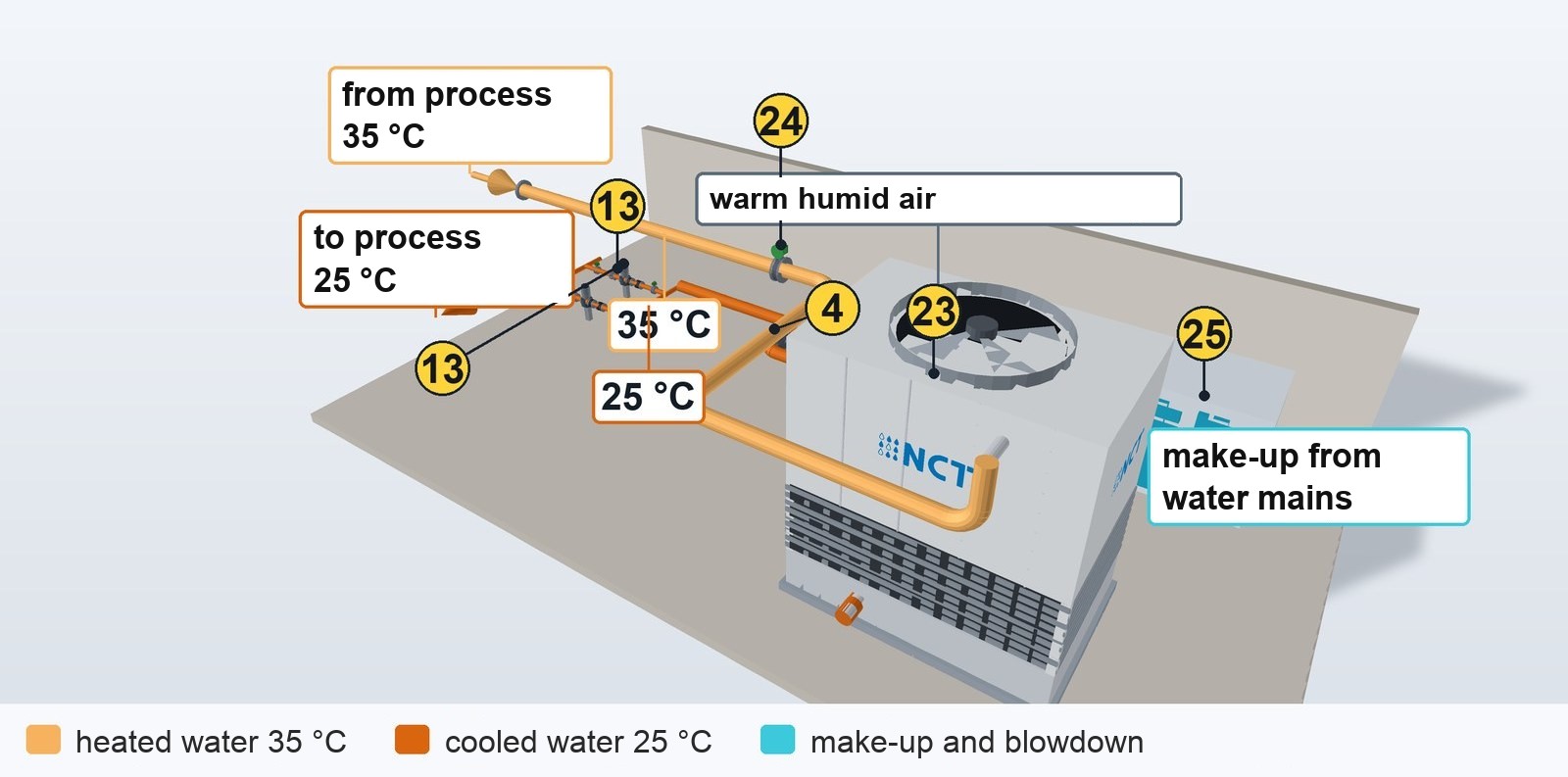
Heated water from the process is cooled in the cooling tower by evaporation and returns to the process; water is consumed only for makeup and blowdown.
Key to the numbers on the scheme
| No. | Element | Purpose |
|---|---|---|
| 3 | Butterfly valve | isolates the machine and pumps for repair and flushing; installed in pairs, at the inlet and the outlet |
| 4 | Y-strainer | catches scale and debris before the unit's tubes; at the INLET only |
| 5 | Flexible connector (vibration isolator) | right at the nozzle: dampens vibration and does not pass the weight and misalignment of the pipe on to the nozzle |
| 13 | In-line pump | circulates water through the loop; in pairs: duty + standby |
| 14 | Check valve | prevents water from flowing back through an idle pump |
| 23 | NCT open cooling tower | the water gives off heat to the air by evaporation: the cheapest way to reject megawatts |
| 24 | Butterfly valve on the supply line | isolates the cooling tower for repair without stopping the other cells |
| 25 | Water treatment and automatic blowdown | reverse osmosis or dosing: without it, scale eats up the heat transfer, and blowdown is done blindly |
Steam-driven absorption chiller: cooling from waste heat
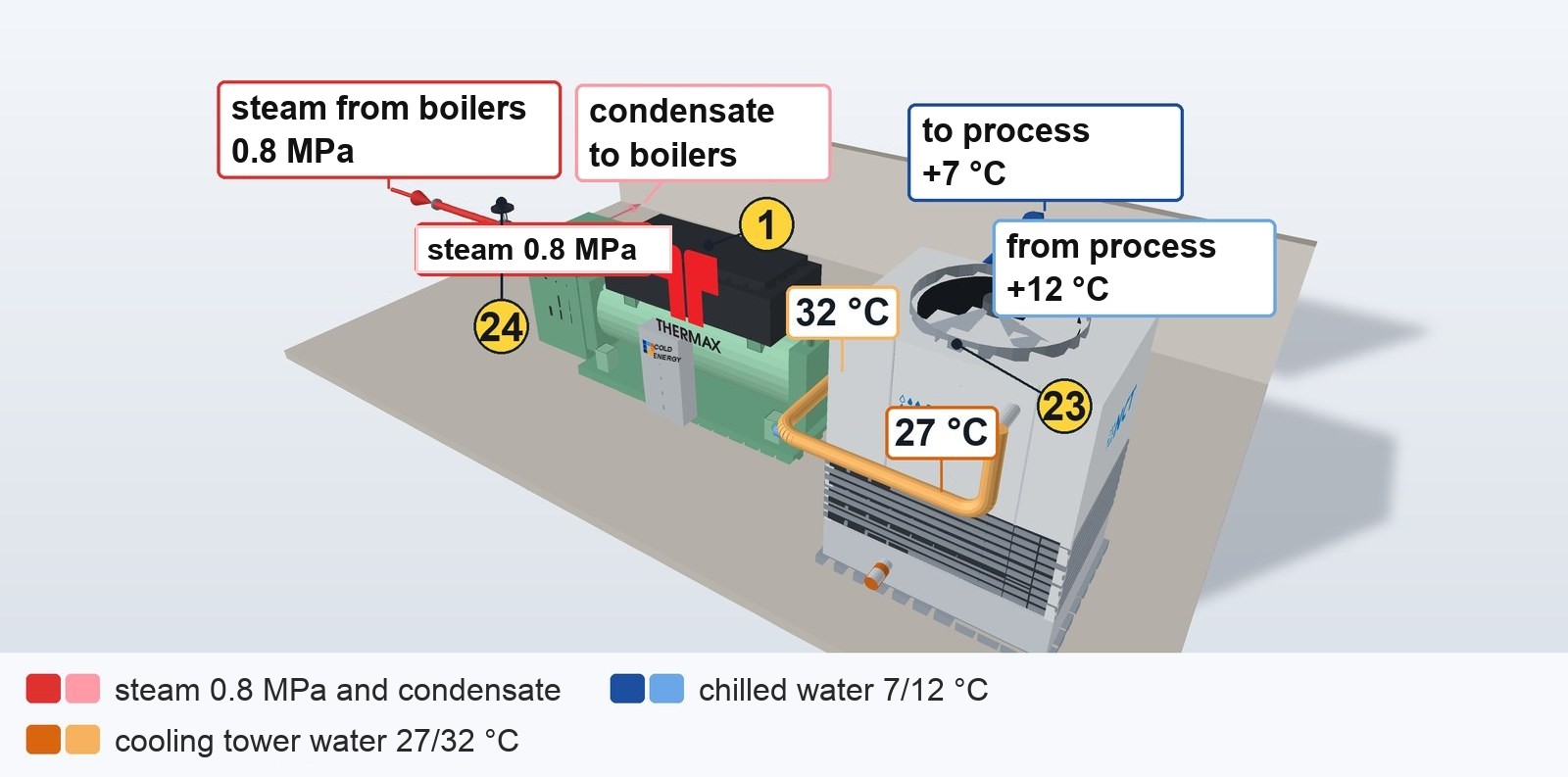
Steam heats the machine's generator, chilled water goes to the process, and the heat of absorption goes to the cooling tower.
Key to the numbers on the scheme
| No. | Element | Purpose |
|---|---|---|
| 1 | Steam-driven Thermax absorption chiller | steam heats the solution, and the machine delivers chilled water without a compressor |
| 23 | NCT cooling tower | rejects the heat of absorption: there is more of it than with a compressor machine of the same capacity |
| 24 | Steam control valve | meters the steam according to the load: the machine holds +7 °C at the outlet |
Hybrid scheme: dry in winter, wet in summer
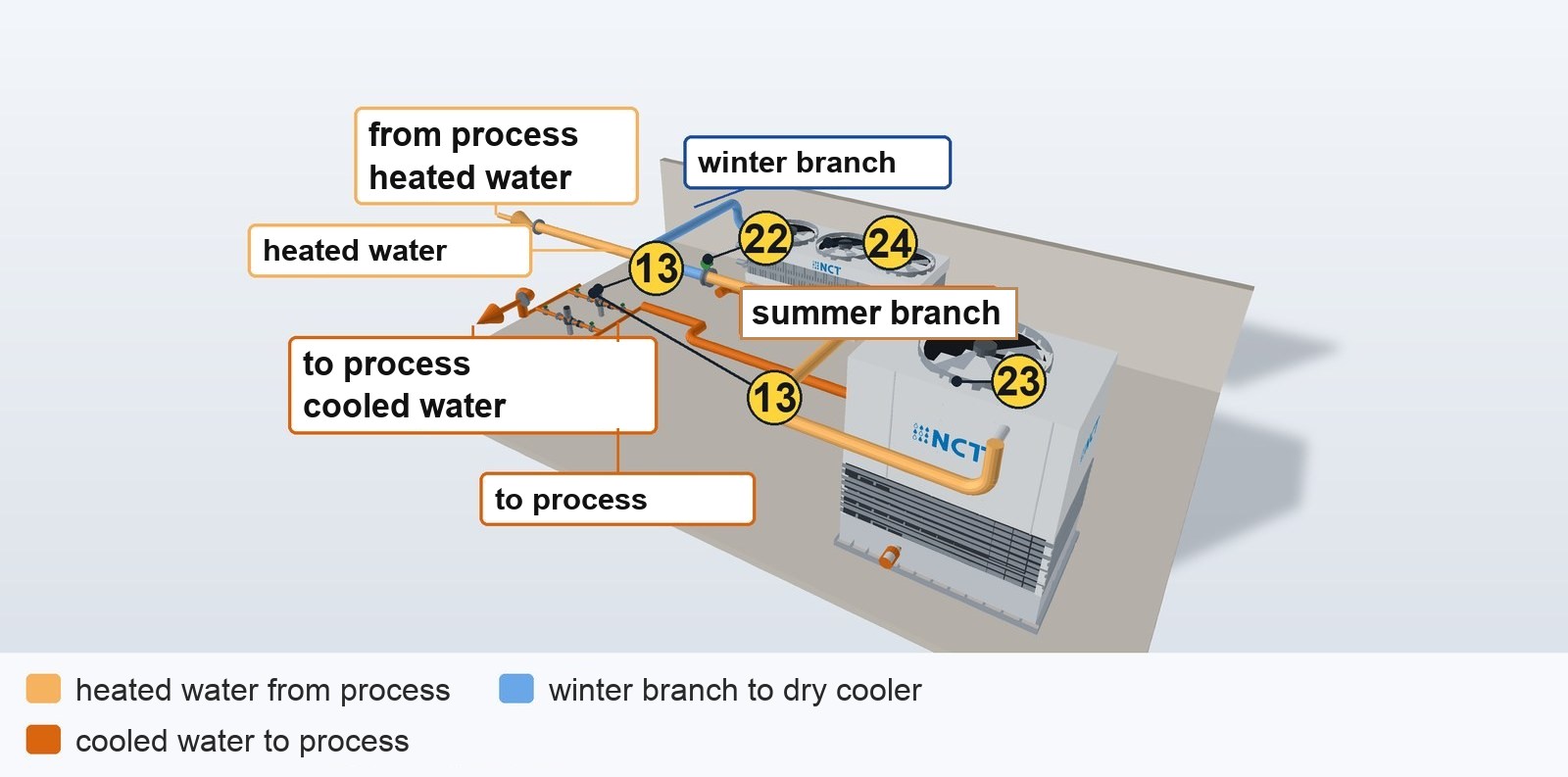
In the cold months the dry cooler removes the heat and no water is consumed; the evaporative stage switches on only in hot weather.
Key to the numbers on the scheme
| No. | Element | Purpose |
|---|---|---|
| 3 | Butterfly valve | isolates the machine and pumps for repair and flushing; installed in pairs, at the inlet and the outlet |
| 5 | Flexible connector (vibration isolator) | right at the nozzle: dampens vibration and does not pass the weight and misalignment of the pipe on to the nozzle |
| 13 | In-line pump | circulates water through the loop; in pairs: duty + standby |
| 14 | Check valve | prevents water from flowing back through an idle pump |
| 22 | Cooling tower three-way bypass valve | sends part of the water past the cooling tower: the water going to the machine is not overcooled (for an absorption chiller, there is a risk of crystallization) |
| 23 | NCT cooling tower: summer stage | switches on when dry cooling is no longer enough |
| 24 | NCT dry cooler: dry stage | works without water: no blowdown, no chemicals, no icing |
Frequently asked questions
Can an absorption chiller deliver −18 °C for a cold store?
No. The limit of such machines is −5 °C when running on gas or steam; below that you need a compressor. They will not deliver −6 °C glycol from a 97/70 °C gas engine loop either: the hot water driven series deliver down to 3.5 °C as standard. For the cold store, the freezing machines will remain compressor-based. The heat will be useful here too: by taking over the condensing of the freon, the absorption part will reduce electricity costs, if you have spare steam or hot water.
Fish processing: water in two 7 m³ tanks has to be cooled from 11 to 4.5 °C, and the condenser is remote. What will work?
It depends on how many hours you have to do it in. Taking 6.5 °C off 14 m³ requires about 106 kWh: in one hour that is 106 kW, in five hours about 21 kW plus heat gains. So the chiller is calculated against the cool-down schedule, and the tanks act as cold storage. Our chillers start at 69 kW. The water for the product is run through an intermediate heat exchanger; it is not let into the evaporator.
We will calculate the system for your site free of charge: submit a request or call +7 (800) 333-49-96.
Watch: food industry (in Russian)
Cooling plant with NCT cooling towers and Thermax absorption chillers for Kursk MaltLet us size a cooling system for your site
An engineer will select the equipment and send you a calculation. Free of charge, no obligation.