
Car Plant Cooling: Casting, Welding, Painting, Cooling Water
In brief. We keep casting, welding, presses, paint booths and the plant's cooling water cooled at conveyor takt time 24/7 with NCT chillers, cooling towers and dry coolers with redundancy, and on waste heat with Thermax absorption chillers, where a 5 MW station pays back from 1 year.
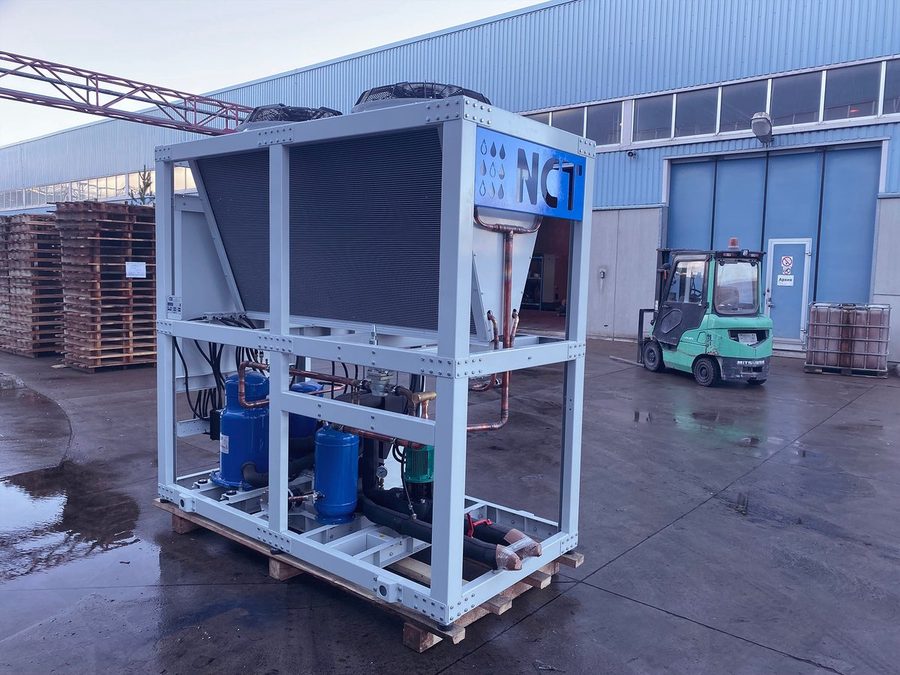
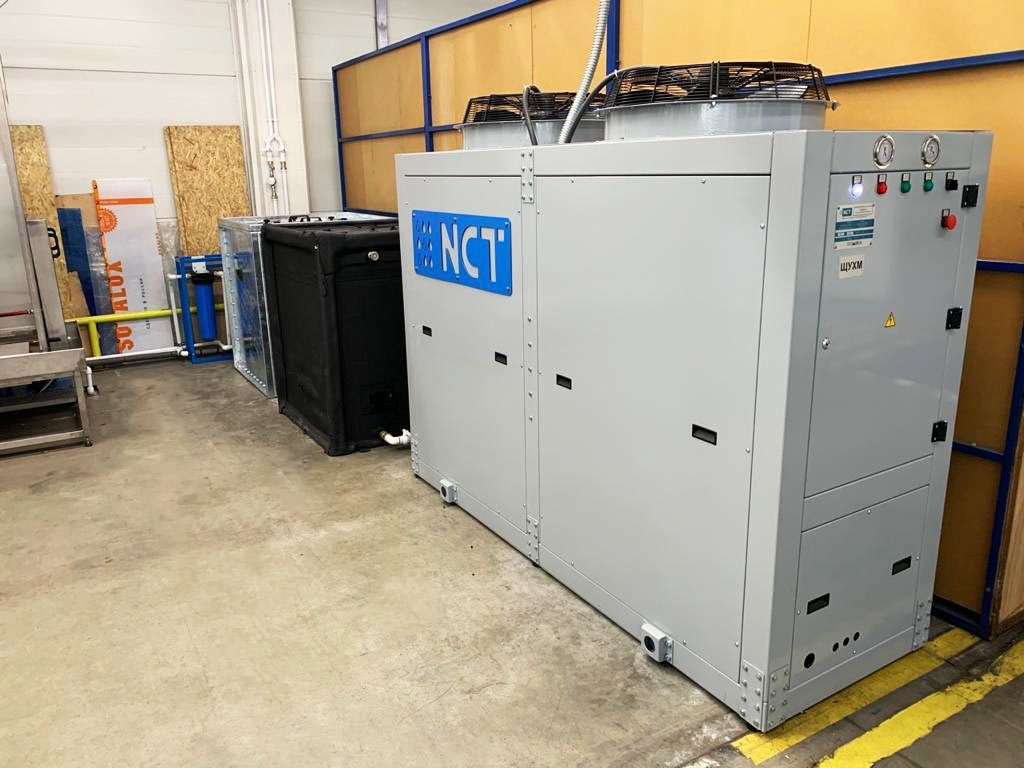
A car plant needs cooling for casting, stamping, welding, painting and assembly, and a cooling failure in any of these areas leads to rejects or stops the conveyor. We design, manufacture, install and maintain the entire loop: NCT cooling towers and dry coolers for free cooling, NCT chillers for precise temperature, and Thermax lithium bromide absorption chillers where waste heat is available.
| Indicator | Value |
|---|---|
| Payback of a 5 MW absorption chiller station | from 1 year |
| Thermax absorption chiller capacity | 350 kW – 10.5 MW |
| Russian-made components | up to 85% |
Which areas of a car plant need cooling, and what kind?
| Area | What we cool | Temperature | Solution |
|---|---|---|---|
| Die casting, welding | Molds and welding equipment | +10…+25 °C | NCT chillers and cooling towers |
| Painting | Paint booth air | +20…+23 °C | NCT chillers |
| Presses, welding, hydraulics | Shop cooling water | +15…+30 °C | NCT cooling towers and chillers |
| Assembly | Everything that keeps the conveyor takt 24/7 | — | Modular station with redundancy |
| The chiller plant as a whole | Large cooling capacities are a major cost item | — | Thermax absorption chillers on waste heat |
Assembly runs on a strict takt time: if cooling fails, the whole conveyor stops, so we build in redundancy from the start.
Which schemes do we use?
We choose the scheme by area and by whether the plant has waste heat:
- Paint booths: chillers provide stable cooling for air handling.
- Presses and welding: dry coolers and cooling towers reject heat in closed loops.
- Compressor stations and process loops: heat is rejected by cooling towers and dry coolers.
Cooling from waste heat. If the plant has steam, hot water or exhaust gases, a Thermax absorption chiller turns them into cooling. The machine itself consumes about 5 kW of electricity per 1,000 kW of cooling, while a compressor chiller consumes about 300 kW.
Hybrid. Where waste heat is scarce or unstable, the absorption chiller covers the base load and a compressor chiller handles the peaks. We build in N+1 redundancy at the design stage.
What equipment do we install?
| Product | Application | Capacity |
|---|---|---|
| NCT chillers | Precise process cooling | 69 kW – 7 MW, depending on the series |
| NCT cooling towers | Cooling the recirculating water | open from 100 kW, closed-circuit from 150 kW |
| NCT dry coolers | Dry cooling of oil and water loops without water consumption | 300 kW – 2 MW |
| Thermax absorption chillers | Cooling from waste heat | 350 kW – 10.5 MW |
| Thermax absorption heat pumps | Heat at 60–90 °C from waste heat for space heating, hot water supply and processes | from ~0.5 MW, COP up to ~1.7 |
| NCT pump skids and controls | Hydraulic piping and SCADA monitoring of the chiller plant | per project |
NCT chillers
They hold a stable temperature in process and closed loops at capacities from 69 kW (scroll NASA, NCSA and NWSA series) to about 7 MW (modular NWCV units) in the NCT 2026 catalog. Up to 85% of the components are Russian-made, a modular chiller is installed in 1–3 days, and the warranty against perforation corrosion is 10 years. We calculate to the technical specification, without paying for extra capacity. Danfoss and Wilo components are available on the open market.
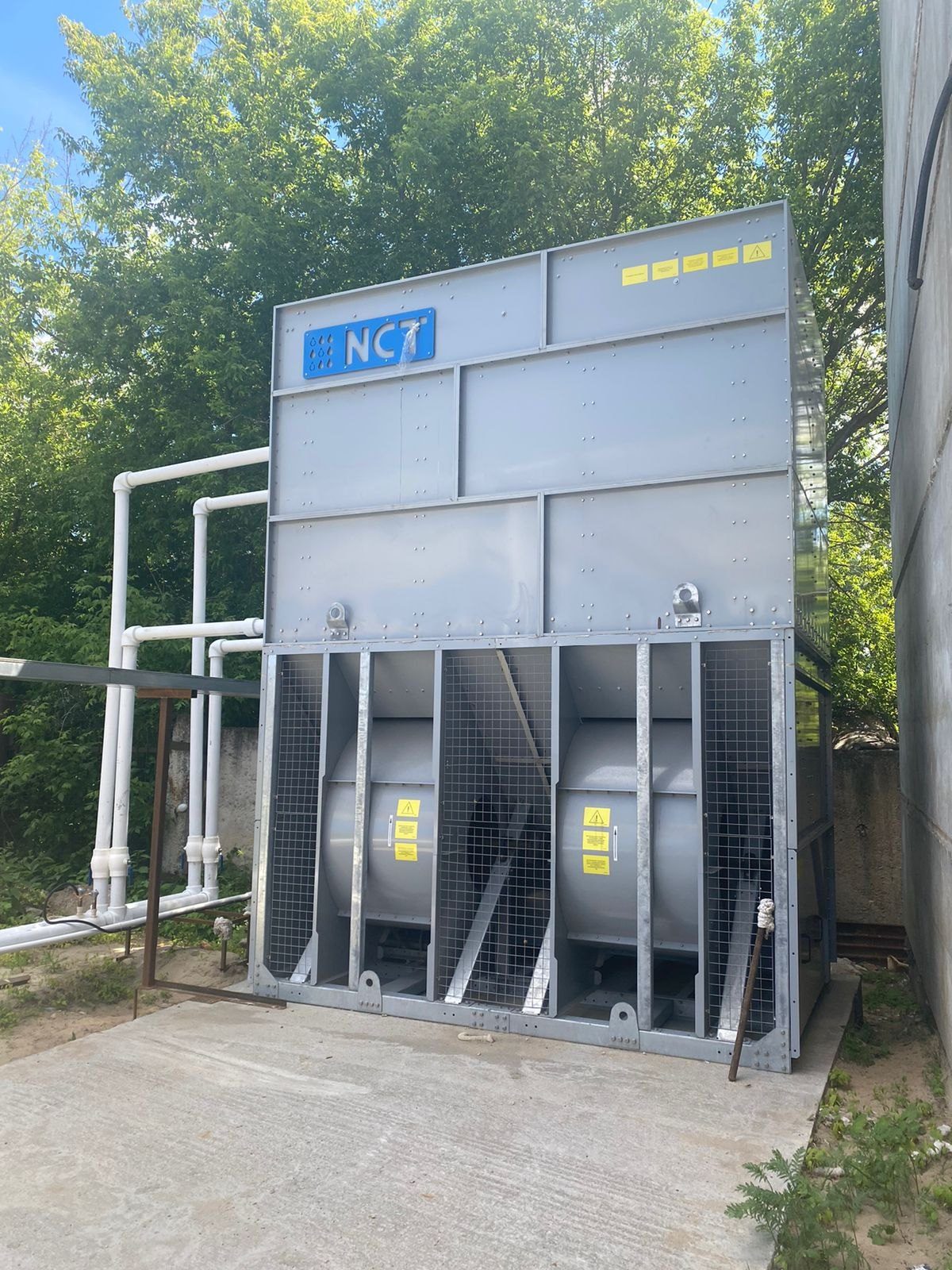
NCT cooling towers and dry coolers, including adiabatic ones
Dry coolers (300 kW – 2 MW) cool oil and water loops without water consumption. Open cooling towers (from 100 kW) reject condenser heat, while closed-circuit towers (from 150 kW) keep the heat transfer fluid clean, with no contact with the atmosphere. Adiabatic cooling with high-pressure nozzles maintains capacity in hot weather and cuts energy consumption by up to 30%; the spray water is treated so that salts do not deposit on the fins.
Thermax absorption chillers
Lithium bromide absorption chillers produce cooling from steam, hot water or exhaust gases with almost no electricity. Cold Energy (NCT) is the official and exclusive representative of Thermax in Russia and the CIS; more than 50 absorption chillers with capacities from 350 kW to 10.5 MW have been installed. On waste heat, operating costs are 40–60% lower, and the stainless steel generator and helium leak test extend the service life.
Thermax absorption heat pumps
An absorption heat pump on the same Thermax platform raises low-grade heat (warm water at 25–40 °C, cooling water, condensate) to 60–90 °C for space heating, hot water supply and processes. The coefficient of performance is up to ~1.7: for 1 kW of driving heat you get up to 1.7 kW of heat, and the boiler house burns less fuel. SS-430Ti stainless steel, Teikoku pumps, 25-year service life.
How much does an absorption chiller save on a 5 MW chiller plant?
| Indicator | Compressor chiller | Absorption chiller |
|---|---|---|
| Electrical power | 1,261 kW | 230 kW |
| Annual energy costs | RUB 52.0 million | RUB 9.5 million |
The absorption chiller saves about RUB 42.5 million a year; the additional investment compared with a compressor chiller pays back in 1–1.5 years. We do the exact calculation for the plant's tariffs and load profile in a feasibility study.
Which projects have we completed?
Our projects include automotive component plants and agricultural machinery production, and many others:
- Doowon Rus automotive components plant (in Russian), Levashovo settlement, Leningrad Region. A subsidiary of the Korean company Doowon Climate Control, a Hyundai partner, it makes car air conditioners and compressors. Following a tender, we supplied three NCT SVA-1 cooling towers for cooling the process line to replace a failed Evapco cooling tower (in service since 2010). The customer required installation and operation in winter; we handled the supply, installation supervision and commissioning.
- NPK Avtopribor (in Russian), Vladimir: automotive components production. We manufactured and supplied a VRC closed-circuit cooling tower with basin heating and a control panel with variable frequency control for cooling an industrial furnace.
- Bobruiskagromash (in Russian), Bobruisk, Belarus: production of trailed agricultural machinery. A Thermax absorption chiller and an NCT SVA-1 cooling tower for cooling the production line.
- At the Hanil Rus automotive components plant in Vsevolozhsk (Leningrad Region), an NCT chiller cools a thermal bending machine. In 2023 the Rostselmash combine harvester plant received an NCT SVA cooling tower and an NCT pump skid for its test benches, and at the Kolomna machine-building plant an NCT cooling tower cools two test benches. NCT equipment also runs at the ZTEO and Technotron plants in Naberezhnye Chelny and at the Piterplast automotive components plant in the Leningrad Region.
Why NCT?
- Own production in St. Petersburg to the ISO 9001 standard. The NCT brand has been produced since 2015, and the equipment operates at Rosatom and Gazprom facilities.
- Rated performance or replacement. The equipment delivers the calculated parameters; if it does not, we repair or replace it. Every machine goes through quality control and 3D modeling, and factory testing of the chiller is available at the customer's request.
- Designed for the Russian climate and 24/7 operation. Anti-corrosion protection, a 10-year warranty against perforation corrosion, SKF bearings, assembly without self-tapping screws.
- Spare parts and factory service. A spare parts warehouse of more than 2,000 m² with consumables and spare parts; a plant engineer travels to the site. Service is ruble-based, with no dependence on supplies from China or Turkey.
How does a project run?
- We calculate the load by area and select the scheme.
- We design the chiller plant.
- We manufacture the equipment; acceptance at the plant is possible.
- We supply the equipment and carry out installation supervision and commissioning with engineers certified in occupational safety and industrial safety.
- We train the customer's staff and maintain the system.
Design, manufacturing, installation, commissioning and first-year service come under a single contract with a single responsible party. The warranty is up to 5 years from commissioning, so the equipment can be stored until start-up. We provide a bank guarantee for performance and for refund of the advance payment.
What questions do engineers, finance and procurement ask?
Chief engineer: trays or nozzles for LiBr? In Thermax absorption chillers, lithium bromide is distributed by gravity through trays, without nozzles. In cheap alternatives the nozzles clog and leak, the solution crystallizes and the machine stops, while a tray has nothing to clog. Without power to its pumps and controls, an absorption chiller stops, so its panel is fed from a UPS or a backup power feed: it rides through a dip of up to 3 minutes, and anything longer needs a solution dilution cycle. The generator tubes are SS-430 Ti stainless steel, with a service life of 25+ years.
Technical director: a Chinese absorption chiller is 15–25% cheaper, why pay more? Cheap machines have LiBr spray nozzles, a carbon steel generator, cooling no lower than +4…+5 °C and no service in Russia. Thermax has tray distribution, SS-430 Ti stainless steel, cooling down to −5 °C and on-site service. Whether the difference pays off depends on what an hour of downtime costs your plant and how long the stops are expected to last; we calculate it for the specific site.
Procurement: imports, sanctions, spare parts? The price is in rubles. For absorption chillers there is exclusive certified Thermax service in Russia through Cold Energy: a spare parts warehouse in Russia, a site visit within 24–48 hours, a Siemens controller in Russian. Cooling towers, dry coolers and piping are NCT's own production, with up to 85% Russian components.
Environmental officer: refrigerant and sorbent? In an absorption chiller, the refrigerant is water (R718) and the sorbent is lithium bromide. Ozone depletion potential and global warming potential are zero, and the medium is non-flammable. Waste heat recovery reduces heat rejection to the atmosphere and the carbon footprint.
Operations: part load and winter? A Thermax absorption chiller modulates smoothly in the 20–100% range with a stable thermal coefficient. In winter, part of the heat can be returned to the hot water supply and heating loop, and the site's overall fuel utilization rate rises.
Procurement: can we find it cheaper? With honest performance, the price is comparable, and we do not take part in tenders where the price is lowered by understating the specifications.
General designer: is it turnkey only? No. If a third-party company runs the chiller plant design, we give it the basic piping diagrams for our equipment: valves, strainer, check valve, expansion tank, sensors. Standard schemes are collected in the Cooling System Schemes Atlas: 32 schemes with full piping on 46 pages, from an open cooling tower to an absorption heat pump, with pros, cons and a selection table by required outlet temperature. It goes out by email or via Telegram: get it on the resource page.
Cooling system schemes
Typical schemes we use in this industry. The numbers on the diagram are piping components; the key is under each diagram.
Open recirculating cooling cycle
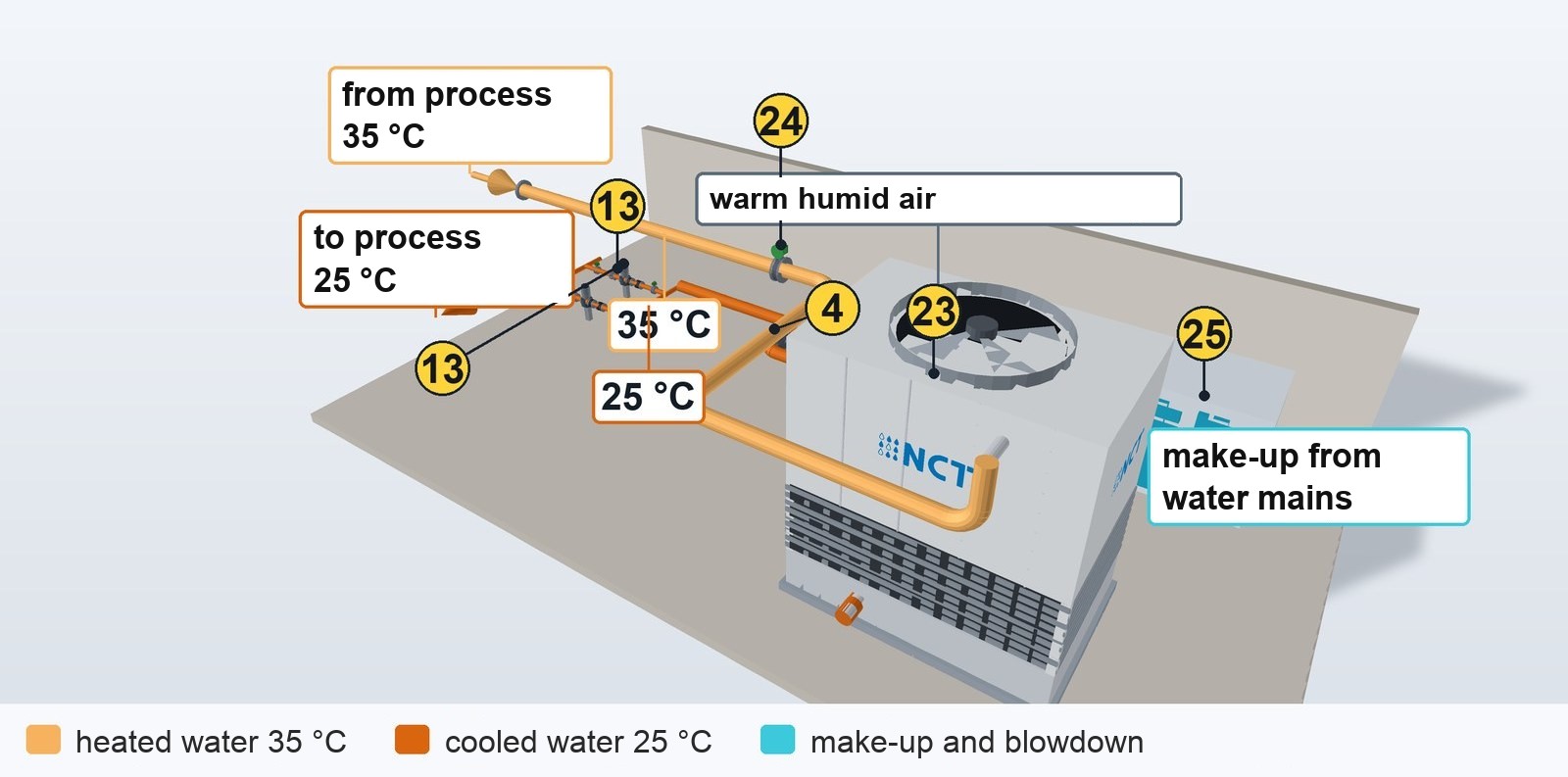
Heated water from the process is cooled in the cooling tower by evaporation and returns to the process; water is consumed only for makeup and blowdown.
Key to the numbers on the diagram
| No. | Component | Purpose |
|---|---|---|
| 3 | Butterfly valve | isolates the machine and pumps for repair and flushing; installed in pairs, inlet and outlet |
| 4 | Y-strainer | catches scale and debris before the unit's tubes; INLET only |
| 5 | Flexible connector (vibration isolator) | right at the nozzle: dampens vibration and does not transfer the pipe's weight and misalignment to the nozzle |
| 13 | In-line pump | circulates water through the loop; in pairs, duty + standby |
| 14 | Check valve | prevents backflow through an idle pump |
| 23 | NCT open cooling tower | water gives off heat to the air by evaporation, the cheapest way to reject megawatts |
| 24 | Butterfly valve on the supply line | isolates the cooling tower for repair without stopping the other cells |
| 25 | Water treatment and automatic blowdown | reverse osmosis or dosing: without it, scale eats up heat transfer and blowdown runs blind |
NCT closed-circuit cooling tower, cutaway
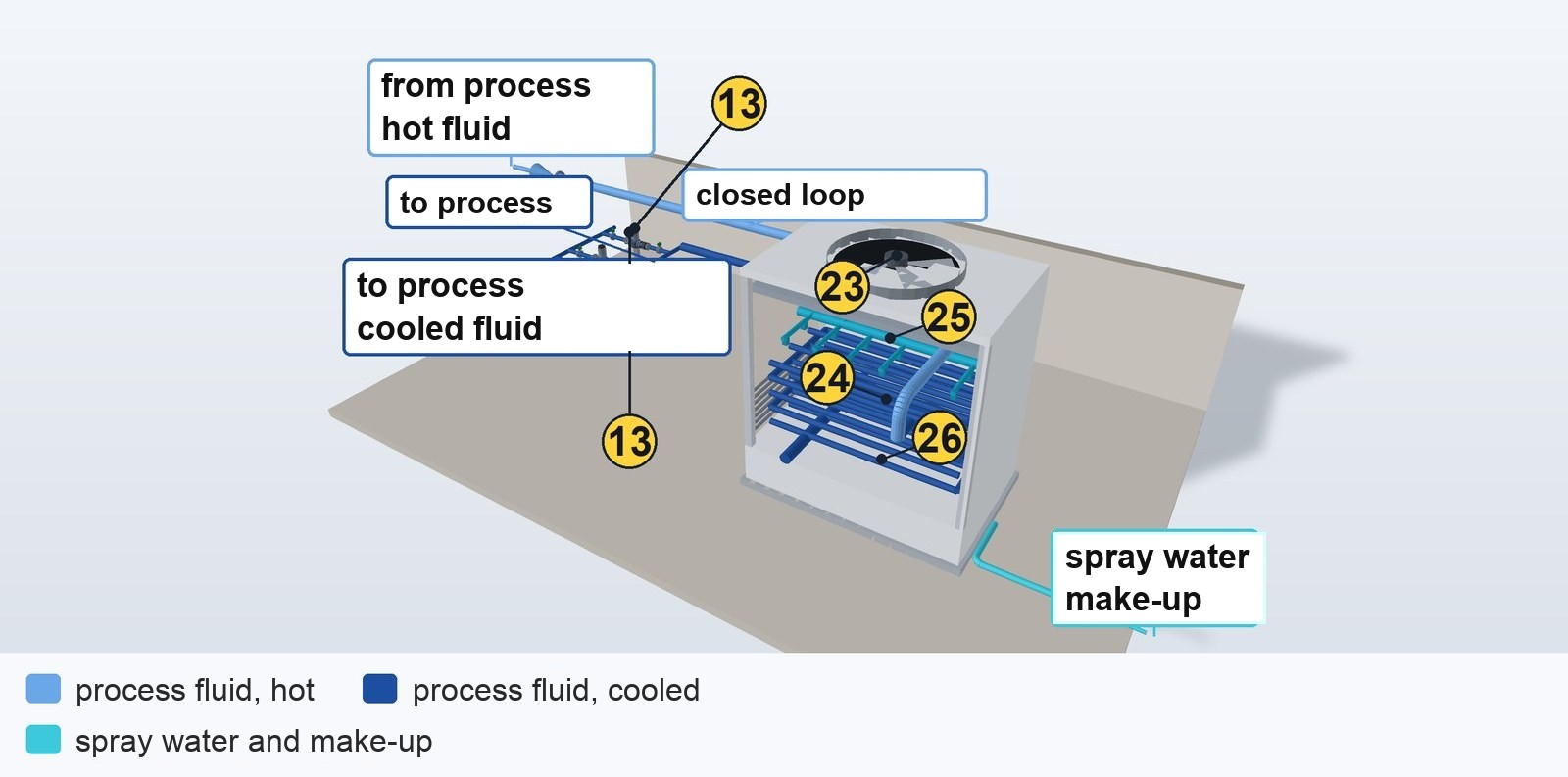
The process fluid flows inside the coil and the spray water outside it: the loop stays clean and no heat transfer fluid is lost.
Key to the numbers on the diagram
| No. | Component | Purpose |
|---|---|---|
| 3 | Butterfly valve | isolates the machine and pumps for repair and flushing; installed in pairs, inlet and outlet |
| 5 | Flexible connector (vibration isolator) | right at the nozzle: dampens vibration and does not transfer the pipe's weight and misalignment to the nozzle |
| 13 | In-line pump | circulates water through the loop; in pairs, duty + standby |
| 14 | Check valve | prevents backflow through an idle pump |
| 23 | NCT e-VRC series closed-circuit cooling tower | the casing is shown with a cutout so you can see inside |
| 24 | Coil: process fluid inside the tubes | it does not contact the air, is not lost to evaporation and does not get contaminated |
| 25 | Spray water outside the coil | water pours over the tubes and evaporates, carrying heat away: this is a separate loop, and it is the one that is consumed |
| 26 | Spray water basin | only this water needs makeup, blowdown and water treatment |
Compressor chiller with a cooling tower
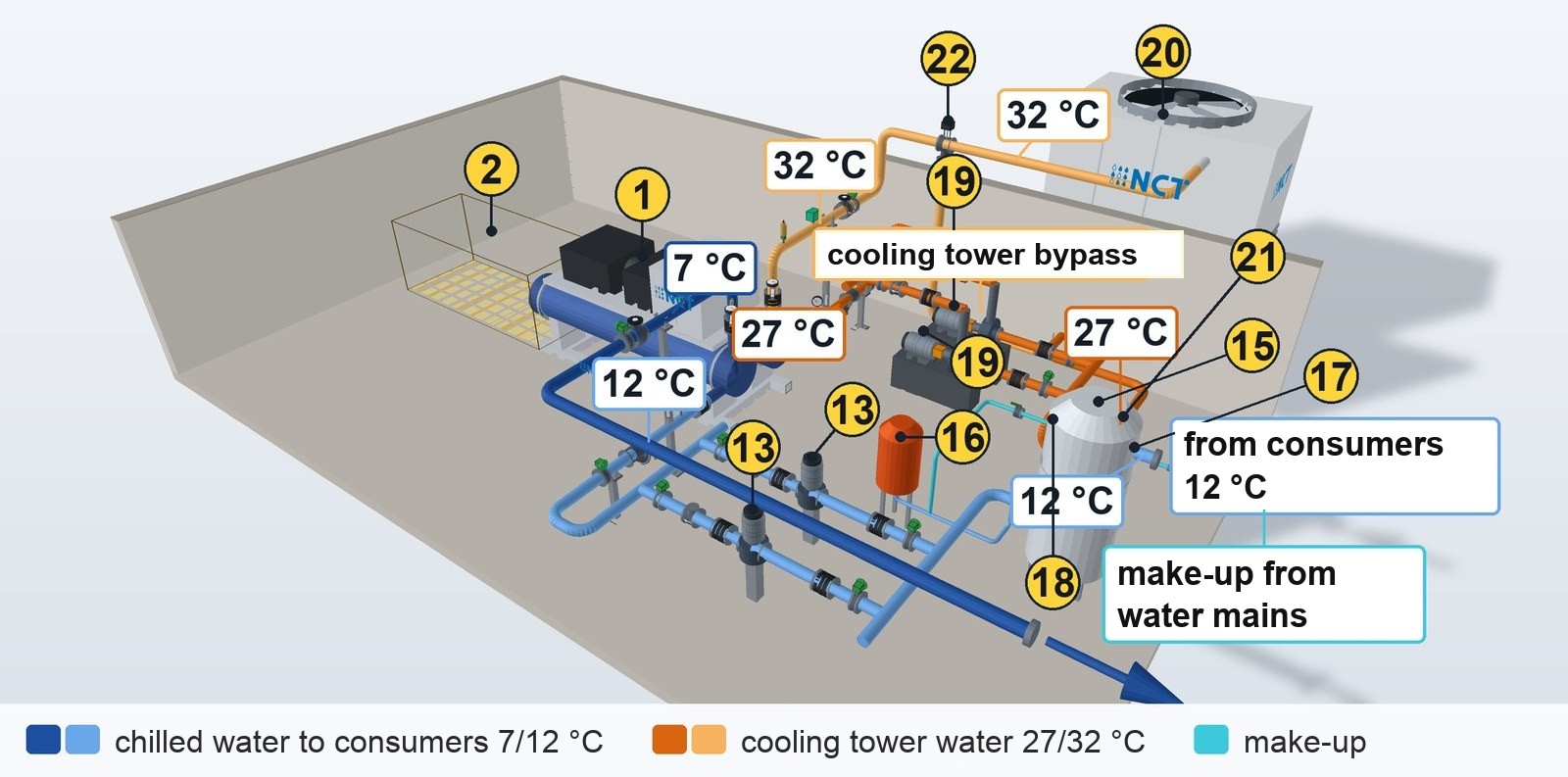
When you need a lower temperature than a cooling tower can give: the evaporator cools the consumer's water, and the condenser rejects heat to the cooling tower.
Key to the numbers on the diagram
| No. | Component | Purpose |
|---|---|---|
| 1 | NCT water-cooled chiller | the evaporator takes heat from the consumer's water, and the condenser gives it to the cooling tower water |
| 2 | Tube pull zone (keep clear) | clear space the length of the unit at its end: tube cleaning and replacement |
| 3 | Butterfly valve | isolates the machine and pumps for repair and flushing; installed in pairs, inlet and outlet |
| 4 | Y-strainer | catches scale and debris before the unit's tubes; INLET only |
| 5 | Flexible connector (vibration isolator) | right at the nozzle: dampens vibration and does not transfer the pipe's weight and misalignment to the nozzle |
| 6 | Thermometer in a thermowell | inlet and outlet temperature: the difference shows the load |
| 7 | Pressure gauge with valve | pressure before and after: the pressure drop = flow and tube fouling |
| 8 | Drain valve | drains water from the unit and the loop, at the lowest point |
| 9 | Pipe support | carries the weight of the pipe and fittings so the machine's nozzle is not loaded |
| 10 | Automatic air vent | at the very highest point: releases air (noise, corrosion, pump air binding) |
| 11 | Flow switch | no flow, no machine start; a paddle flow switch needs straight runs of ≥5 DN |
| 12 | Balancing valve | sets the design flow through the unit; the test ports are for the meter |
| 13 | In-line pump | circulates water through the loop; in pairs, duty + standby |
| 14 | Check valve | prevents backflow through an idle pump |
| 15 | Buffer tank | reserve water volume so the machine does not cycle on and off frequently |
| 16 | Diaphragm expansion tank | takes up fluid expansion during heating and holds pressure at the pump suction |
| 17 | Makeup unit: valve | loop makeup; the valve is for manual shut-off |
| 18 | Makeup unit: backflow protection (shown as a check valve in the picture for simplicity) | loop fluid must not enter the drinking water supply: one ordinary check valve is not enough; you need a double check valve, a reduced pressure zone valve (RPZ) or an air gap; with glycol or chemicals, only an RPZ or an air gap; the type is set by the water utility's technical conditions |
| 19 | End-suction pump (duty + standby) | axial inlet, top outlet; motor on a common baseplate |
| 20 | NCT open cooling tower | cools water by evaporating part of it into the air |
| 21 | Strainer at the cooling tower pump suction | an open loop collects dust and leaves: a screen ahead of the pumps |
| 22 | Cooling tower three-way bypass valve | sends part of the water past the cooling tower so the water going to the machine is not overcooled (for absorption chillers, a risk of crystallization) |
Frequently asked questions
We are designing a foundry shop for a car plant. Can you offer equipment based on a description?
From a description we can only give an initial estimate. For a proposal we need the heat from each consumer, the allowable water temperature, the loop cleanliness and the shift schedule. Molds, furnaces and compressors are often split into separate loops: there is no point running a chiller for something that can take water at outdoor temperature. Tell us where the furnace heat goes now: some of the cooling may come from it. We prepare a technical proposal free of charge based on a questionnaire.
If the bath temperature rises by 2 degrees, the line goes out of tolerance. Can a dry cooler hold 14–16 °C?
Not in summer: a dry unit cannot cool below the outdoor temperature, and in hot weather it lags several more degrees behind the outdoor air. A 14–16 °C band is held by a compressor machine with a water reserve in the loop. The dry unit is useful for savings: in frosty weather it will offload the compressors. Start with the line's schematic and its peaks: without them, nobody will seriously promise such a tolerance.
Press oil: a packaged unit or a system with a remote condenser?
If there is space outdoors next to the shop, usually a packaged unit: it is faster to install, often cheaper than a field-assembled system, and is serviced in one place. A remote or water-cooled condenser is needed when the machine will stand indoors: a packaged unit will not work there without powerful ventilation. But first check whether you need a compressor at all. If 30–40 °C is enough for the loop, the chiller can be replaced by a closed-circuit cooling tower or a dry cooler.
We will calculate the system for your site free of charge: submit a request or call +7 (800) 333-49-96.
Let us size a cooling system for your site
An engineer will select the equipment and send you a calculation. Free of charge, no obligation.