
Containerized units and container versions
In brief. A containerized unit is a ready-made, factory-assembled modular building with the cooling system equipment inside; the cooling tower can sit on top of the container. On site, power and water are connected to it, and startup takes from 1 to 4 weeks. There is no standard model range: we design each station for the site and are fully responsible for it, from design to service.
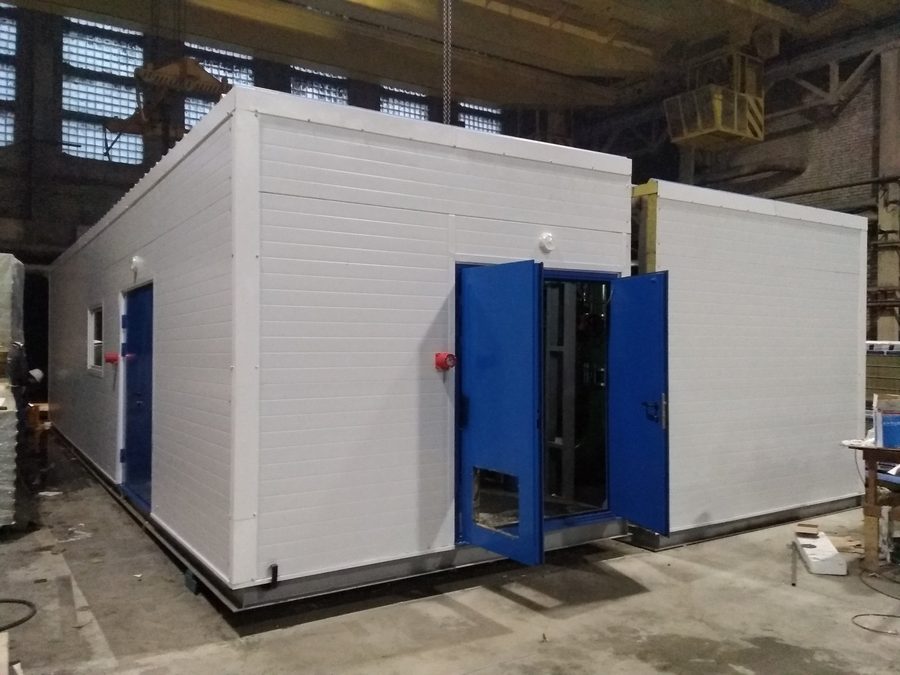
A containerized unit solves the problem when cooling is needed but putting up a building for it is slow, expensive or hard to get approved. All the equipment is assembled in a heated shop at our plant in Sertolovo and arrives on site as a ready-made building.
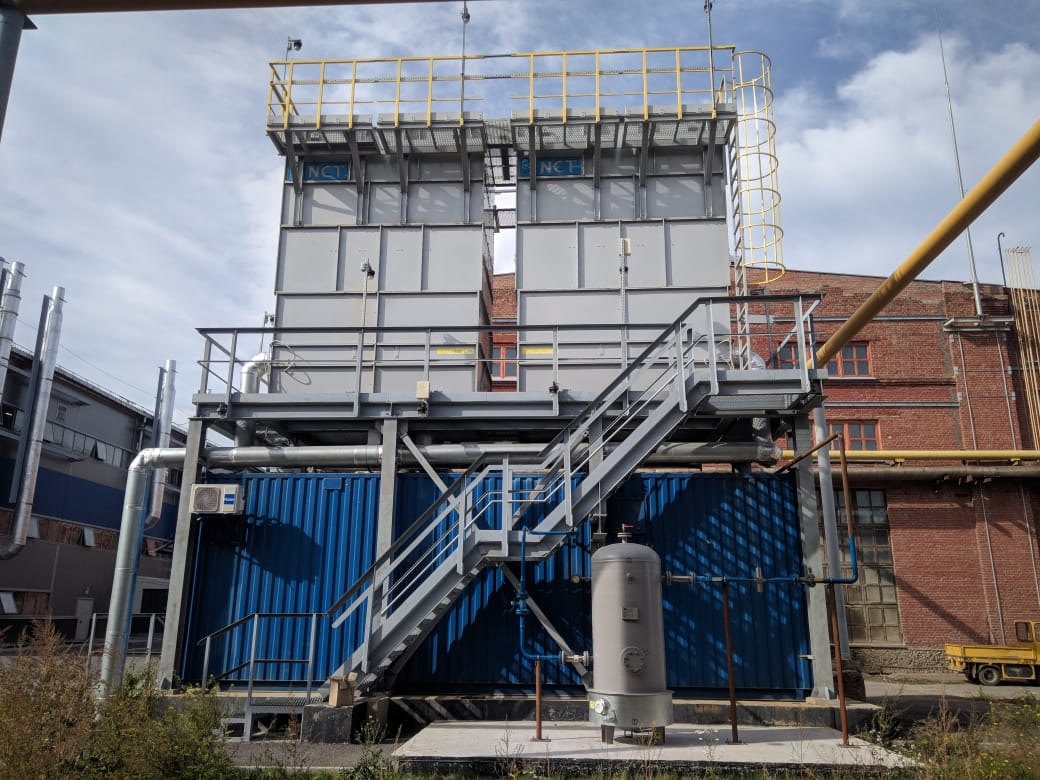
What is inside a containerized unit?
| Assembly | What we install |
|---|---|
| Cooling machine | an NCT chiller or a Thermax absorption machine |
| Cooling tower | can sit on top of the container |
| Pump skids | NCT, flow 16–1,560 m³/h, head 10–100 m of water column |
| Controls | sensors, controllers, variable frequency drives, control panels, SCADA |
| Water treatment | protection against corrosion, scale and bacteria |
| Filters and make-up | filtration and automatic make-up of the circuit |
| Condenser | an air-cooled condenser if the station runs without a cooling tower |
| Indoor climate | ventilation, heating, lighting, air conditioning with redundancy |
| Enclosure | insulated inside with sandwich panels, floor of ribbed aluminum sheet |
| Fire safety | fire alarm and fire suppression to code |
| Hoist | for removing pumps without outside lifting equipment |
The configuration changes to suit the task. One container can hold only a pump skid, or it can house a complete cooling station.
From our leaflet: the container houses a 505.7 kW NWRA screw chiller with one compressor, four capacity steps and shell-and-tube evaporator and condenser. It cools 40% ethylene glycol from 12 to 7 °C, rejects heat to water at 45/50 °C, and operates inside the container at +10…+35 °C. The container is set on a concrete pad outside the building and connected to the piping and electrical lines brought out to it, so no machine room has to be built.
What container versions do we make?
- A complete cooling station. The machine, pumps, controls and building services in one building.
- Cooling tower on a container. Pumps and controls below, the cooling tower with a service platform on top.
- Pump skid in a container. An insulated Sever-type block box designed to operate at −60 °C: a reinforced, vandal-resistant, all-welded container with a non-demountable frame, rated for a load of 14 t.
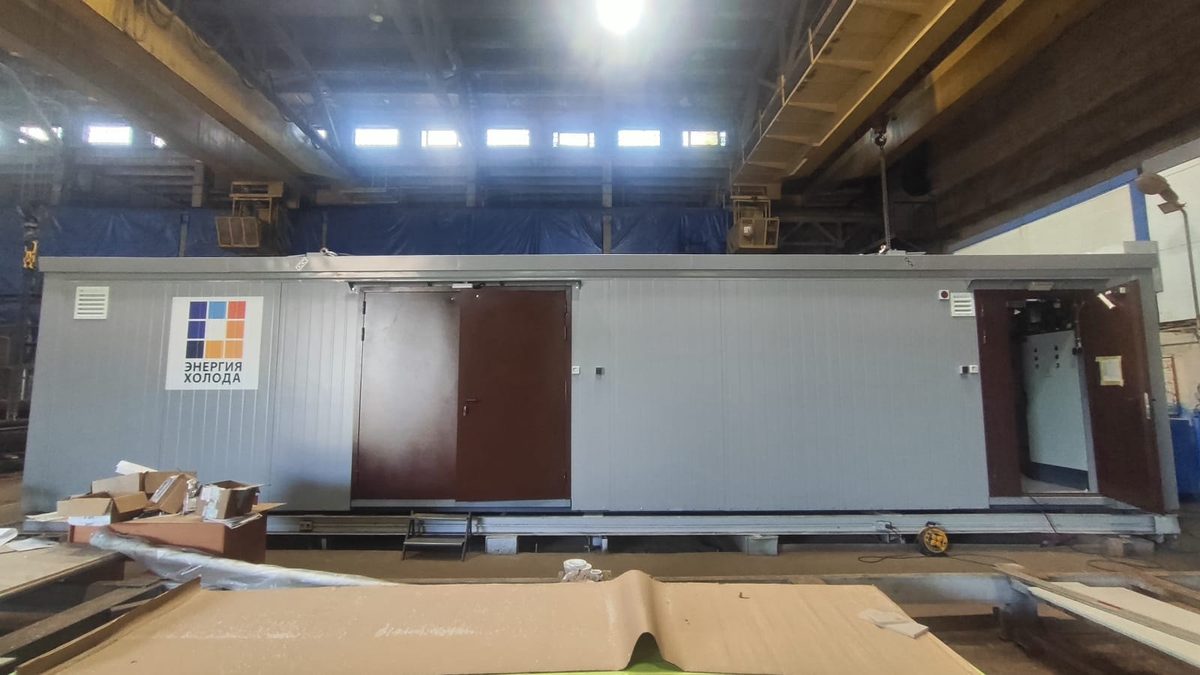
- A building made of several modules. The walls are removable, and several containers become one building if the equipment or people need more space.
How is this different from conventional construction?
| Parameter | Containerized unit | Separate building |
|---|---|---|
| Startup on site | 1–4 weeks after delivery, factory manufacturing is separate | 6–18 months including construction and installation |
| Contractors | one | 5–7 or more |
| Where it is assembled | in a heated plant shop, quality control under ISO 9001 | on site, depends on the weather and the installers |
| Relocation to another site | can be moved | cannot be dismantled |
| Expansion | add modules | rebuilding |
| Costs | known after the pre-design study | unaccounted work comes up during construction |
A containerized unit is not classed as capital construction, so it usually does not require a building permit or an expert review. For hazardous production facilities this is often the main argument: approval of a reconstruction there can take years. We confirm the procedure for a specific site at the design stage.
Who is a containerized unit for?
- Petrochemical and chemical plants, where capital construction is hard to get approved.
- Food production facilities that need cooling quickly and without a major construction project.
- Plants with no free room for a cooling station.
- Customers who do not want to coordinate several contractors.
- Small sites with no in-house cooling specialists.
- Warehouses and logistics complexes, mobile cold rooms, skating rinks and ice arenas.
- Large cooling and ground freezing systems, where the container serves as a mobile machine room.
If a room already exists and there is enough space in it, a container is usually not needed: a conventional chiller plant in that room is a better choice.
How much does it cost and how do you order?
We quote the price after a pre-design study: there is no standard model range, and the cost depends on the configuration of the station. You can start with a request or a call to +7 (800) 333-49-96. We will need the capacity, the temperature schedule, the installation location and any delivery constraints. The catalog description is the block-modular cooling center on nc-t.ru (in Russian).
We have completed dozens of such projects at industrial sites. What customers say about our work can be read in the reviews (in Russian).
Frequently asked questions
Won't it be too cramped for maintenance?
There will be no spacious machine room, but an ordinary fitter can reach the pumps and service them. We build the aisles into the layout at the design stage, and replacing a unit does not require a crane on site.
Won't the equipment inside overheat in summer?
Two split systems run inside, a main one and a standby one. If one of them fails, the container is not left without cooling.
How is the container unloaded on site?
The container has lifting lugs for unloading, and we provide the spreader beam. If needed, our specialists come out for the unloading.
How do you include a containerized unit in a design if the customer has not yet chosen a supplier?
Enter it in the specification as a single item with the capacity and the water temperature schedule: for example, "cooling station 1,200 kW, water 7–12 °C". There is no need to break the contents down by machine. We will work out the pad, pipe entries and power supply together with you before the section is issued.
Watch: pump stations (in Russian)
NCT recirculating water pump station reviewLet us size a cooling system for your site
An engineer will select the equipment and send you a calculation. Free of charge, no obligation.