
Turnkey chiller plant
In brief. A turnkey chiller plant is run by one company, from the site survey and design to installation by our own crews, handover after an integrated test run and 24/7 service; we make NCT chillers, cooling towers and dry coolers at our own plant in Sertolovo and supply Thermax absorption chillers as the official and exclusive representative in Russia and the CIS.
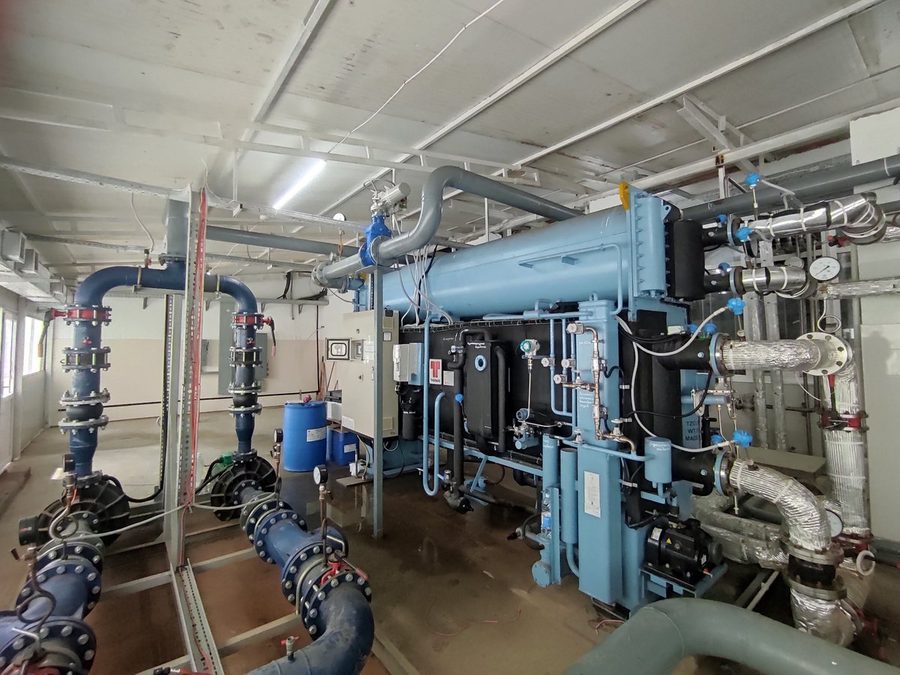
A turnkey chiller plant means one company is responsible for the chilled water at the outlet: we survey the site, design the plant, manufacture and supply the equipment, install it with our own crews, commission it and service it. The chiller plant itself is a room or containerized unit that houses the refrigeration machines, pumps, tanks, heat exchangers and controls that supply chilled water to an entire plant or building. We make NCT chillers, cooling towers and dry coolers at our own plant in Sertolovo (Leningrad Region), and we supply Thermax lithium bromide absorption chillers as the official and exclusive representative of Thermax in Russia and the CIS since 2011.
We hand over the chiller plant after an integrated test run, usually 72 hours under process load, and then service it ourselves: scheduled maintenance, online monitoring, 24/7 emergency call-outs. Since 2011 the company has completed more than 780 projects.
What does the work include, and who is responsible for what?
One team runs every stage, so the input data, the design, the equipment and the start-up do not drift apart between contractors.
| Stage | What we do | Result for the customer |
|---|---|---|
| Survey | we collect the heat balance, load profiles and electrical capacity limit, and check the space and the rigging path | a technical specification with scope boundaries and input data |
| Concept and feasibility study | we compare electric, absorption and hybrid schemes by capital cost, operating cost and connected power | a chosen scheme backed by figures, not by "extra margin just in case" |
| Design | design documentation (Stage P) and working documentation (Stage R) in our own engineering center with an SRO (self-regulatory organization) certificate | documentation for expert review and construction |
| Manufacturing and supply | NCT chillers, cooling towers, dry coolers and pump skids from our plant, Thermax absorption chillers from the official representative; factory testing at the customer's request | equipment built for the design, with no re-approval of substitutes |
| Installation | we install the machines, piping, pump skids and controls with our own crews | one party responsible on site |
| Commissioning and handover | hydraulic tests, controls setup, an integrated test run, usually 72 hours under process load | a chiller plant handed over at design parameters |
| Service | scheduled maintenance, diagnostics, online monitoring, 24/7 emergency service | a warranty of up to 5 years with our installation and a service contract |
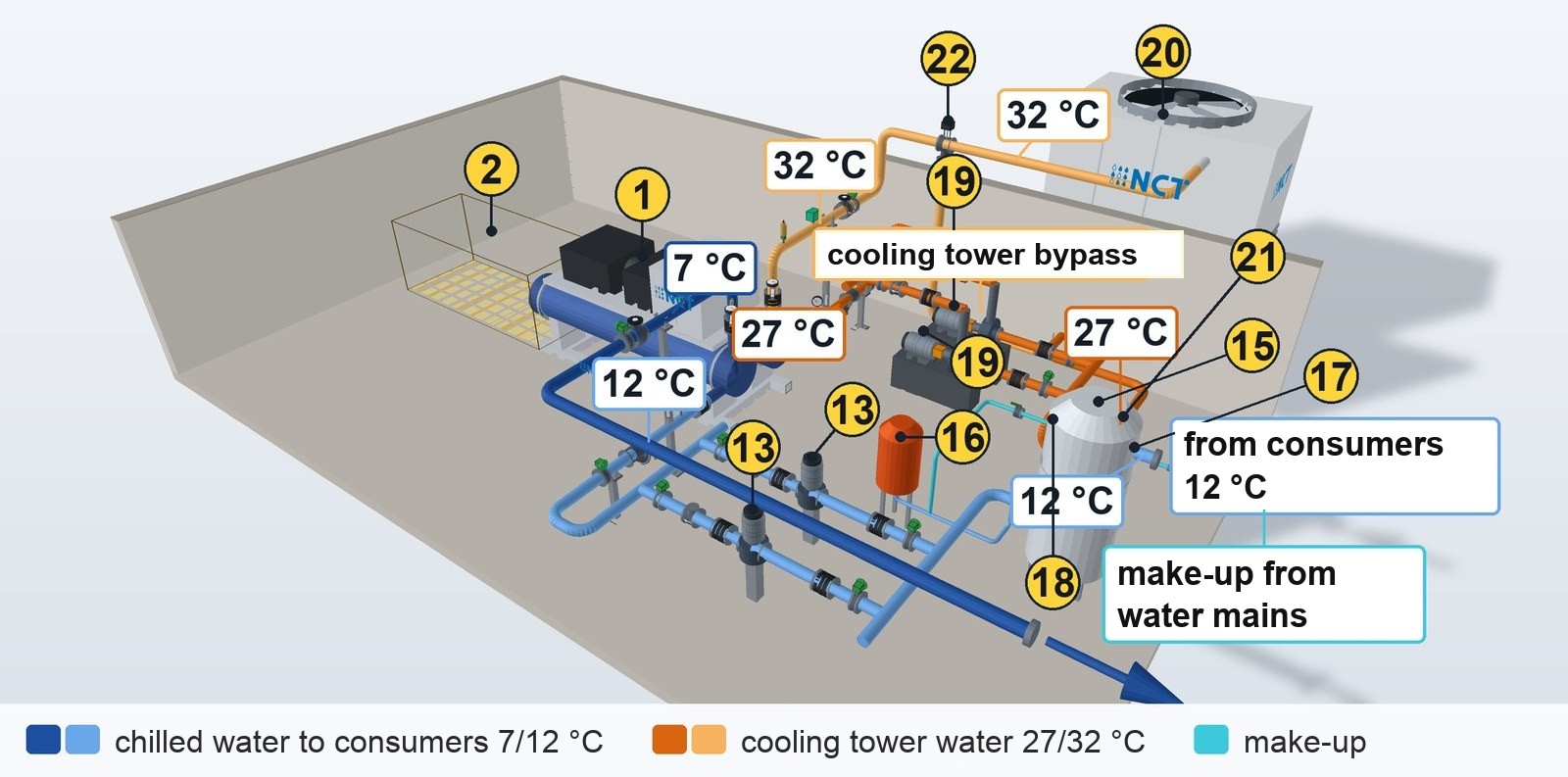
What does a chiller plant include?
- Refrigeration machines: NCT vapor-compression chillers or Thermax absorption chillers, often with N+1 redundancy.
- Heat rejection: NCT open or closed-circuit cooling towers, dry coolers.
- Pump skids: for the machine, cooling tower and consumer circuits, with 1+1 or 2+1 redundancy and automatic standby changeover.
- Tanks and hydraulics: buffer and expansion tanks, headers, filters, shut-off valves.
- Controls: control panels, pump rotation by operating hours, signals to the control room.
- Water treatment: for the open cooling tower circuit.
What chiller plants have we built?
A few examples among many others, with different cooling sources and site conditions:
| Site | Cooling source | Capacity | What makes it interesting |
|---|---|---|---|
| Mineral fertilizer plant, Cherepovets (in Russian) | two steam-driven Thermax absorption chillers | 3,766 kW | air cooling in fertilizer production using waste heat |
| Kursky Solod malt plant (in Russian) | two steam-driven absorption chillers, four NCT VR cooling towers | 1,500 + 2,500 kW | water at +3 °C, 9–12 °C in the workshop for barley germination |
| Döhler food ingredients plant, Lobnya (in Russian) | absorption chiller driven by gas engine heat, two NCT VR4 cooling towers | 1,500 kW | trigeneration (CCHP), cooling of pasteurizers |
| Potato chips plant (in Russian) | absorption chiller driven by hot water from the oven heat recovery unit, NCT VR3 cooling tower | 1,000 kW | the workshops are cooled with heat from the frying oven |
| MOSGAZ engineering center (in Russian) | two Thermax gas-fired chiller-heaters | 1,200 kW | chilled and hot water in summer, space heating in winter; 40% less gas for domestic hot water than with boilers |
| Central Customs Administration (in Russian) | two hot water driven absorption chillers | 2 × 500 kW | the machines were brought into the basement of a historic building in parts |
Chiller plants running on gas engine heat are part of trigeneration; we cover how such energy centers work in detail on our dedicated website 3genia.ru (in Russian).
Electric or absorption chiller plant?
An absorption chiller plant makes cooling from heat. We choose it when the site has steam, hot water from 80 °C, exhaust from gas engines or natural gas, when electrical capacity is short, and when the load is long: 3,000–4,000 hours a year or more. An absorption chiller uses 5–10 kW of electricity per 1 MW of cooling. A 5 MW absorption chiller station running on waste heat pays back in as little as a year.
An electric chiller plant remains the only option when there is no heat, when less than 100 kW of cooling is needed, when temperatures below −5 °C are required, when the site runs less than 2,000 hours a year, or when there is no room for a larger cooling tower: an absorption machine rejects 1.7–2.45 kW of heat to the cooling tower for every kilowatt of cooling, a compressor machine about 1.2 kW. A hybrid can also pay off: absorption and vapor-compression machines in one station, as in our solutions for food processing. More on cooling from heat on the Waste heat recovery page.
Heat rejection is tied to the machine type: an absorption chiller works only with a wet cooling tower, as do most centrifugal chillers of high capacity. Below 700 kW, a station of standard packaged chillers is usually simpler. The "5 cooling schemes" guide (11 pages: five ways to produce 1,000 kW of cooling with capital expenses, operating expenses and connected power, figures for Cherepovets) is available by email or Telegram: get it on the resource page.
How do we ensure reliability?
We provide N+1 or 2N redundancy for the machines and 1+1 or 2+1 for the pumps, with automatic standby changeover on a fault or a pressure differential. Pumps are rotated by operating hours so that the standby units do not stagnate. After start-up, the chiller plant is maintained by our service team: scheduled maintenance, diagnostics, online monitoring, 24/7 emergency service.
The equipment warranty is 12 months as standard, up to 5 years with our installation and a service contract, and 10 years against through-corrosion.
Why one company instead of three contractors?
- No disputes at start-up. When the supplier, the designer and the installer are different companies, each one points at the others after a failed start-up. With us, the final water temperature is the responsibility of the same team that calculated the scheme and installed the machines.
- Our own plant. We have been making NCT chillers, cooling towers and dry coolers in Sertolovo since 2015, so delivery times and spare parts depend on us, not on someone else's queue. The production has passed audits by Gazprom and Rosatom.
- Thermax from the official representative. We have represented Thermax in Russia and the CIS since 2011 and have installed more than 60 absorption chillers: the machine is selected and started up by a team that knows how it is built.
- Handover under load. We hand over the chiller plant after an integrated test run under process load, usually 72 hours, not after an idle start.
Frequently asked questions
We want the energy center and the chiller plant from one company, so we don't have to figure out who is to blame. Will you take on the whole job?
We take on the chiller plant in full: design, equipment, installation, start-up and service. The gas engine part we discuss site by site. There is one condition: a signed technical specification with the scope boundaries and input data. Without it, split decisions raise the risk of errors at start-up, and rework costs more. Decide right away who gets the design approved by the fire authorities and the regulator, and who is responsible for cooling if the energy center does not supply enough heat. We will need the heat balance and the load profiles.
It is easier for our budget to split the procurement: equipment separately, installation and controls separately. Is that possible?
It is, but the interface will have to be closed on paper. Before design, draw up a scope of supply matrix: for each item, who supplies it, who installs it, who connects it and who sets it up. Without it, a valve or a cable easily ends up belonging to no one, and this surfaces at start-up, when fixing it costs the most. Decide separately who is responsible for the final water temperature: with split procurement, this line is often left unwritten.
Our operations team requires that a scheme with an absorption chiller have no more equipment than one with a chiller. Is that realistic?
Counted honestly, no: the absorption scheme has a longer list. A heating circuit with a control valve appears, and the cooling tower gets larger because it rejects both the cooling load and the supplied heat. Some items drop out: there are no large compressors, no oil system and no refrigerant. So compare not the length of the list but what will actually need maintenance: the water in the circuits, the solution and the inhibitor. With a backup chiller in case the heat source stops, the list grows further.
We don't want to build a building for the chiller plant. Can we install the absorption chiller on an open site?
No, if the machine will spend the winter in freezing conditions: it needs a positive ambient temperature around it, not below +5 °C. A permanent building is not required, though. Usually the absorption chiller, the pump station and the control panel are assembled in one module, often in a light sandwich-panel building, or in a containerized unit. A gas-fired machine also needs a room that meets boiler house codes and gas monitoring. The cooling towers stay outside. We take the machine's weight into account at an early stage: the foundation and the lifting depend on it.
The grid will not give us the electrical capacity for chillers. Will free cooling solve this?
It will lower the bill, not the capacity. In our calculation for 1,000 kW of cooling in Cherepovets, free cooling (in Russian) reduces annual electricity costs by almost half, but about 340 kW still has to be connected to the grid: in summer the compressors run at full load. A different scheme reduces the connected power. A water-cooled chiller with an open cooling tower draws about 190 kW instead of 333 kW for an air-cooled packaged unit, and an absorption chiller on waste steam about 60 kW for the pumps. So tell us the power limit on your site before the scheme is chosen.
The chiller plant is the heart of a facility's cooling system and part of our industry solutions. We will survey the site and select a scheme free of charge: submit a request or call +7 (800) 333-49-96.
Where to place a chiller plant?
In a separate room, on an open site or in a factory-assembled containerized unit, where most of the work is done at the plant and only the connections remain to be made on site. We start the layout with empty space: first the tube pull zones for evaporators and condensers, the service zones for control panels and the rigging path, then the equipment, and the piping and cable routes last. In existing buildings this decides everything: at the Triumph Plaza shopping and entertainment center (in Russian) the absorption chiller was lifted by crane to the 12th floor in parts and assembled on site, and our service team has been maintaining the center since 2016.
How long does it take to build a chiller plant?
- Pre-design study with options and a technical and economic comparison: 2–4 weeks.
- Design documentation: 2–3 months; working documentation: 2–4 months.
- Manufacturing and delivery: NCT cooling towers and chillers may be in stock; if not, 10–12 weeks.
- Installation by our own crews, commissioning and handover after an integrated test run, usually 72 hours under process load.
Watch: chillers (in Russian)
Review of a monobloc chiller with a built-in air condenserLet us size a cooling system for your site
An engineer will select the equipment and send you a calculation. Free of charge, no obligation.