
Chiller plant: from calculation to service
In brief. We design and build chiller plants with NCT chillers from our own plant in Sertolovo: we calculate the load and redundancy, select a scheme with a cooling tower, dry cooler or free cooling, install pumps and controls, and handle installation and maintenance. Chiller warranty is up to 5 years. Models and prices are in the catalog at nc-t.ru.
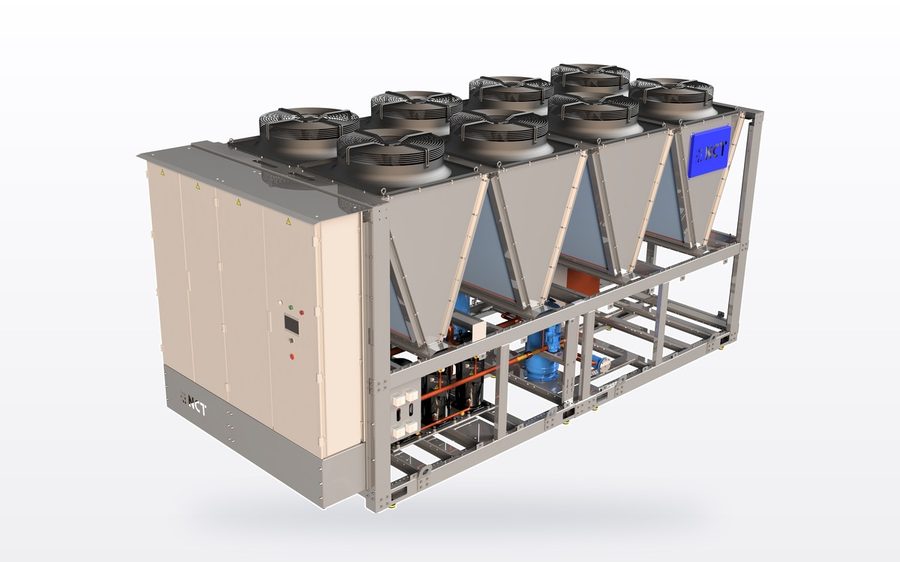
A turnkey chiller plant with NCT chillers costs from RUB 13 to 30 million per megawatt of cooling, depending on the configuration. The chiller warranty is up to 5 years. We make the machines at our own plant in Sertolovo (Leningrad Region), calculate the load ourselves, and do the installation and maintenance. A chiller plant includes chillers with redundancy, pumps, heat exchangers, a cooling tower or dry cooler for heat rejection, and controls.
A single NCT chiller costs from RUB 900,000; that is the simplest version. The price of a specific machine depends on the capacity, the condenser cooling type, the compressors and the options; we calculate it in a free selection sheet. All items with prices are in the catalog (in Russian).
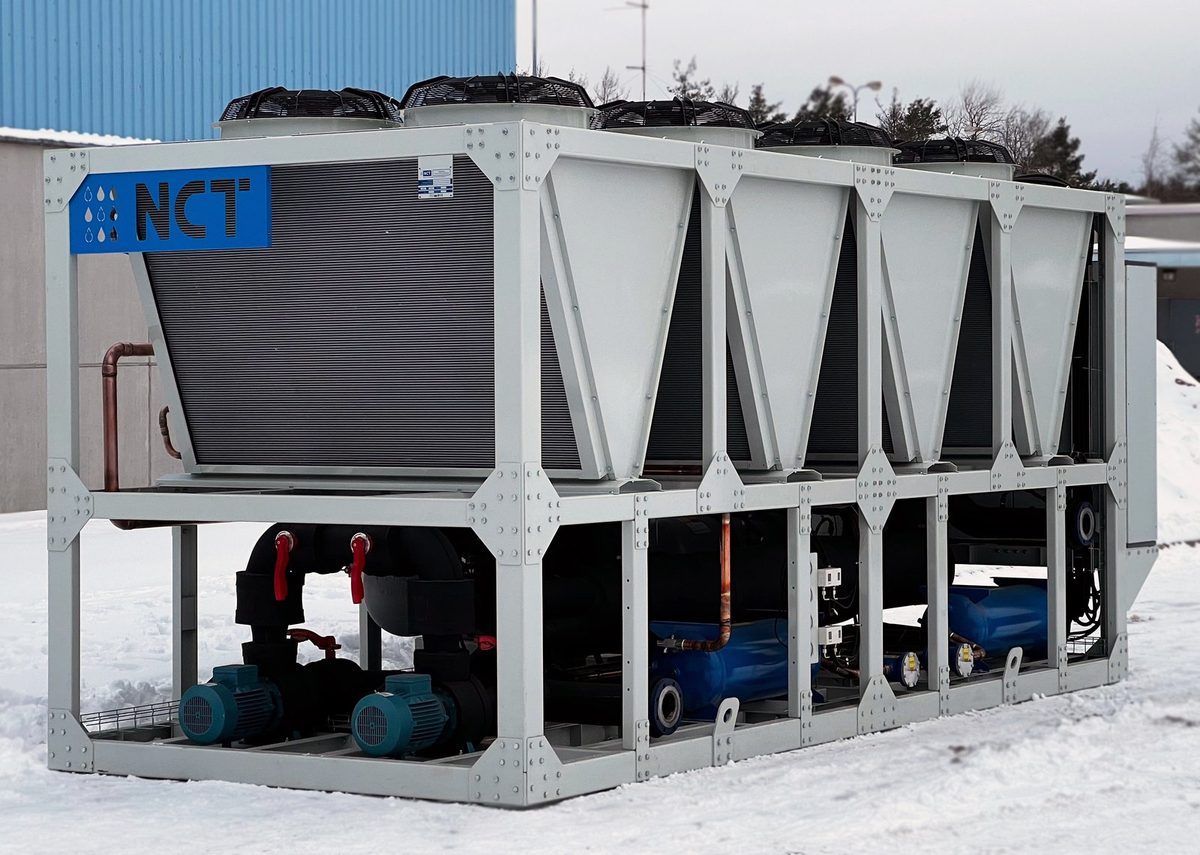
Why do we build chiller plants with NCT chillers?
Because the plant is ours: warranty of up to 5 years, 85% Russian-made components, installation in 1–3 days.
- Warranty of up to 5 years on all NCT chillers.
- Certification. ISO 9001:2015 quality management system; the equipment is certified by Gazprom (certificates). NCT chillers of the NWSA, NASA, NCSA, NWRA, NARA, NCRA and other series are covered by a EAEU declaration of conformity to technical regulations TR CU 004/2011, 010/2011 and 020/2011, valid until 13 March 2029.
- 85% Russian-made components. Prices do not jump along with imports, and spare parts are kept in stock in St. Petersburg.
- Installation in 1–3 days. The modular design is installed without major construction work.
- Designed for the Russian climate.
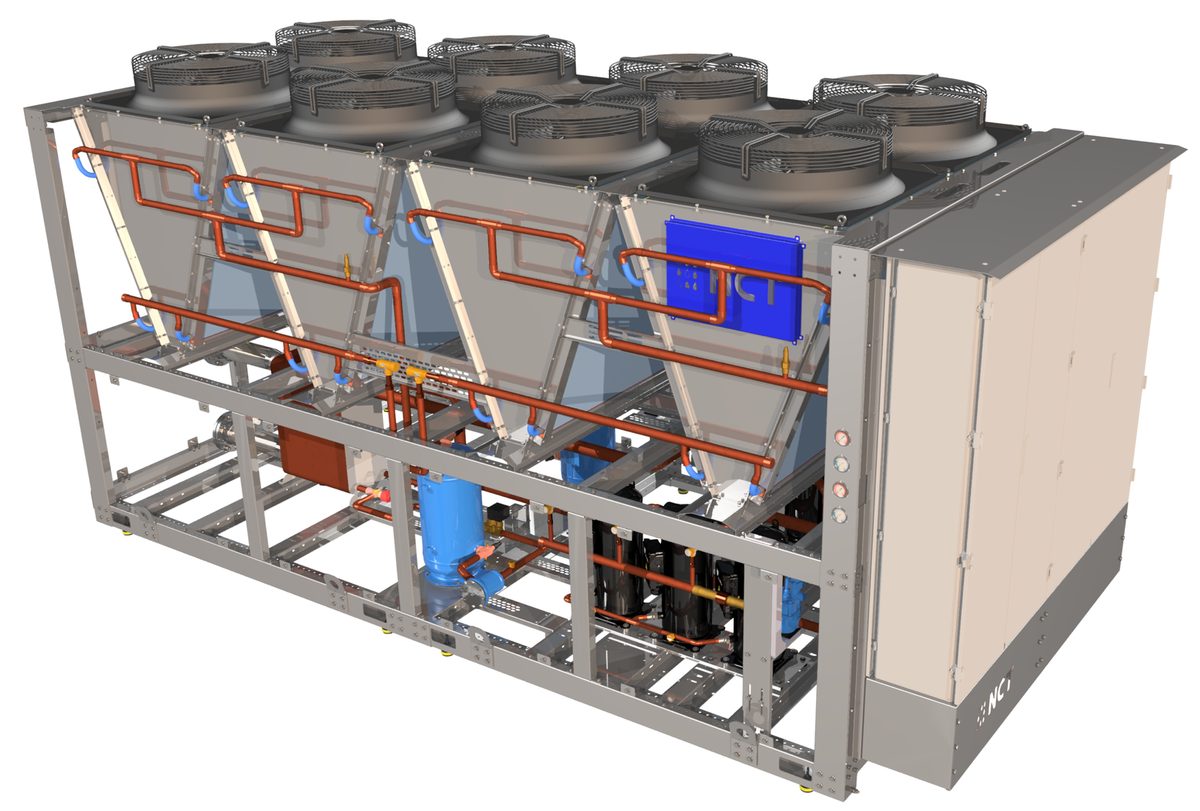
- Bolted frame and freely programmable controllers: the machine is easier to install, repair and maintain without the supplier.
What does the customer get from an NCT chiller?
A machine built to your calculation and dimensions, spare parts sold not only by us, and a controller that can be serviced without the supplier.
| Feature | What it gives | Customer benefit |
|---|---|---|
| Individual calculation | Our in-house engineers calculate the chiller to your technical specification | The capacity you need, without paying for extra kW |
| Custom dimensions | The chiller fits into a cramped space or the footprint of the old machine | Less floor space; an imported chiller can be replaced with a Russian one in the same place |
| Widely available components | Danfoss, Wilo, AL-KO, Siemens | Spare parts can be bought anywhere, not only from us |
| Freely programmable Danfoss controllers | Commissioning and maintenance can be done without the supplier | Lower staff costs; the controller is easier to replace than a closed proprietary one |
| Industrial design | Long service life, the machine can be repaired | Lower costs for repairs and for buying a new machine |
| Quality components | Reliability and the stated performance depend on them | The machine holds the set temperature |
3 more features
| Feature | What it gives | Customer benefit |
|---|---|---|
| Bolted rather than welded frame | The frame can be taken apart and reassembled for installation and repair | Fast delivery and simple installation |
| Wide choice of options | The chiller is equipped to your requirements | A model for the task without overpaying |
| Galvanized steel casing with powder coating | Lasts longer than plain painted steel | The chiller lasts longer |
What chiller plant schemes do we build?
Three schemes, depending on where the condensing heat goes: into cooling water with a cooling tower, into the outdoor air, or into a dry cooler with free cooling in winter.
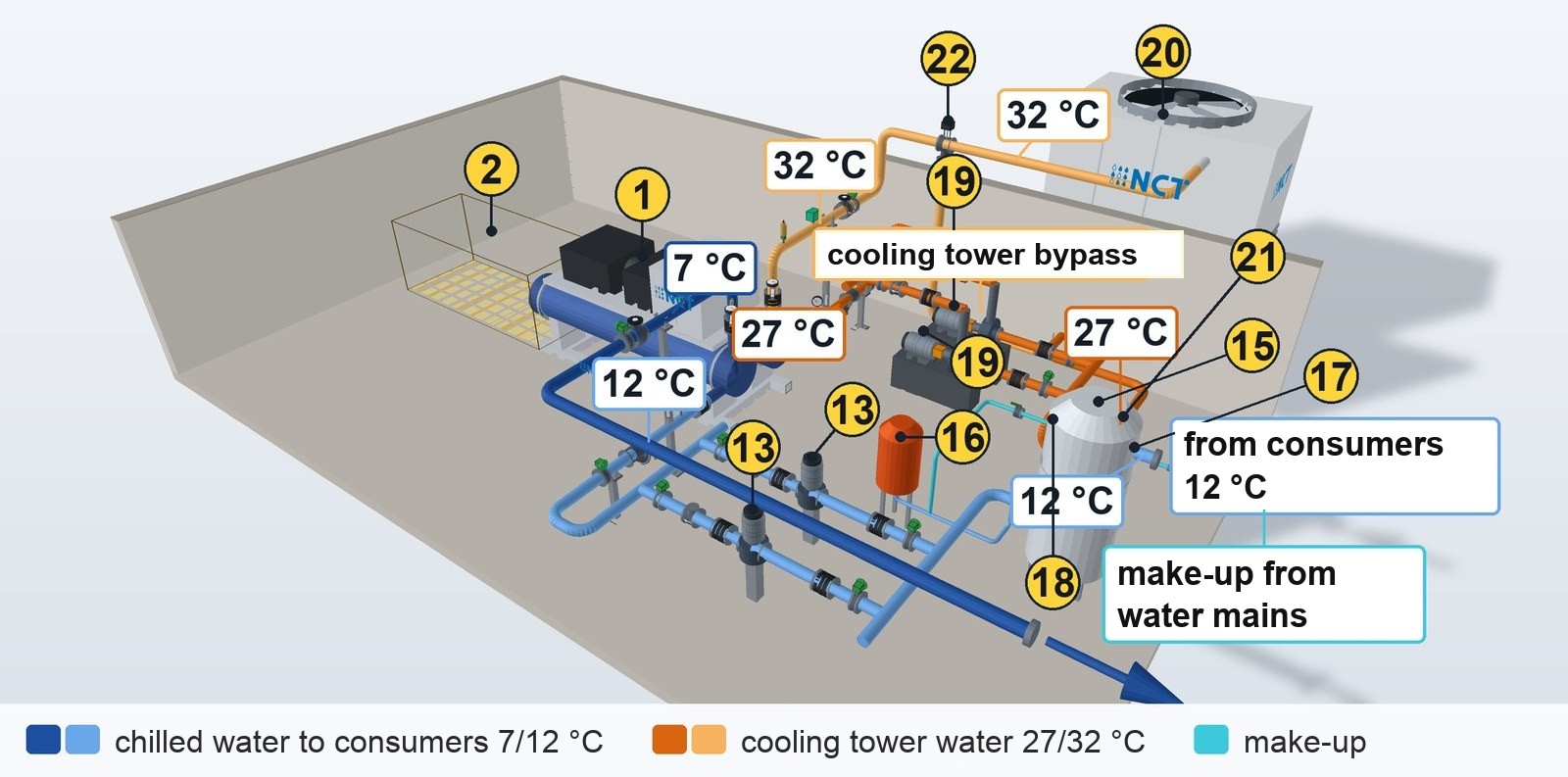
- Water-cooled chiller and cooling tower. The condensing heat goes into the cooling water, which is cooled by an NCT cooling tower as part of a recirculating cooling water system. For this scheme there are series with a water-cooled condenser: the scroll NWSA and the screw NWRA.
- Air-cooled or remote-condenser chiller. NASA and NARA packaged units or NCSA machines with a remote condenser, when there is no cooling water on site. On the NCSA, the refrigeration unit stays indoors and only the condenser goes outside; when this pays off is covered in the article Chiller with a remote condenser.
- Chiller and dry cooler with free cooling. In winter, the process water is cooled by outdoor air through a dry cooler while the compressor is off. For this scheme there is a NASA version with built-in free cooling. How much this saves is covered in the article Free cooling in manufacturing (in Russian).
Series ranges from the NCT 2026 catalog: the scroll NASA, NCSA and NWSA have 11 models each from 69 to 621 kW, and the screw NWRA has 10 models from 436 to 1,412 kW. For large loads on cooling tower water there are modular NWCV units from 229 to 7,033 kW: the centrifugal compressor runs on gas bearings without oil, and the catalog COP is 6.0–6.8. NCT machines deliver water or glycol down to −18 °C. Below +6 °C the chiller runs only on glycol, and modes from −15 to −18 °C are selected separately for the model and load. On request we add a heat pump function (cooling in summer, heating in winter), an explosion-proof version with scroll, reciprocating or screw compressors, extra sound insulation and factory refrigerant charging.
In every scheme we calculate the machine and pump redundancy, the buffer volume and the controls. How a chiller plant works as a whole is described on the Turnkey chiller plant page.
Chiller models, capacities and special versions (explosion-proof, aggressive media, ambient from −60 to +60 °C) are in the chiller catalog at nc-t.ru (in Russian). Repair and maintenance of the machines after start-up are on the Chiller repair (in Russian) page.
What data is needed to calculate a chiller?
Four parameters. With them, we calculate the machine and a cost estimate with delivery and installation free of charge:
1. Cooling capacity. 2. Temperature of the medium to be cooled. 3. Coolant type. 4. Installation location: indoors or outdoors.
We calculate in our own NCT Select program. What to consider when choosing is covered in the article How to choose an industrial chiller: 7 parameters (in Russian), and when a cooling tower is enough instead of a chiller, in the article Chiller or cooling tower (in Russian).
If you are preparing a tender, we will send the guide on chiller selection mistakes (16 questions for suppliers, 13 mistakes with red flags in proposals and a 10-year cost of ownership model) by email or Telegram: request it on the resource page.
How do NCT chillers differ from European and Chinese ones?
On price, NCT is in the middle; on service life, it is on par with European machines (15–20 years); and service and delivery are faster than with either:
| Parameter | NCT | European chillers | Chinese chillers |
|---|---|---|---|
| Price | medium | high | low |
| Service life | 15–20 years | 15–20 years | 7–12 years |
| Energy efficiency | high, for real operating conditions | very high | medium |
| Operation in a harsh climate (frost, dust, unstable load) | adapted | require adaptation | limited reliability |
| Components | European compressors, local assembly | premium | depends on the manufacturer |
| Service | local, fast site visits | slow and expensive | limited |
| Lead time | short | long | medium |
| Custom solutions | for the project | limited by standards | limited |
| Cost of ownership | low | high | grows because of repairs |
Where are NCT chillers made?
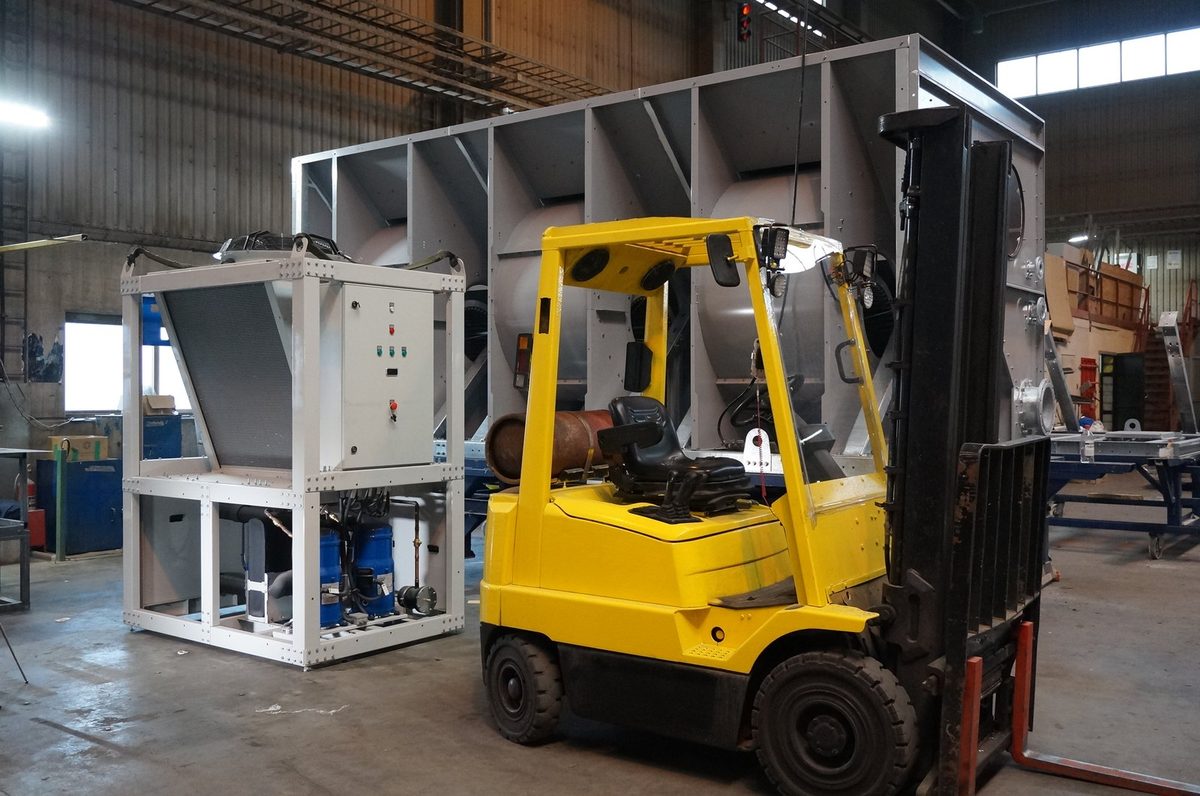
At our own plant in Sertolovo, full cycle: engineering for the customer, procurement of materials, CNC machines, automated painting lines, assembly. Factory testing is carried out at the customer's request. Semi-hermetic screw compressors are Bitzer (Germany) or Fusheng (Taiwan). Bitzer confirmed in a letter that its official distributors in Russia supply screw compressors made only at its plant in Rottenburg, Germany. Other components come from Danfoss, Güntner, Wilo, Schneider Electric, ABB and Sevkabel. More on the Equipment manufacturing page.
Where are NCT chillers used?
- food industry;
- metalworking, machine tool cooling;
- chemical industry;
- process cooling.
Water-cooled machines run in a closed loop paired with NCT cooling towers.
Which projects use our chillers?
- Likoflex printing house (in Russian), St. Petersburg: a compact 43 kW NCSA chiller for cooling production equipment. The controller cuts energy consumption by 15% by selecting operating modes.
- ATI plant (in Russian), Barnaul: a NASA26 packaged chiller with two compressors and a winter kit.
- Roshal Plasticizer Plant (in Russian): two NWRA chillers.
- Hanil Rus auto components plant, Vsevolozhsk (Leningrad Region): a NASA9 chiller and two insulated galvanized steel tanks cool a thermal bending machine on a new plastic bending line. In its 2021 letter of thanks, the plant noted the build quality and that the delivery dates were adjusted to its production plan.
- Bromine and lithium production, Ust-Kut (Irkutsk Region): chillers cool reactors in the acid production cycle.
- Oil extraction plant, Ertil (Voronezh Region): a chiller for winterizing and cooling oil.
And many others in the Projects section.
How is a chiller delivered and installed?
From stock or in 10–12 weeks, across Russia and the CIS; we install with our own crews.
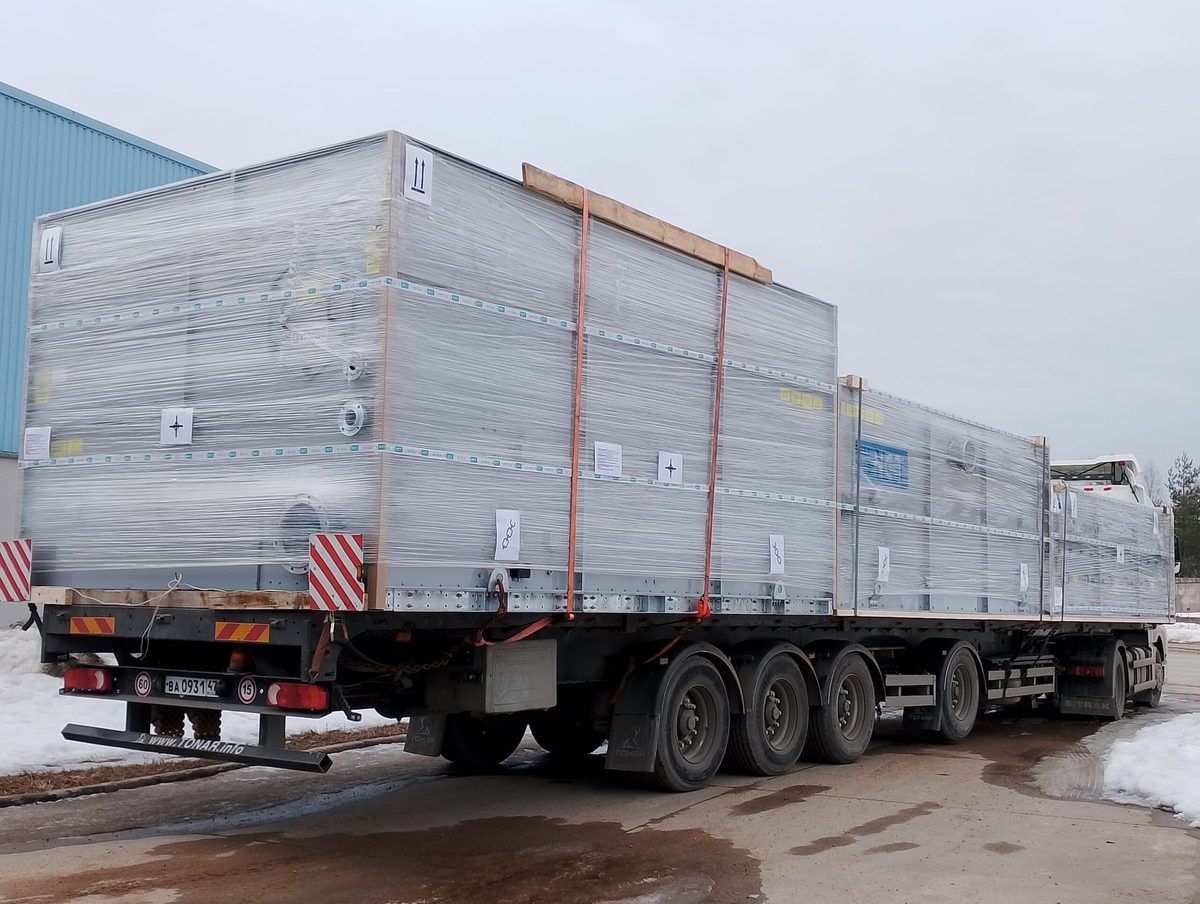
- Lead time: some machines are in stock, the rest take 10–12 weeks.
- Delivery: across Russia and the CIS; modular dimensions cut logistics costs by 30–50%.
- Installation: turnkey, by our own crews.
Selection and calculation are free: submit a request or call +7 (800) 333-49-96. Office in St. Petersburg: +7 (812) 332-53-66.
Frequently asked questions
How much does a megawatt of cooling cost? I need a range for management.
From RUB 13 to 30 million per megawatt of cooling, depending on the configuration. We can give a more precise figure once the capacity and temperatures are known, even preliminary ones: an air-cooled packaged unit and a machine running on cooling tower water cost differently. We do not price installation as a percentage of the equipment: it depends on the length of the piping runs, integration with the system and the structures. And show management a second figure: the machine itself is 5–15% of the cost of cooling over 15 years.
Maybe we don't need a chiller at all and a cooling tower will do?
It will, if the process can use water 3–5 °C warmer than the wet-bulb temperature. For most regions of Russia, that means a setpoint from 25 °C. Electricity costs in this mode are roughly 10 times lower than for a chiller doing the same job. If you need colder water, the chiller stays, but a water-cooled machine still needs a cooling tower: it removes heat from the condenser, and without it the machine will not run. If there is no water on site, we calculate a dry cooler: it uses no water, but in hot weather it delivers warmer water.
The water comes in at 30–35 °C, and when heated, even 50–60. Why can't a chiller take it directly?
Because a compressor cannot be selected for such temperatures in the evaporator: NCT machines deliver water or glycol from −18 to +20 °C. Hot water is cooled in two stages, with the circuits separated by a heat exchanger. First a cooling tower or dry cooler removes the heat, and the chiller takes care of the last few degrees. On a drop from 80 to 15 °C, the cooling tower removes about 75% without a compressor, and the chiller comes out 3–4 times smaller.
The furnace heats up for hours, then cools down sharply: the chiller will run for five minutes and stand idle. Can it handle that?
Not without a tank. Frequent starts eat up compressor life; many machines allow no more than two starts per hour. Taking a bigger machine will not help: it will go into even shorter cycles. The scheme that works is different: the chiller steadily builds up chilled water in a tank, and the peak is taken from the tank. The volume is calculated from the smallest capacity step of the machine and the circuit volume. The tank is placed so that the flow passes through it, otherwise it barely works.
The water in our loop is not perfectly clean. Won't a plate evaporator clog?
It can, so we discuss water quality before selection. If there is no certainty that the water will stay clean, we fit a shell-and-tube evaporator: it can be cleaned, although it usually costs more than a plate one. A plate evaporator is for clean water. If you need water below +5 °C at the outlet, we calculate glycol right away: on plain water in that mode the risk of freezing the heat exchanger is high.
We want to put a packaged chiller inside the workshop so we don't have to install it outdoors. Is that possible?
No, unless the workshop has powerful ventilation. An air-cooled packaged unit rejects heat straight into the room: about 1.25 kW for every kilowatt of cooling. For 500 kW of cooling, that is more than 600 kW of heat into the workshop. For indoor installation, use a machine with a remote condenser outdoors or with a water-cooled condenser and a cooling tower. Above residential and office spaces, such a machine is put on spring isolators; rubber does not stop the vibration there.
Watch: chillers (in Russian)
Chiller set: project walkthroughLet us size a cooling system for your site
An engineer will select the equipment and send you a calculation. Free of charge, no obligation.