
Cooling towers as part of a turnkey cooling system
In brief. We integrate cooling towers into recirculating cooling water systems and chiller plants on a turnkey basis: we calculate the load, design the system, install NCT cooling towers from our own plant in Sertolovo together with pumps, chemical water treatment and controls, then commission and service them. Cooling tower models, specifications and prices are in the catalog at nc-t.ru.
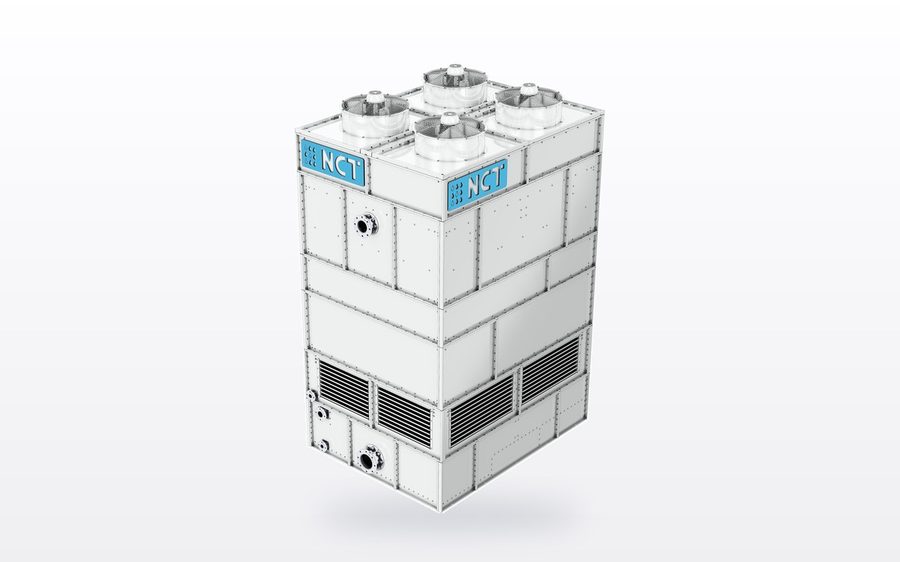
We install NCT cooling towers from our own plant in Sertolovo (Leningrad Region) and take responsibility for the whole system around them: we survey the site, calculate the load, design, install, commission and service. A cooling tower cools the process cooling water or rejects heat from chillers and absorption machines, so we select the pumps, chemical water treatment and controls together with it.
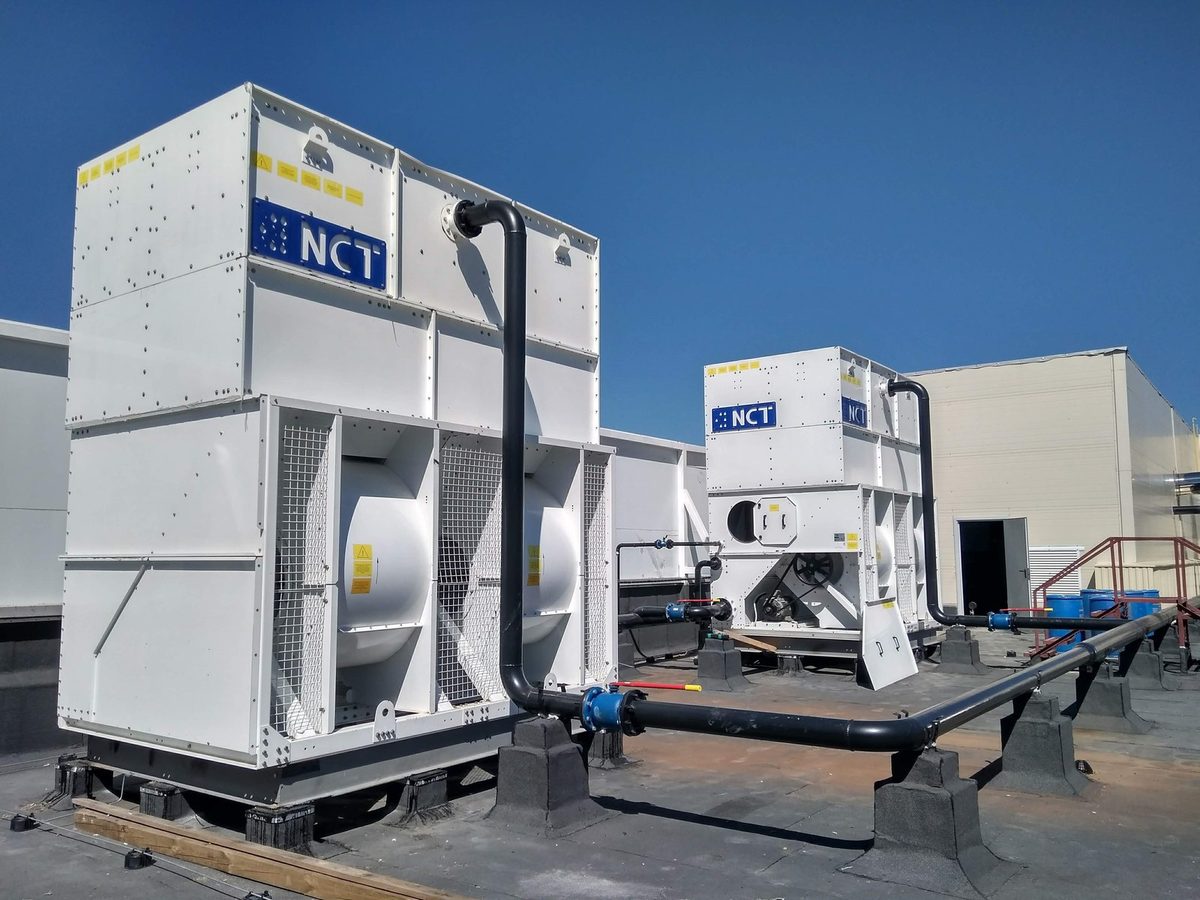
What systems do we integrate cooling towers into?
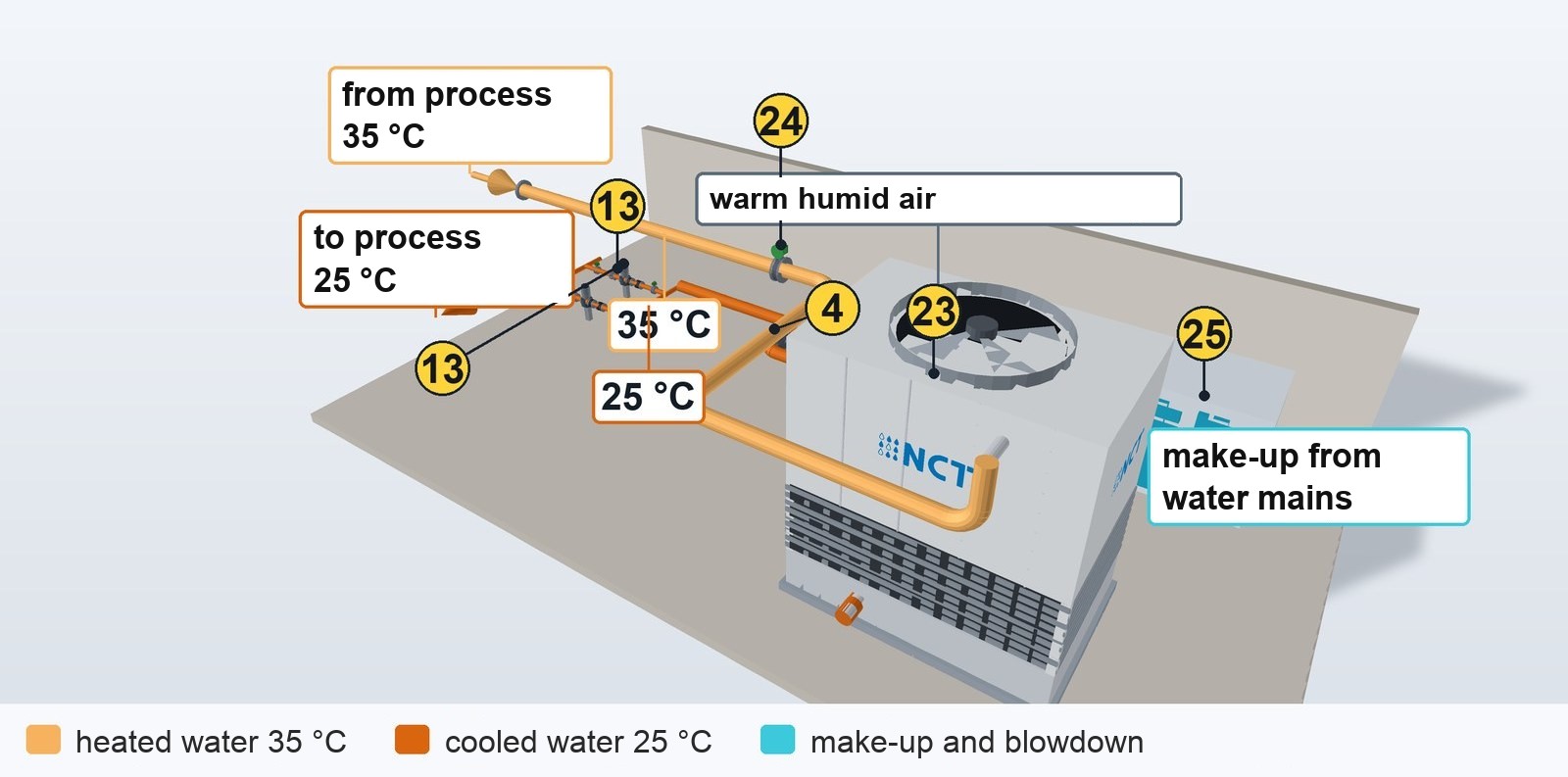
- Into a plant's recirculating cooling water system. The cooling tower cools process water for furnaces, compressors, pasteurizers and vacuum evaporators. Together with it we design pump skids, NCT W2C chemical water treatment and control panels with variable frequency control. How such a water cooling system works and how much water it uses is covered on a separate page.
- Into a chiller plant with chillers. The cooling tower rejects heat from the chillers' condensers. How the load is shared is explained in the article "Chiller and cooling tower in one system" (in Russian).
- Into a chiller plant with Thermax absorption chillers. An absorption machine rejects more heat into the cooling water than a compressor machine, so we size the cooling tower together with the machine. This is how it was done at a shopping center in Stary Oskol and at the Syry Kubani cheese plant. At a dairy plant in Kropotkin, the absorption chiller produces 450 kW of cooling, while its SVA-4 cooling tower rejects 1,056 kW: 189 m³/h of water cooled from 34 to 28 °C.
- For winter operation. Basin heating, fan control, drainage and pipe protection are built into the design; more in the article "A chiller plant in winter" (in Russian).
The capacity stated in the technical specification is fixed in the contract. The equipment warranty is up to 5 years; we keep spare parts in stock in St. Petersburg.
How does a project run?
- Survey of the site and input data: water flow, inlet and outlet temperatures, operating mode, installation location.
- Thermal calculation in the NCT Select program and choice of layout.
- Design at our engineering center.
- Manufacturing at the plant: the cooling tower may be in stock; if not, 10–12 weeks.
- Installation: a modular cooling tower is assembled on site in 1–2 days, with no construction work.
- Commissioning and service.
We prepare a cost estimate including delivery and installation free of charge.
What cooling towers do we install?
Open and closed-circuit modular NCT cooling towers with axial and centrifugal fans, as well as sectional cooling towers — more than 5,000 sizes in total. Models, specifications and prices are in the cooling tower catalog at nc-t.ru (in Russian); a comparison of the series is in the article "Comparison of NCT cooling towers" (in Russian).
How the series differ, according to the NCT 2026 catalogs:
| Series | Type | What sets it apart |
|---|---|---|
| VR | open, centrifugal fans at the bottom | 30–500 m³/h per module, cascades up to 5,000 m³/h; one tower cools by up to 40 °C, e.g. 60 → 23 °C; the fan sits in a dry compartment and does not ice up |
| VA | open, one large-diameter axial fan per section | 250–10,000 m³/h, water down to 23 °C (45 → 23 °C); the fan turns slowly, so power consumption is low |
| SVA | open, several axial fans | from SVA-0 and SVA-1 mini towers for flows up to 30 m³/h to SVA-12 |
| HR, HRC | open and closed-circuit, low height | quiet, 60 → 25 °C; used on shopping centers, offices and wherever height is limited |
| VRC, SVAC | closed-circuit | temperature difference up to 60 °C in one tower; in the e-VRC and e-SVAC versions a finned coil gives 30–40% more heat transfer surface |
| VAC | closed-circuit, large-diameter fan | 250–10,000 m³/h, 45 → 23 °C |
| FX | open crossflow | large-diameter axial fan, gravity water distribution |
| Field-erected | assembled on site | from 500 m³/h, service life up to 25 years |
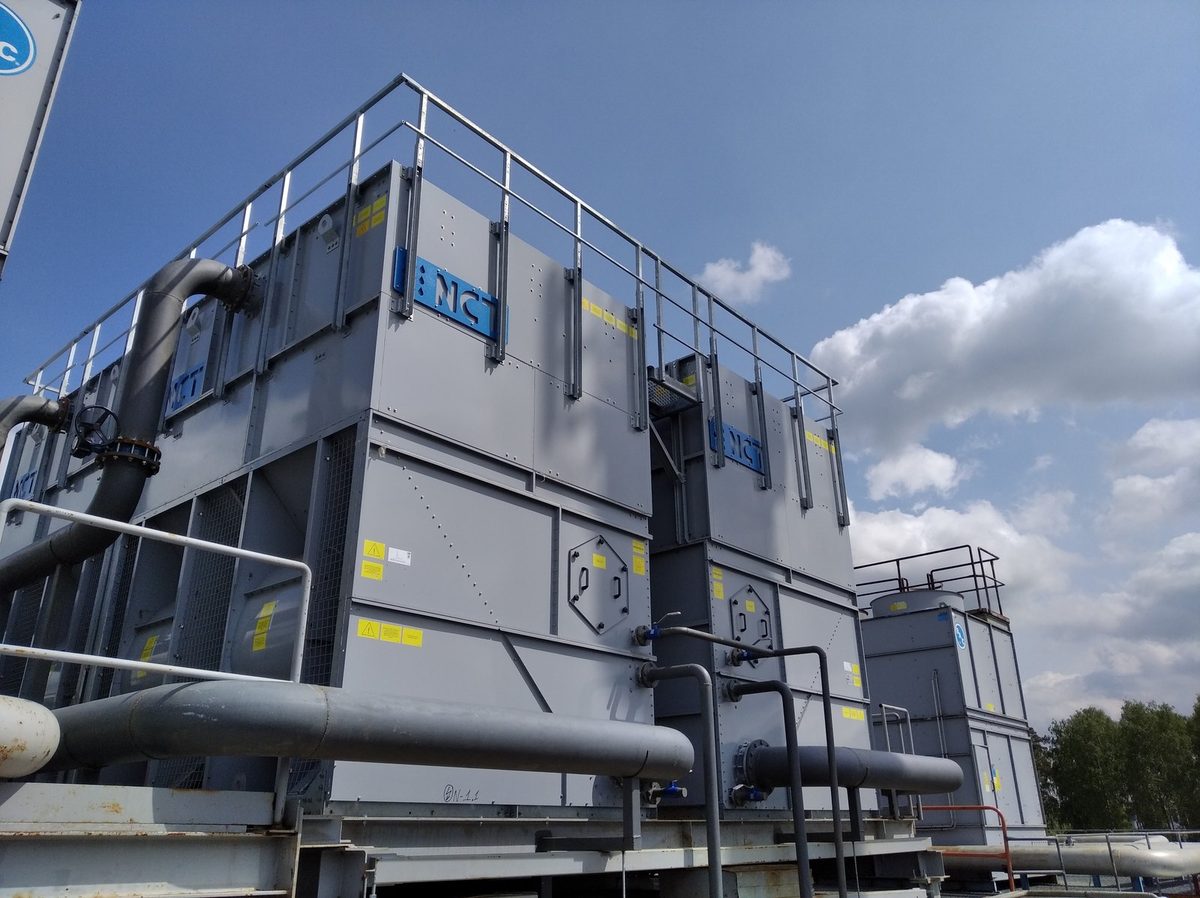
What does the customer get from NCT cooling towers?
Below, by series: the feature, what it does and what the customer gains from it.
NCT modular cooling towers: what all series have in common
| Feature | What it does | Customer benefit |
|---|---|---|
| Factory-assembled | Blocks arrive assembled, not as thousands of parts | Assembly is already in the price, no assembly contractor needed, lower risk of missing the startup date |
| Panels and sealant instead of welding | No welds where corrosion and leaks start | No need for a new cooling tower or an upgrade after a few years |
| Galvanized steel instead of black steel | Corrosion protection | No constant repairs due to leaks |
| Galvanized steel instead of fiberglass | No cracking in frost | No constant repairs or casing replacement |
| Panels with powder coating on both sides | The polymer layer protects the zinc from depletion, including with poor water | No repairs due to leaks or replacement of rusted parts |
| The same coating resists hardness salts | The cooling tower runs at higher salt content | Less blowdown water than towers made of uncoated metal |
21 more features
| Feature | What it does | Customer benefit |
|---|---|---|
| Stainless steel version | Corrosion protection with extremely poor water | No constant repairs due to leaks |
| Stainless steel bolts and nuts instead of self-tapping screws | Zinc and paint are not damaged during tightening | No corrosion around fasteners; part of the cooling tower can be taken apart for cleaning or repair |
| Wide choice of options and accessories | No need to add components on your own | The system works precisely, one company is responsible |
| Splash-film fill on plastic studs, 19 mm gap between sheets | Can be taken apart and flushed, has a margin against fouling | The fill can be cleaned and reinstalled |
| Nozzles that do not clog or freeze | Self-draining; rubber sleeves withstand twice the rated pressure | Cheaper maintenance, no blow-through needed before layup |
| Indoor installation | Ducts can be connected to the air inlet and outlet | The cooling tower can be installed in a basement or another room, for example in the Far North |
| ISO 9001:2015, certificates available | Quality control at every stage, processes documented | Minimal risk of breakdown, cooling shutdown and losses |
| Maximum share of domestic components | No dependence on imports; for example, Vladimir plant motors are in stock | Lower price and faster spare parts |
| Drift eliminator with three flow turns | High droplet capture efficiency | Minimal drift and lower make-up costs |
| Make-up into the built-in basin (option) | Automatic make-up directly into the basin | An additional tank can be avoided |
| Remote basin in a heated room (option) | The basin is built as a tank inside the building | No risk of freezing in winter and no electricity spent on immersion heaters |
| Chemical water treatment (option) | The fill and heat exchanger do not foul | Savings on replacing them |
| Basin immersion heaters (option) | Switch on automatically when the outdoor temperature drops below +5 °C | The cooling tower can be switched off from time to time without draining the water; lower risk of freezing in autumn |
| Factory service platforms (option) | Embedded mounts are already in the cooling tower, no separate supports needed | Cheaper than building a frame and platform yourself |
| Fill certified at the Vedeneev VNIIG hydraulic engineering research institute | Calculations use real rather than theoretical performance | Accurate calculation: the required cooling without overpaying |
| Built-in support frame | The cooling tower stands on a concrete base | Savings on a separate frame |
| Built-in outlet strainer (option) | Retains dirt, leaves and debris | Fine filters need cleaning less often; pumps and the consumer last longer |
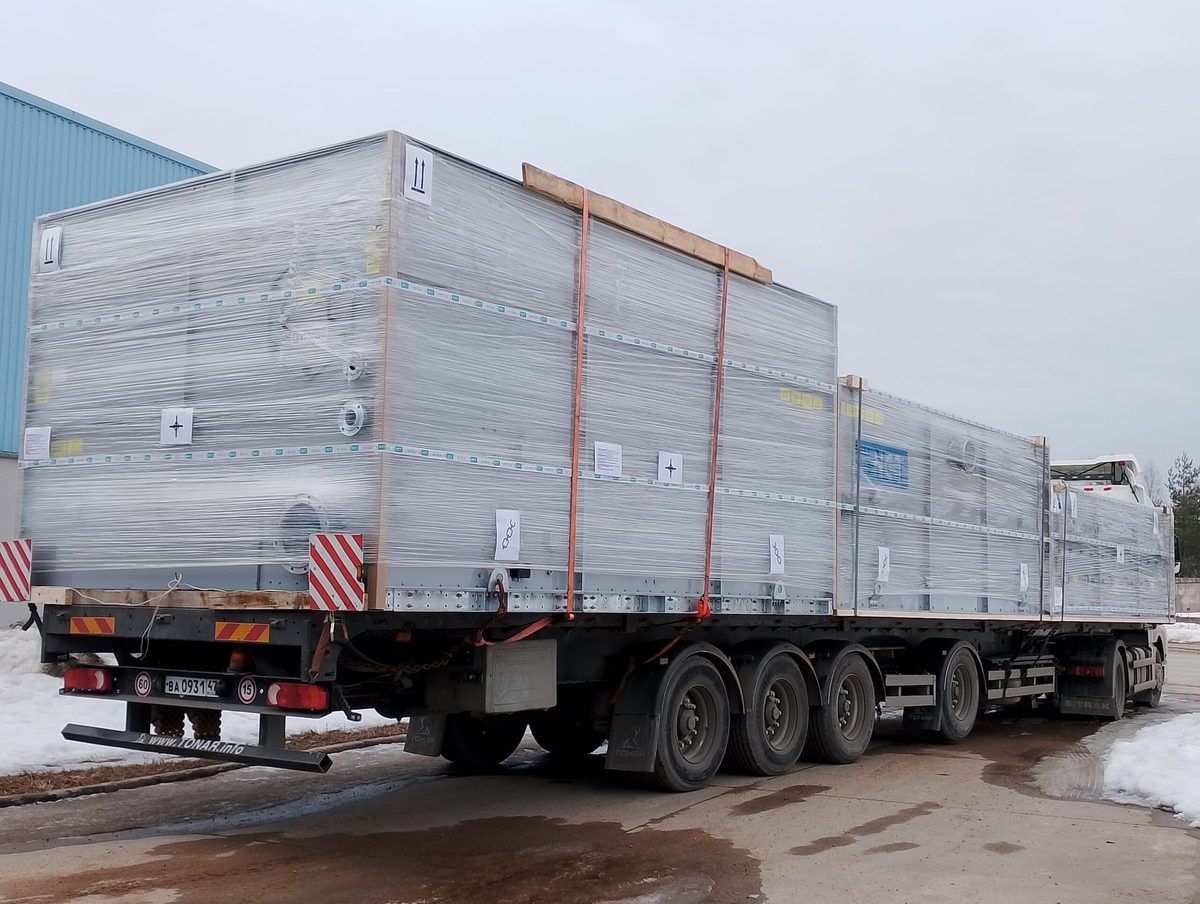
| Width of 2.4, 2.9 and 3.4 m (standard 2.4 m, except the -S and -SW series) | Transport without an escort | Cheaper and faster delivery |
| Simple maintenance | No gearboxes or large-diameter fans | Maintained by local technicians, including the customer's own staff |
| A closed-circuit cooling tower can be installed below the consumer | More placement options | Fewer modifications and lower capital costs |
| No plastic in the casing | The casing is made of non-combustible materials | No fire risk and no costs from its consequences |
VR and VRC series with centrifugal fan
| Feature | What it does | Customer benefit |
|---|---|---|
| High-pressure centrifugal fan | Many layers of fill and sound attenuation can be installed | One cooling tower instead of several at a large temperature range, lower system cost |
| The fan and air inlet louvers do not ice up | Water drains far from the louvers | Full capacity in winter, without vibration shutdowns or switching to reverse |
| Motor in a dry compartment at the bottom | No icing or corrosion, access from the installation level | The motor does not fail, no winding heating needed |
| Motor serviced from below | No top platform needed | Cheaper and simpler service |
| Sunlight does not reach the basin | Algae and microorganisms do not grow | Clean basin |
| Belt drive with a service life of 25,000 hours | No gearbox needed | Replacement is cheaper and faster than a gearbox, no oil changes needed |
14 more features
| Feature | What it does | Customer benefit |
|---|---|---|
| SKF or equivalent couplings and bearings | Long service life | Lower repair and maintenance costs |
| Roller bearing for motors from 37 kW | Higher load capacity | Bearing service life doubled |
| Air intake on one side | Can be installed back to back or right against a wall | Saves space on site |
| Low noise, one side even quieter | Low speed of the centrifugal fan | At some sites, no noise barriers or silencers are needed |
| 800 mm fan diameter | Arrives as a ready-made impeller | Simple and inexpensive repair |
| Low speed, 300–500 rpm | No balancing needed on site | Cheaper and faster commissioning |
| Up to 6 fans in one cooling tower | Higher reliability | If one fails, the others keep working normally |
| Hot standby motor (option) | A second motor on the same shaft takes over the rotation automatically | One cooling tower instead of a standby one for critical systems, half the cost including piping |
| Plume abatement coil (option) | Less visible plume and lower make-up; closed-circuit towers run dry in cold weather | No plume near housing, lower costs for water and heat exchanger cleaning |
| Built-in basin of several m³ | At some sites, no water storage tank is needed | No costs for a tank, supports and piping |
| Basin manhole | No need to take the cooling tower apart for cleaning | Cheaper maintenance |
| Removable drift eliminators with handles | Easy to service them and the water distribution | Inexpensive, fast and simple maintenance |
| Finned heat exchanger on closed-circuit towers | Switches to dry mode at a higher temperature | Savings on make-up water, dry operation in the cold season |
| Drift eliminator with titanium dioxide | The film is not degraded by ultraviolet light | No need to buy and install a new drift eliminator |
SVA and SVAC series with axial fans
| Feature | What it does | Customer benefit |
|---|---|---|
| Several fans in one cooling tower | The load is split among many fans and motors | Failure of one barely reduces capacity; step control without a variable frequency drive |
| Axial fan | High energy efficiency | Lower electricity costs |
| Stock program | The SVA-1 series may be in stock; if not, lead time is 10–12 weeks | Fast commissioning of the cooling system |
| Standard fan | The customer can buy it on their own | Minimal time and cost of replacement, no downtime |
| Direct drive | No gearboxes or belts | Cheaper repair and operation |
| 800–1,200 mm fan, standard low-power motors | No balancing on site, replacement is elementary | Cheaper and faster commissioning; repairs can be done in-house |
2 more features
| Feature | What it does | Customer benefit |
|---|---|---|
| Access hatch to the water distribution | Nozzles are easy to clean and replace | Cheap and simple maintenance |
| Removable metal louvers | Less ultraviolet light in the basin, easy access to it | Lower costs for water treatment and basin cleaning |
Also, access to the basin from all sides.
VA series with a large-diameter fan
| Feature | What it does | Customer benefit |
|---|---|---|
| One large fan per section | Very high energy efficiency: the fan is large and rotates slowly | Annual electricity costs can be several times lower than with SVA and VR |
| Motor outside the cooling tower, at the side of the casing | Not in the humid air stream | Longer service life, lower motor price, simpler maintenance |
| Adjustable blades | Flow and pressure are adjusted on site | If conditions change, the fan can be readjusted instead of buying a new one |
| Belt drive | Easier to maintain than a gearbox | Cheaper repair and operation; if the fan jams, the motor does not burn out |
| Access hatch to the water distribution | Nozzles are easy to clean and replace | Cheap and simple maintenance |
| Removable metal louvers | Less ultraviolet light in the basin, easy access to it | Lower costs for water treatment and basin cleaning |
1 more feature
| Feature | What it does | Customer benefit |
|---|---|---|
| Access hatch to the drift eliminators | No need to take half the cooling tower apart | Saves money and time |
Also, access to the basin from all sides.
Closed-circuit cooling towers with a finned heat exchanger
| Feature | What it does | Customer benefit |
|---|---|---|
| Finned heat exchanger instead of a plain-tube one | The cooling tower is smaller | Fits into tight spaces |
| Lower fan motor power | Lower power consumption | Annual energy savings, cheaper controls and variable frequency drive |
| Dry operation from 0 °C | With plain tubes, usually only from −20 °C | Less make-up and lower spray pump costs; no plume in cold weather |
| At some coolant temperatures, dry operation already below +10 °C | In autumn, winter and spring, make-up is reduced or not needed | Lower water costs over the year |
Field-erected (sectional) cooling towers
| Feature | What it does | Customer benefit |
|---|---|---|
| Axial fans 2–5 m in diameter | Low speed reduces energy consumption | Lower electricity costs |
Also:
- Various casing options;
- Various frame options;
- Large water flows can be cooled.
Which options should I specify for a cooling tower?
| Series | Options to discuss during selection |
|---|---|
| SVA | Basin heater, variable-speed fan control, NCT W2C water treatment control, service ladder and guardrail. |
| VA | Vibration sensor for each fan, variable-speed fan control, basin heater, service ladder and guardrail. |
| VR | Upper and lower sound attenuators, standby fan drive in each cell, plume-abatement coil, right-hand layout. |
| HR | Lower sound attenuator, plume-abatement coil, upper service platform. Standby drive is available on selected models. |
| VRC | Upper and lower sound attenuators, standby fan drive in each cell, stainless-steel coil tubing, spray pump freeze protection. |
| SVAC and VAC | Stainless-steel coil tubing, basin heater, spray pump freeze protection, service ladder and guardrail. VAC also offers fan vibration sensors. |
| HRC | Upper and lower sound attenuators, stainless-steel coil tubing, spray pump freeze protection. Standby drive is available on selected models. |
| e-VRC and e-HRC | Upper and lower sound attenuators, plume-abatement coil, upper service platform, basin heater and spray pump freeze protection. |
| e-VAC | Basin heater, spray pump freeze protection, service ladder and guardrail, variable-speed fan control panel. |
NCT W2C is available for the open- and closed-circuit series listed above. It monitors dissolved solids and doses biocides and inhibitors. We confirm option compatibility with the model code and operating conditions. For selection, send the water analysis, winter operating schedule, sound limit and measurement location, and site layout.
What certification do the cooling towers have?
All series (VR, SVA, VA, HR, VRC, e-VRC, SVAC, e-SVAC, VAC, e-VAC, HRC, e-HRC) are covered by a EAEU declaration of conformity with technical regulations TR CU 010/2011 "On the safety of machinery and equipment" and TR CU 020/2011 "Electromagnetic compatibility of technical equipment". It is valid until 4 April 2028. For a casing made of galvanized steel with powder coating we give a separate 10-year warranty against perforation corrosion. Since April 2024 NCT has been a member of the US Cooling Technology Institute (CTI), which issues cooling tower test codes.
Which projects use our cooling towers?
We complete more than 100 projects a year. Examples from the project catalog, and many others:
- Maskarad shopping mall (in Russian) — the same shopping center with a Thermax absorption chiller: a VR3 cooling tower and W2C chemical water treatment;
- Döhler food ingredients plant (in Russian) — two VR4 cooling towers with basin heating, W2C chemical water treatment, pump skids;
- Lebedinskaya Usadba (in Russian) — two SVA cooling towers;
- DEP LLP dairy plant (in Russian) — three VR1 cooling towers with a standby electric motor;
- Molochny Mir (in Russian) — a VR1 cooling tower;
- Navoi Hydrometallurgical Plant (in Russian) — an open VR cooling tower with a winter package for cooling the oxygen plant compressors;
- Gulkevichsky starch plant (in Russian) — two VR4 cooling towers, 700 m³/h and 10 MW, cool vacuum evaporators from 40 to 28 °C; according to the plant's letter, specific gas consumption fell by 90 m³ per tonne of product;
- Svetlogorsk Khimvolokno (in Russian) — a four-section VR1S with a heating system, chosen through a tender;
- Nesvizh Plant of Medical Preparations (in Russian) — a VR0S cooling tower;
- Duvon Rus plant (in Russian) — three SVA-1 cooling towers;
- Bellakt (in Russian) — an SVA-0 cooling tower;
- Libella Bottlers Almaty LLP (in Russian), a petrochemical plant in Kazakhstan (in Russian), Kobrin Butter and Cheese Plant (in Russian) — SVA series cooling towers.
What are the lead times?
The cooling tower may be in stock; if not, we will make it in 10–12 weeks. We deliver across Russia and the CIS; the modules are light and compact, so transport costs less.
We will send the guide "13 Cooling Tower Selection Mistakes" (17 pages, with an 18-point tender checklist) by email or Telegram: request it on the resource page.
Answers to other questions are in the "Frequently asked questions" section.
Selection and calculation are free: send a request or call +7 (800) 333-49-96.
Frequently asked questions
Our specification calls for 25 °C water in summer at a 22 °C wet bulb. Why do you say this is unrealistic?
Because it is almost the limit of physics: water from a cooling tower is never colder than the wet-bulb temperature. An open tower realistically delivers 3–5 °C above it, a closed-circuit tower 5–8 °C: here that means 25–27 and 27–30 °C. If someone guarantees 25 °C, ask for a printout of the selection with the design point. There are two honest options: agree on warmer water, or install a chiller after the cooling tower to cover only the hot hours.
We have been quoted a cooling tower several times cheaper than yours. Why such a difference?
Most often the quotes were for different tasks, so first compare the selection conditions: flow, water temperatures, design wet bulb and its exceedance probability. If they are not in the proposal, the price means nothing. Next comes the margin: a cooling tower that delivers water 3 °C above the wet bulb must be roughly 2.2 times more powerful than one that delivers 6 °C above it. Then the scope: variable frequency drives, controls, water treatment, commissioning. With foreign proposals, ask separately about heat exchanger pressure testing, documents in Russian and who will come out in case of failure.
Why do you need a water analysis before the contract? Install the station, and we will choose the chemicals later.
Because the water treatment panel and the chemicals are selected based on a make-up water analysis, not a standard list. The water composition determines how many cycles of concentration can be held, and therefore how much water will go to make-up and blowdown. Without an analysis, the proposal will include only the monitoring and dosing station. A closed-circuit cooling tower needs one too: the spray water evaporates and salts build up. Also find out the conditions for discharging blowdown to the sewer before the design stage.
Can a modular cooling tower replace an old field-erected one, on the same basin?
As a rule, yes, but we decide this after a site visit, not from the old design. If the cooling tower has long been falling short of capacity, the old flow should not be used: the load may have changed over the years. We will need as-built diagrams of the cooling water system and the tie-in points, the controls diagram, a site plan with access roads and space for a crane, height and noise restrictions, and the site access procedure. We check the basin and foundation separately as a base for the new modules.
The cooling tower will stand one meter from a building wall, and there is nowhere to raise it. Is this a problem?
Yes, if it is not taken into account in the selection. Next to a wall, the cooling tower starts drawing in its own warm, humid discharge air. Under SP 60 (Russian building code), on a flat roof with walls closer than 3 m, another 3 °C is added to the design wet bulb, and a rise of 2–4 °C due to such recirculation costs 10–15 % of capacity. So we size the cooling tower with a correction and look at how to direct the discharge away: a high-pressure centrifugal fan helps here. In winter, the humid discharge will also go onto the wall.
Watch: cooling towers (in Russian)
VR-1-6-U cooling tower: customer reviewLet us size a cooling system for your site
An engineer will select the equipment and send you a calculation. Free of charge, no obligation.