
Auxiliary equipment
In brief. For a cooling tower or chiller to work throughout its service life, the circuit needs pumps, a tank, make-up, clean water and controls. We make all of this under the NCT brand and select it together with the main unit, so one company is responsible for how the circuit works.
A cooling tower or chiller does not work on its own: the circuit needs pumps with standby, a water reserve, make-up, water quality control and common controls. This page covers everything we install around cooling towers, chillers, dry coolers and absorption chillers.
What equipment do we supply for the cooling circuit?
| Equipment | Why it is needed | More |
|---|---|---|
| Pump skids | circulate water or glycol through the circuit; the standby pump starts automatically | product page |
| Containerized units | a station or pump room where there is no building | product page |
| NCT tanks | water reserve and storage, cold and warm circuit | below |
| Glycol top-up stations | maintain circuit pressure with premixed solution | below |
| Water treatment | protection against scale, corrosion and bacteria | below |
| Panels and controls | unified station control, SCADA monitoring | product page |
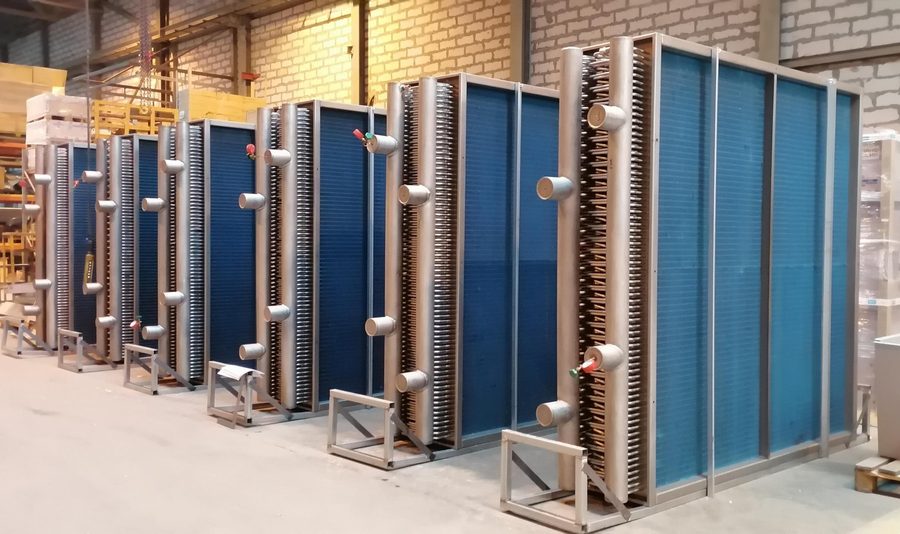
| Heat exchangers for cooling towers | replacement sections for closed-circuit cooling towers and condensers | below |
What types of NCT tanks are there?
Sectional galvanized and fully welded, with volumes from 1 to 10,000 m³, in L, O and U shapes. A sectional tank is assembled on site from pressed panels bolted together with sealing tape, so it can be brought in where a ready-made vessel will not fit. For winter there is factory insulation and heating; as the project requires, we add a manhole, ladders and platforms, level and temperature sensors, and custom nozzle locations.
We supply tanks as part of solutions with NCT cooling towers and chillers: we take full responsibility for how the circuit works. We calculate the tank volume together with the cooling tower or chiller: send a request.
Why do you need a glycol top-up station?
The station automatically restores circuit pressure with premixed solution of the same concentration. When pressure drops, a pressure switch starts the pump and the solution flows from the tank into the system. If you top up with tap water, freeze protection fades without anyone noticing.
The basic station includes a tank, a pump unit, valves, a check valve, a control panel and a frame. Four sizes with tanks from 250 to 1,000 l. Details: glycol top-up stations at nc-t.ru (in Russian).
What does water treatment do for you?
It is needed wherever water evaporates: in an open cooling tower, an evaporative condenser, or a dry cooler with spray. The NCT panel monitors water quality and controls blowdown, and the higher versions also dose chemicals.
| Version | What it does |
|---|---|
| W0C | conductivity monitoring and blowdown control |
| W2C | automatic chemical dosing and blowdown control |
| W3C | dosing with three pumps, conductivity monitoring and blowdown control |
The panel is wall-mounted, rated IP65, and takes 3–4 weeks to make. We select it from an analysis of the circuit water: without the analysis, neither the chemicals nor the blowdown mode can be set. Besides salts, the panel keeps microbial growth under control, including Legionella.
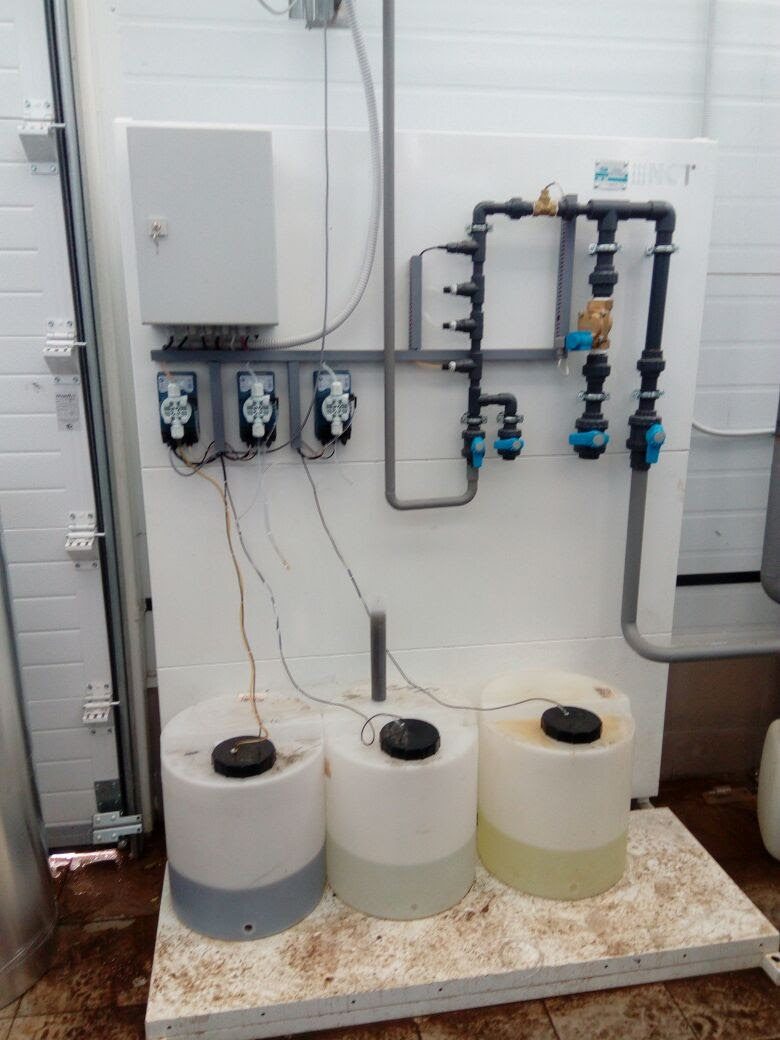
Our job is to keep the water within the limits set in your equipment's data sheet. Details: water treatment at nc-t.ru (in Russian).
What do the controls and panel equipment include?
We assemble control panels in our own shop, write the software ourselves, and handle commissioning and service ourselves too. The chiller, cooling tower and pumps work as one station, and SCADA monitoring over Modbus and Ethernet lets you watch it remotely and connect it to the plant's system. Details are on the "Control panels and controls" page.
Which heat exchangers do we make?
Sections for closed-circuit cooling towers and evaporative condensers, including equivalents for Evapco, Decsa and Baltimore units. The material is hot-dip galvanized carbon steel, or stainless steel on request; a finned design is possible. Every element passes a factory pressure leak test at up to 4 MPa and above. Details: heat exchangers at nc-t.ru (in Russian).
You can have a set selected for your unit by sending a request or by calling +7 (800) 333-49-96.
Frequently asked questions
Can glycol be kept in a galvanized tank?
No. Zinc reacts with the inhibitors, sediment forms, and the solution's protection is depleted. Glycol vessels are made of polyethylene or stainless steel. A galvanized tank is suitable for water. Without monitoring, glycol oxidizes within 3–5 years and starts to corrode metal, so the concentration is checked at startup, every autumn and after every top-up.
Can we top up a glycol circuit with plain water if it leaks a little?
Better not. A 60 m³ circuit with 40 % propylene glycol drops to 34 % after three top-ups of 3 m³ of water each, and the freezing point rises from −21 to roughly −16 °C. In frosty weather this may cost you a heat exchanger, so top-ups are done only with solution of the same concentration.
Will an NCT heat exchanger fit a closed-circuit cooling tower from another manufacturer?
We make replacement coils for Evapco, Decsa and Baltimore closed-circuit cooling towers and evaporative condensers. Send the unit model and coil dimensions so we can check the fit. For a dry cooler or another make, the engineer needs the unit’s technical data sheet to assess compatibility.
We are offered a magnetic or ultrasonic device instead of chemicals. Will it replace water treatment?
No. The physics of such devices partly works, but they do not solve two problems: a magnetic field does not remove biology, including Legionella, and the salts stay in the circuit, so blowdown is still needed. If the device supplier is confident in the result, ask them to take written responsibility for Legionella in the circuit.
If a cooling tower is already installed, can we add only controls or water treatment?
Water treatment can be installed on a running circuit; we start with a water analysis. We take on controls for third-party equipment without replacing it with ours only in exceptional cases.
Let us size a cooling system for your site
An engineer will select the equipment and send you a calculation. Free of charge, no obligation.