
Commercial Real Estate
In brief. When a shopping center or business center lacks electrical capacity, cooling for air conditioning can be produced from gas or hot water. Direct-fired Thermax absorption chillers come in capacities of 175–5,450 kW and can work as a chiller-heater.
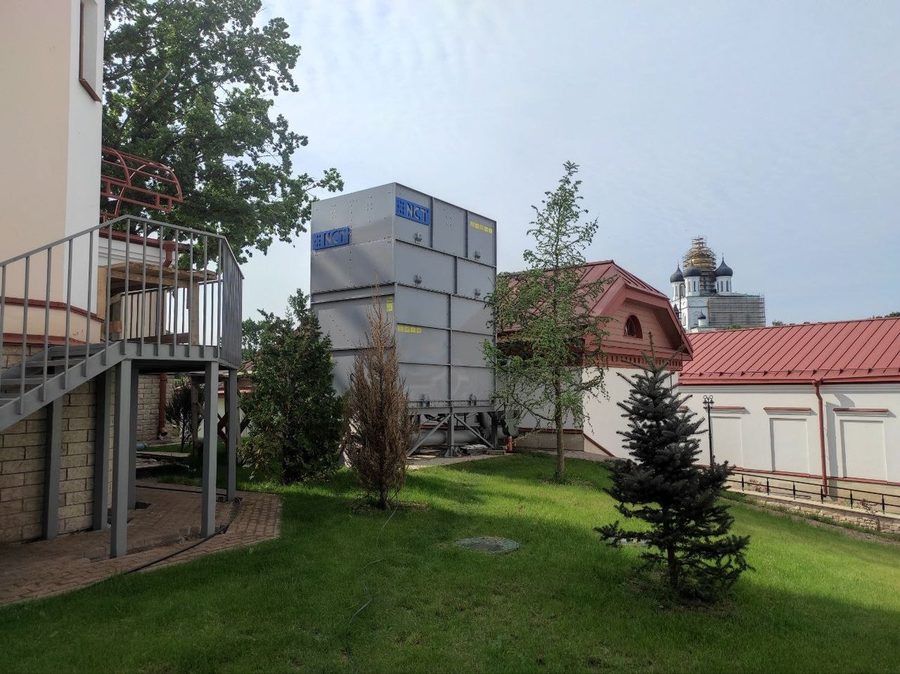
Air conditioning is a must in any shopping center, office or hotel. The cooling for it comes from refrigeration machines of different types. One of them is the lithium bromide absorption chiller. It runs on heat rather than electricity: on hot water, steam, exhaust gases from gas engine generator sets, natural gas and other fuels. Heat is rejected from the absorption chiller by cooling towers.
Why use absorption chillers in commercial real estate?
Many properties run into a shortage of electrical capacity. Most often these are:
- new development areas;
- power-deficient regions;
- historic centers of large cities;
- areas with a high concentration of consumers.
The usual answer in such cases is on-site generation. An absorption chiller solves the problem differently: cooling is produced from natural gas, steam from a boiler house, hot water from a boiler, or exhaust gases from gas engines and gas turbines. Electricity consumption for air conditioning drops sharply, and operating costs go down.
When electricity is in short supply, natural gas is often still available, both in price and in volume. Switching the chiller plant to gas frees up the capacity that vapor-compression machines would otherwise take.
Which absorption chillers suit shopping malls and business centers?
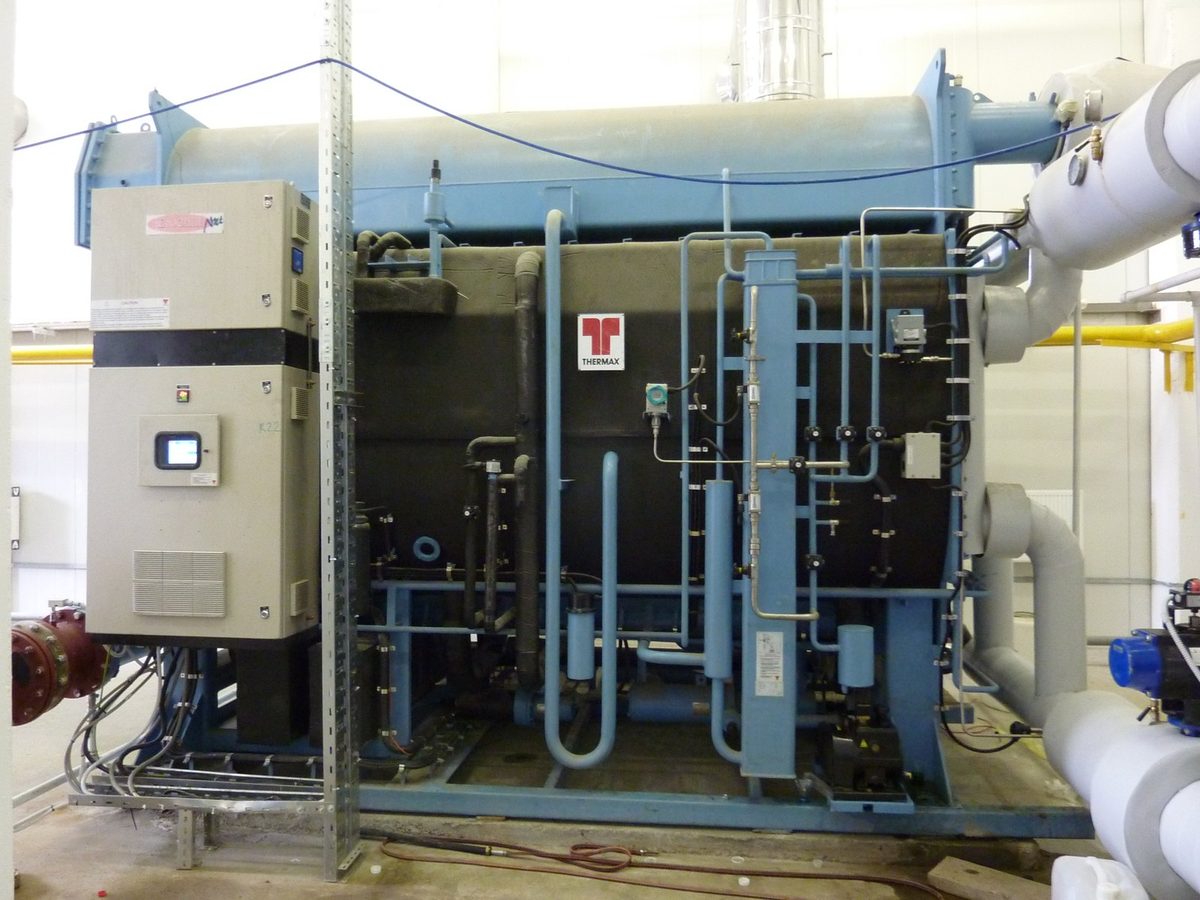
We use direct-fired Thermax absorption chillers:
| Parameter | Value |
|---|---|
| Cooling capacity | 175–5,450 kW |
| Chilled water temperature | down to 1 °C; down to −2 °C with a glycol solution |
| Coefficient of performance | 1.40–1.45 |
Besides mains gas, these machines run on:
- liquefied petroleum gas;
- liquefied natural gas;
- propane;
- kerosene;
- biogas;
- diesel fuel.
This opens up applications in the extractive and manufacturing industries as well, where by-products of the process can serve as fuel for absorption chillers.
If the site has hot water (from a boiler house, cogeneration or waste heat boilers), a hot water absorption chiller is installed. This is how a shopping and entertainment complex in Obninsk, a business center in Minsk and a customs administration building in Moscow work.
Can one machine both cool and heat?
Yes. A direct-fired absorption chiller has a burner, so it works as a chiller-heater:
- the evaporator loop can produce hot water up to 60 °C, which in many cases removes the need for separate heating equipment;
- models with an additional heat exchanger give hot water up to 95 °C.
A chiller-heater is set up to produce heating and cooling simultaneously or to run in one of the modes: "heating" or "cooling". For example, at the Mosgaz engineering center (in Russian), two gas-fired Thermax GD 20C TCU-S absorption chillers deliver 1,200 kW of cooling and work as hot water boilers: 300 kW of heating in summer and 600 kW in winter. For domestic hot water they burn 40 % less gas than conventional hot water boilers.
Example: Minvody Expo international exhibition center
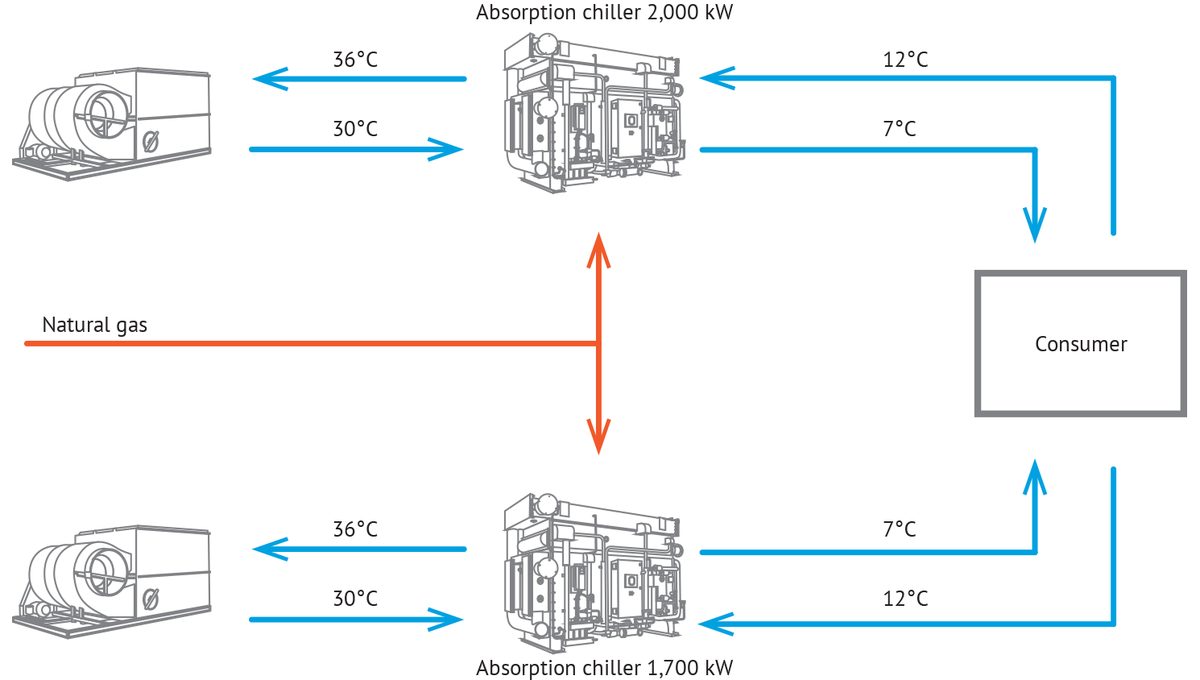
This is a large international exhibition center (in Russian) of about 30,000 m² in Mineralnye Vody. Here, absorption chillers provide cooling for central air conditioning, the most common task in commercial real estate.
Why absorption machines were chosen:
- the center is in a power-deficient region, so electric chillers are hard to install;
- direct gas firing instead of electricity gives a low cost of cooling.
| Equipment | Cooling capacity | Water in/out |
|---|---|---|
| Gas-fired Thermax 2V 4M C absorption chiller | 2,001 kW | 12/7 °C |
| Gas-fired Thermax 2V 5K C absorption chiller | 1,702 kW | 12/7 °C |
Which projects have we completed?
| Project | City | Equipment | Energy source |
|---|---|---|---|
| Exhibition center (in Russian) | Mineralnye Vody | 2V 4M C and 2V 5K C absorption chillers, 2,001 and 1,702 kW | natural gas |
| Sultan Palace hotel (in Russian) | Atyrau, Kazakhstan | 2V 3K C absorption chiller, 2 closed-circuit cooling towers | natural gas |
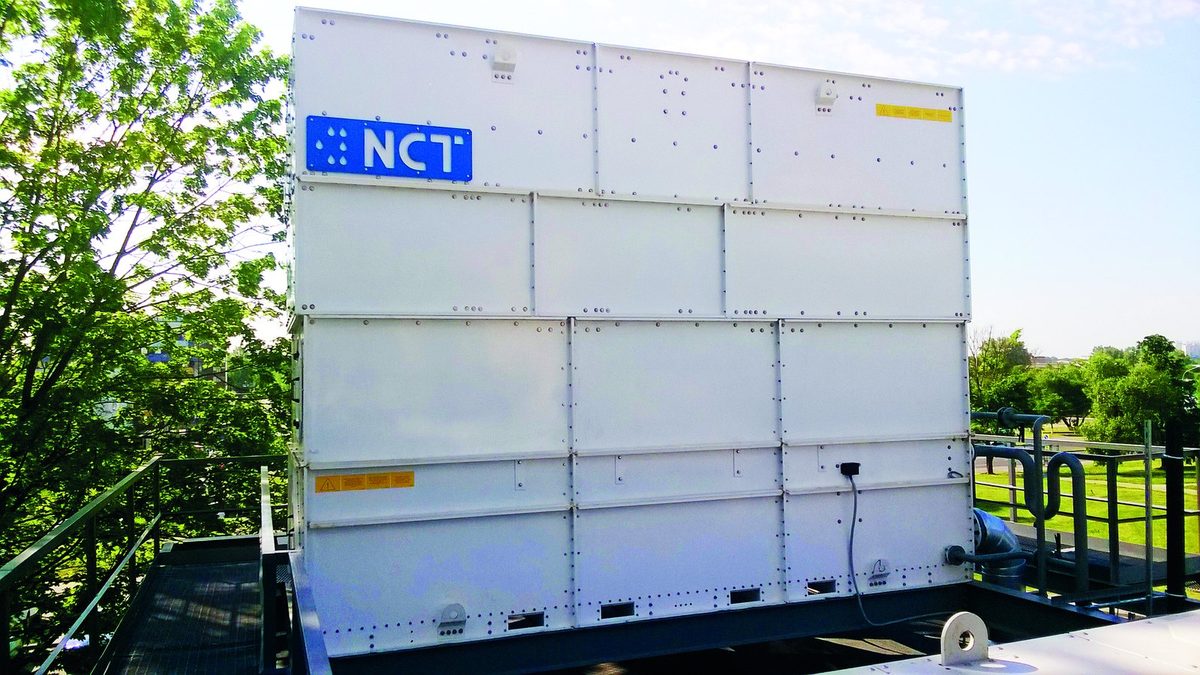
| Aray City Mall shopping center (in Russian) | Kyzylorda, Kazakhstan | 5G 4L C and 2V 3L C absorption chillers, 1,100 kW each, 2 NCT VR cooling towers | hot water from gas engines and gas |
| Triumph Plaza shopping and entertainment complex (in Russian) | Obninsk | 5G 5K C absorption chiller, 2 closed-circuit cooling towers | hot water |
| Omega Tower business center (in Russian) | Minsk, Belarus | LT 18C absorption chiller, NCT VR2 cooling tower | hot water |
| Central Customs Administration (in Russian) | Moscow | 2 LT 14 C absorption chillers, 500 kW each | hot water from a boiler house and waste heat boilers |
| Tau Galereya shopping mall (in Russian) | Saratov | 2 5G 6L C absorption chillers, 2,200 kW each | heat from gas engine flue gases |
| Reef Residence hotel (in Russian) | Sochi | 2 2V 2M C absorption chillers, 1,400 kW in total | natural gas |
| Mikhailovsky grocery store (in Russian) | Astrakhan | 5G 2B H absorption chiller, 320 kW, NCT SVA cooling tower | hot water |
| Depo shopping and entertainment center (in Russian) | Nizhny Tagil | 5G 3L C absorption chiller, 800 kW | hot water |
| Maskarad shopping and entertainment center (in Russian) | Stary Oskol | two phases: LT 16 C absorption chiller, 850 kW, and 2V 3M C-S, 1,350 kW, NCT VR3 cooling tower | hot water from a boiler house and natural gas |
| State circus (in Russian) | Penza | 2 TAC G2 D2 absorption chillers, 1.7 MW each, 2 NCT SVA-6 stainless steel cooling towers | natural gas |
| Metrostroy sports complex (in Russian) | Saint Petersburg | 2 5G 3M C absorption chillers, 925 kW each | hot water from a boiler house |
At the shopping mall in Saratov, the annual benefit from Thermax absorption chillers is more than RUB 7 million. At the sports complex in Saint Petersburg, the on-site boiler house heats the building in winter and in summer supplies hot water to the absorption chillers, which makes cooling 3–4 times cheaper. At the administration building in Moscow's historic center, the machines were delivered to the basement in parts through narrow passages and assembled on site.
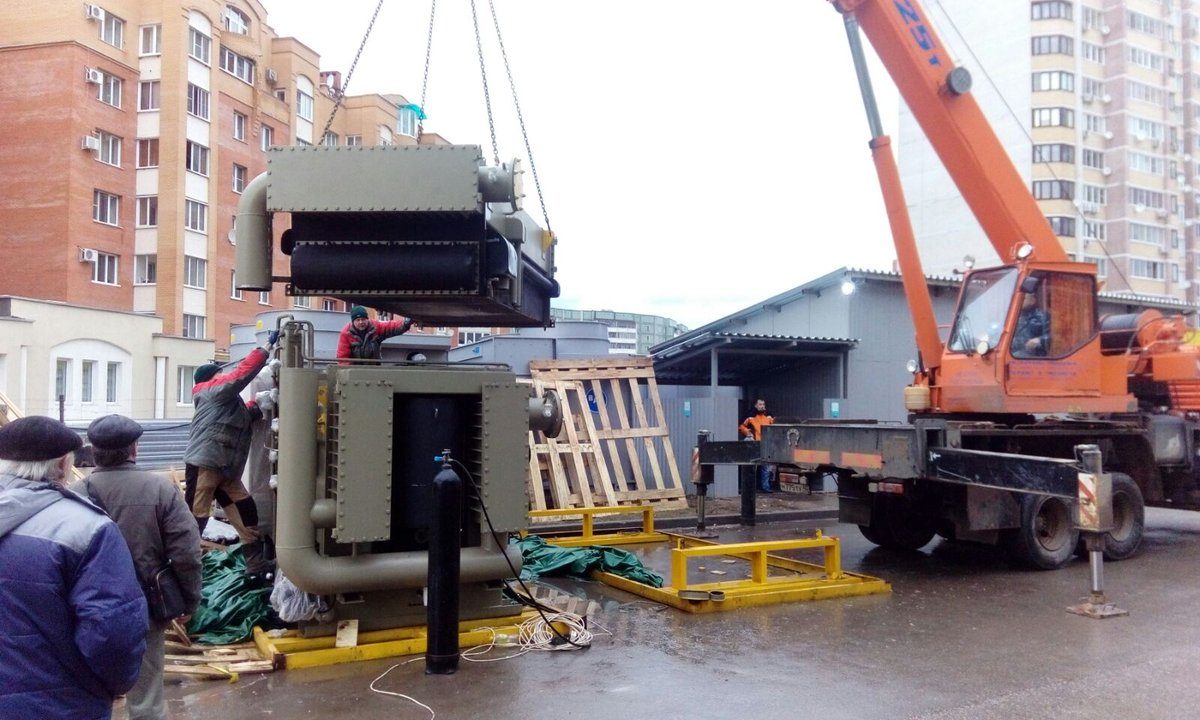
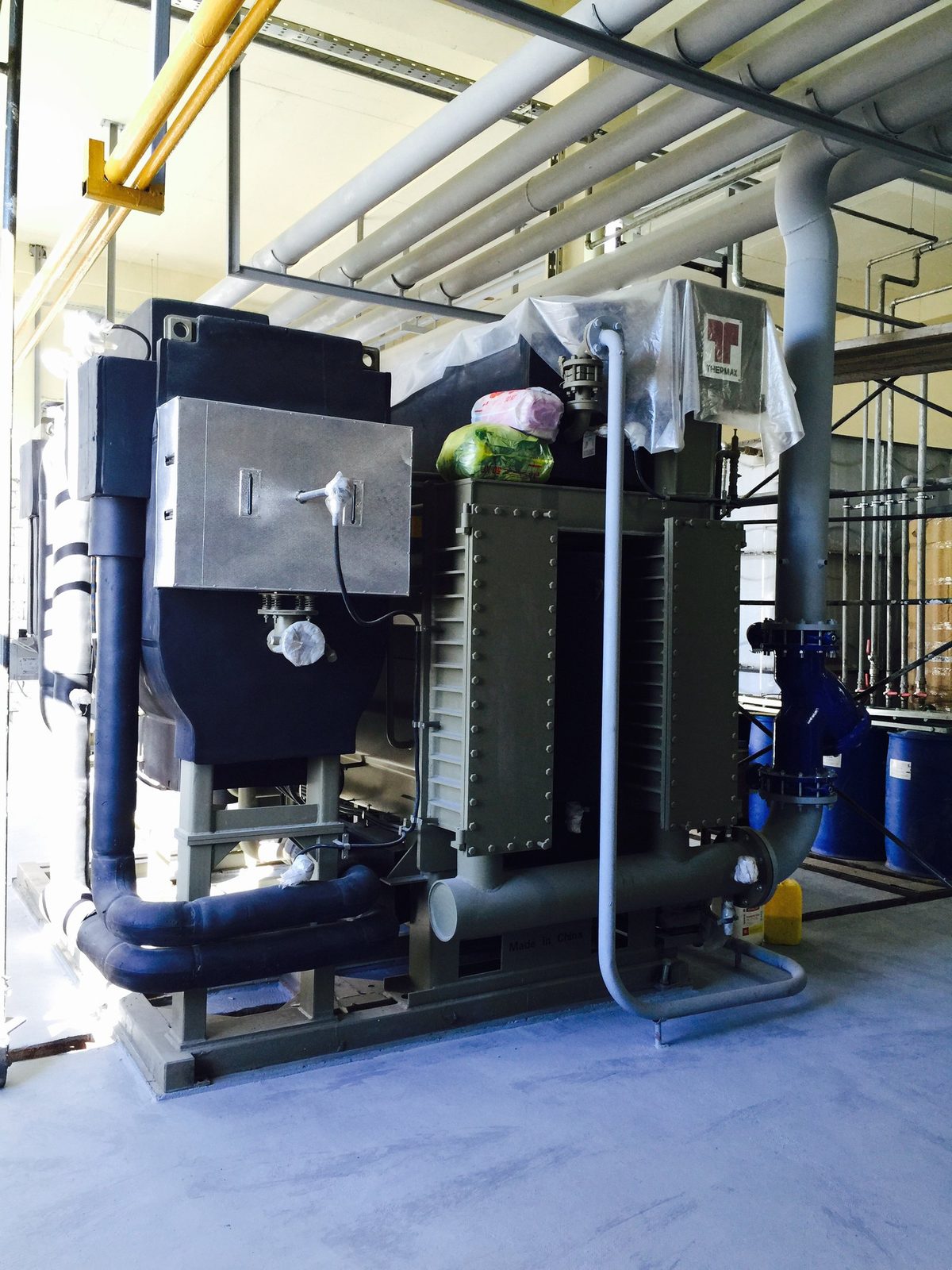
Customer reviews for some of these projects are on the Customer reviews (in Russian) page. Selected projects are in the Projects section.
What if there is enough electrical capacity?
Then we build the chiller plant on NCT chillers, and the heat from the chillers is rejected by NCT dry coolers or closed-circuit cooling towers with low noise levels. In hot weather, when the load peaks, modular NCT chillers cover the peak, while an absorption chiller can stay on the base load. Examples from the chiller reference list:
- Akvatoriya shopping center, Shlisselburg: an NCT chiller with a remote air-cooled condenser air-conditions the retail premises;
- Iskra shopping center, Perm: an NCT chiller serves ventilation and air conditioning;
- Fakel health resort, Divnomorskoye (Krasnodar Territory): an NCT chiller with a heat pump function air-conditions the canteen.
How does a project run?
- Engineer consultation: we assess the air conditioning load, the available electrical capacity and the sources of heat or gas.
- Concept: we choose the type of absorption chiller (gas-fired, hot water or exhaust gas) and the cooling towers.
- Technical specification, layout options and a feasibility study.
- Design, supply, installation supervision and commissioning.
The consultation, layout options and feasibility study are free of charge.
You can estimate the costs yourself in the "Absorption chiller vs electric chiller" calculator: for 1,000 kW of cooling with the default settings (air conditioning for 5 months, electricity at RUB 7.5/kWh, gas at RUB 8.5/m³), a gas-fired absorption chiller spends RUB 1.01 million a year on energy and an electric chiller RUB 3.19 million. Change the tariffs and mode for your site: calculator on the resource page.
Materials
Cooling system schemes
Typical schemes we use in this industry. The numbers on the diagram are piping components; the key is under each diagram.
Direct-fired natural gas absorption chiller
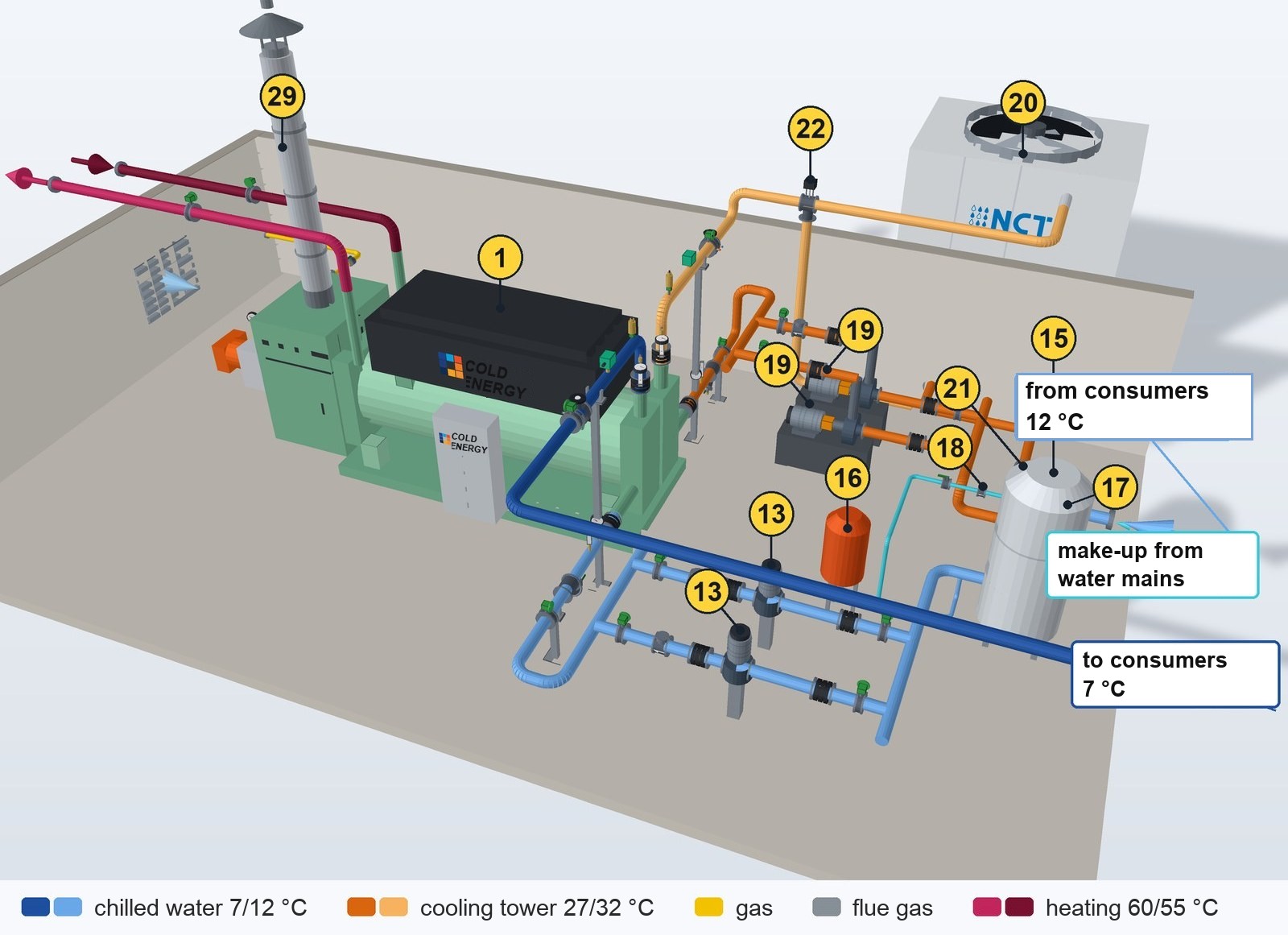
Gas goes through the gas train to the burner, flue gas goes to the stack; chilled water goes to the consumer, cooling tower water passes through the absorber and condenser, and in winter hot water can be taken for heating.
Key to the numbers on the diagram
| No. | Component | Purpose |
|---|---|---|
| 1 | Direct-fired absorption chiller (gas) | cooling from the heat of gas combustion; the refrigerant is water, the absorbent is lithium bromide |
| 3 | Butterfly valve | isolates the machine and pumps for repair and flushing; installed in pairs, inlet and outlet |
| 4 | Y-strainer | catches scale and debris before the unit's tubes; INLET only |
| 5 | Flexible connector (vibration isolator) | right at the nozzle: dampens vibration and does not transfer the pipe's weight and misalignment to the nozzle |
| 6 | Thermometer in a thermowell | inlet and outlet temperature: the difference shows the load |
| 7 | Pressure gauge with valve | pressure before and after: the pressure drop = flow and tube fouling |
| 8 | Drain valve | drains water from the unit and the loop, at the lowest point |
| 9 | Pipe support | carries the weight of the pipe and fittings so the machine's nozzle is not loaded |
| 10 | Automatic air vent | at the very highest point: releases air (noise, corrosion, pump air binding) |
| 11 | Flow switch | no flow, no machine start; a paddle flow switch needs straight runs of ≥5 DN |
| 12 | Balancing valve | sets the design flow through the unit; the test ports are for the meter |
| 13 | In-line pump | circulates water through the loop; in pairs, duty + standby |
| 14 | Check valve | prevents backflow through an idle pump |
| 15 | Buffer tank | reserve water volume so the machine does not cycle on and off frequently |
| 16 | Diaphragm expansion tank | takes up fluid expansion during heating and holds pressure at the pump suction |
| 17 | Makeup unit: valve | loop makeup; the valve is for manual shut-off |
| 18 | Makeup unit: backflow protection (shown as a check valve in the picture for simplicity) | loop fluid must not enter the drinking water supply: one ordinary check valve is not enough; you need a double check valve, a reduced pressure zone valve (RPZ) or an air gap; with glycol or chemicals, only an RPZ or an air gap; the type is set by the water utility's technical conditions |
| 19 | End-suction pump (duty + standby) | axial inlet, top outlet; motor on a common baseplate |
| 20 | NCT open cooling tower | cools water by evaporating part of it into the air |
| 21 | Coarse screen at the cooling tower pump suction | protects the pump from leaves and large debris: 4.8–6.4 mm mesh, low pressure drop, a basin outlet screen is better; a fine strainer is not installed at the suction, it goes after the pump and at the condenser inlet (item 4) (B&G TEH-1209A, pp. 14–16) |
| 22 | Cooling tower three-way bypass valve | sends part of the water past the cooling tower so the water going to the machine is not overcooled (for absorption chillers, a risk of crystallization) |
| 23 | Gas train: ball valve | manual gas shut-off at the gas train inlet |
| 24 | Gas train: gas filter | traps dust and scale, otherwise the valves will not close tightly |
| 25 | Gas train: pressure gauge / pressure switch | gas pressure monitoring; the min./max. pressure switches are part of the burner protection |
| 26 | Gas train: pressure regulator | reduces the gas pressure to what the burner needs and keeps it constant |
| 27 | Gas train: two solenoid valves | double shut-off: the gas closes instantly in an emergency or if the flame goes out |
| 28 | Gas burner | burns gas in the high-temperature generator |
| 29 | Insulated flue | carries flue gases above the roof; the insulation protects against burns and condensation |
| 30 | Combustion air intake louvers | the burner needs air: without an air supply, the room will run short of oxygen |
Compressor chiller with a cooling tower
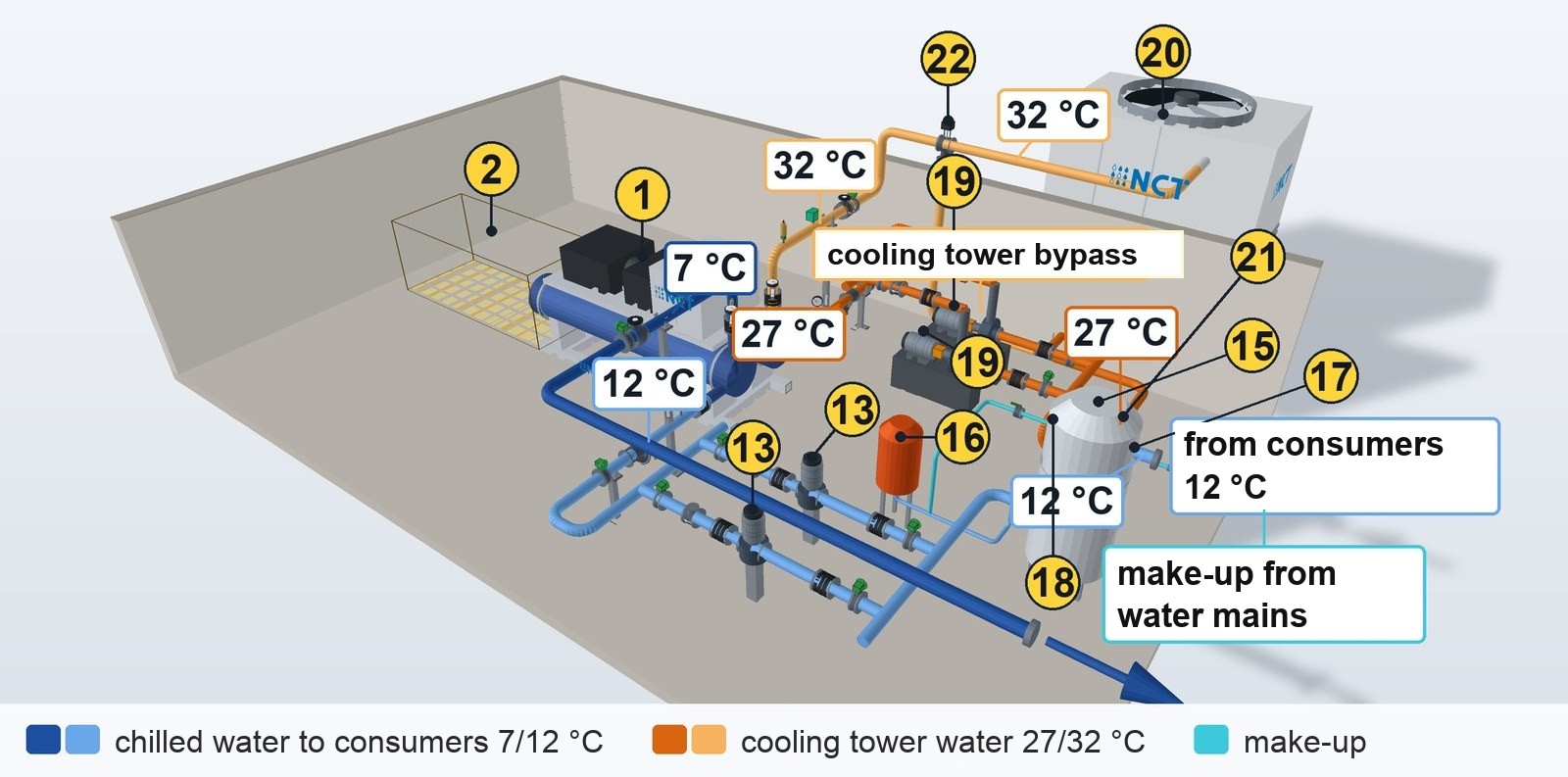
When you need a lower temperature than a cooling tower can give: the evaporator cools the consumer's water, and the condenser rejects heat to the cooling tower.
Key to the numbers on the diagram
| No. | Component | Purpose |
|---|---|---|
| 1 | NCT water-cooled chiller | the evaporator takes heat from the consumer's water, and the condenser gives it to the cooling tower water |
| 2 | Tube pull zone (keep clear) | clear space the length of the unit at its end: tube cleaning and replacement |
| 3 | Butterfly valve | isolates the machine and pumps for repair and flushing; installed in pairs, inlet and outlet |
| 4 | Y-strainer | catches scale and debris before the unit's tubes; INLET only |
| 5 | Flexible connector (vibration isolator) | right at the nozzle: dampens vibration and does not transfer the pipe's weight and misalignment to the nozzle |
| 6 | Thermometer in a thermowell | inlet and outlet temperature: the difference shows the load |
| 7 | Pressure gauge with valve | pressure before and after: the pressure drop = flow and tube fouling |
| 8 | Drain valve | drains water from the unit and the loop, at the lowest point |
| 9 | Pipe support | carries the weight of the pipe and fittings so the machine's nozzle is not loaded |
| 10 | Automatic air vent | at the very highest point: releases air (noise, corrosion, pump air binding) |
| 11 | Flow switch | no flow, no machine start; a paddle flow switch needs straight runs of ≥5 DN |
| 12 | Balancing valve | sets the design flow through the unit; the test ports are for the meter |
| 13 | In-line pump | circulates water through the loop; in pairs, duty + standby |
| 14 | Check valve | prevents backflow through an idle pump |
| 15 | Buffer tank | reserve water volume so the machine does not cycle on and off frequently |
| 16 | Diaphragm expansion tank | takes up fluid expansion during heating and holds pressure at the pump suction |
| 17 | Makeup unit: valve | loop makeup; the valve is for manual shut-off |
| 18 | Makeup unit: backflow protection (shown as a check valve in the picture for simplicity) | loop fluid must not enter the drinking water supply: one ordinary check valve is not enough; you need a double check valve, a reduced pressure zone valve (RPZ) or an air gap; with glycol or chemicals, only an RPZ or an air gap; the type is set by the water utility's technical conditions |
| 19 | End-suction pump (duty + standby) | axial inlet, top outlet; motor on a common baseplate |
| 20 | NCT open cooling tower | cools water by evaporating part of it into the air |
| 21 | Strainer at the cooling tower pump suction | an open loop collects dust and leaves: a screen ahead of the pumps |
| 22 | Cooling tower three-way bypass valve | sends part of the water past the cooling tower so the water going to the machine is not overcooled (for absorption chillers, a risk of crystallization) |
Frequently asked questions
We are replacing the air conditioning in a 12,000 m² business center. How many machines do we need, and where do we put them if the roof is in use?
You can't tell from the square meters: first the load is calculated by month and by hour. One large machine is usually not chosen: at night and in the shoulder seasons it goes into short cycling, and if it fails, the office is left without cooling. If the roof is occupied, the machines are placed on a technical floor or in the basement, and the outdoor units are moved to the courtyard. Above offices you need spring vibration isolators: rubber lets too much through.
Can we put absorption chillers on an underground floor and the cooling towers on the roof?
Yes, this is a workable scheme, but three things are checked. Pressure: the water column up to the roof gives about 1 bar per 10 m, and the water boxes of most series are rated for 8 kgf/cm². Access route: the machine is checked in advance against the openings and the lifting route. The flue of a gas-fired machine: outlet resistance below 5 mm of water column; a stack shared with a boiler is generally not recommended.
In a historic district outdoor units are not allowed, the basement heats up to 50 °C, and once-through water means a huge flow. How else can we reject the heat?
The heat still has to go outside; the only question is where. A workable approach: machines with a water-cooled condenser and a closed loop to a remote unit, a closed-circuit cooling tower or a dry cooler, in the courtyard or on a neighboring roof. A recirculating cycle uses almost 40 times less water than a once-through system. A packaged unit in the basement will not work without powerful ventilation. Keep in mind our lower limit: NCT chillers start from 69 kW.
Does a cooling tower 60 m from a residential building need silencers?
For nighttime, most likely yes. If the cooling tower produces 68 dBA at 10 m, at 60 m it will be about 52.4 dBA. The daytime limit of 55 dBA is met, but the nighttime limit of 45 dBA is not. There are two options: a variable frequency drive that holds 70% speed at night and takes off 7–8 dB, or silencers. Silencers add resistance, so the fan has to be recalculated.
We will calculate the system for your site free of charge: submit a request or call +7 (800) 333-49-96.
Watch: commercial buildings (in Russian)
Thermax absorption chiller and NCT VR cooling tower in a hotel climate systemLet us size a cooling system for your site
An engineer will select the equipment and send you a calculation. Free of charge, no obligation.