
NCT pump skids
In brief. An NCT pump skid is a ready-made factory module on a frame: duty and standby pumps, piping, valves, a strainer and pressure gauges. Flow from 16 to 1,560 m³/h, head from 10 to 100 m of water column, manufacturing from 4 weeks, installation usually takes a day. An outdoor version in an insulated container is available.
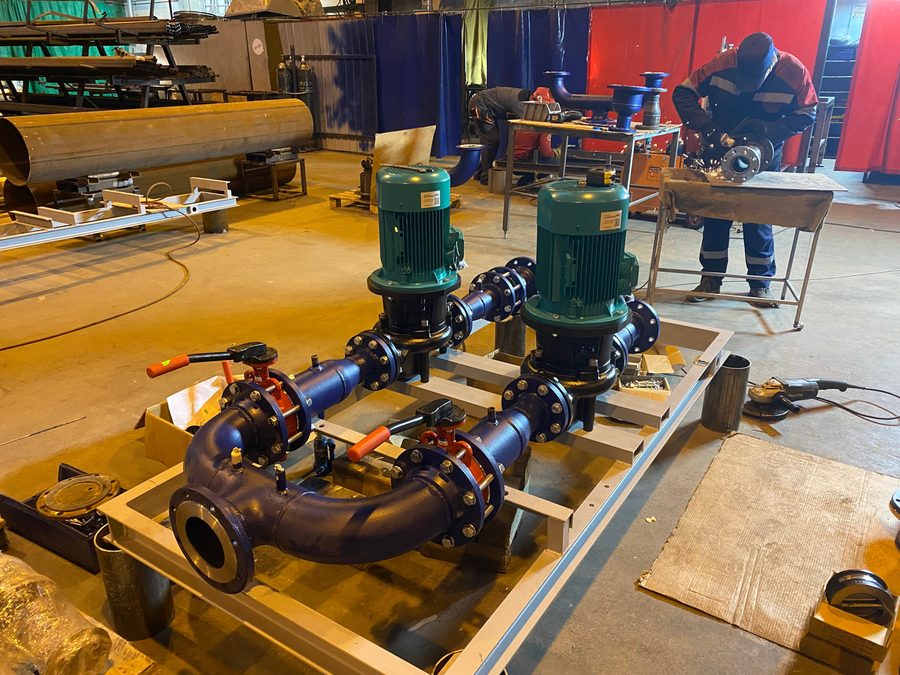
A pump skid (pump station) moves water or glycol solution around the cooling circuit: from the consumer to the cooling tower, chiller or dry cooler and back. We assemble it at our plant in Sertolovo and deliver it as a single module on a frame. On site, all that remains is to connect the suction, the discharge and the power supply to the panel.
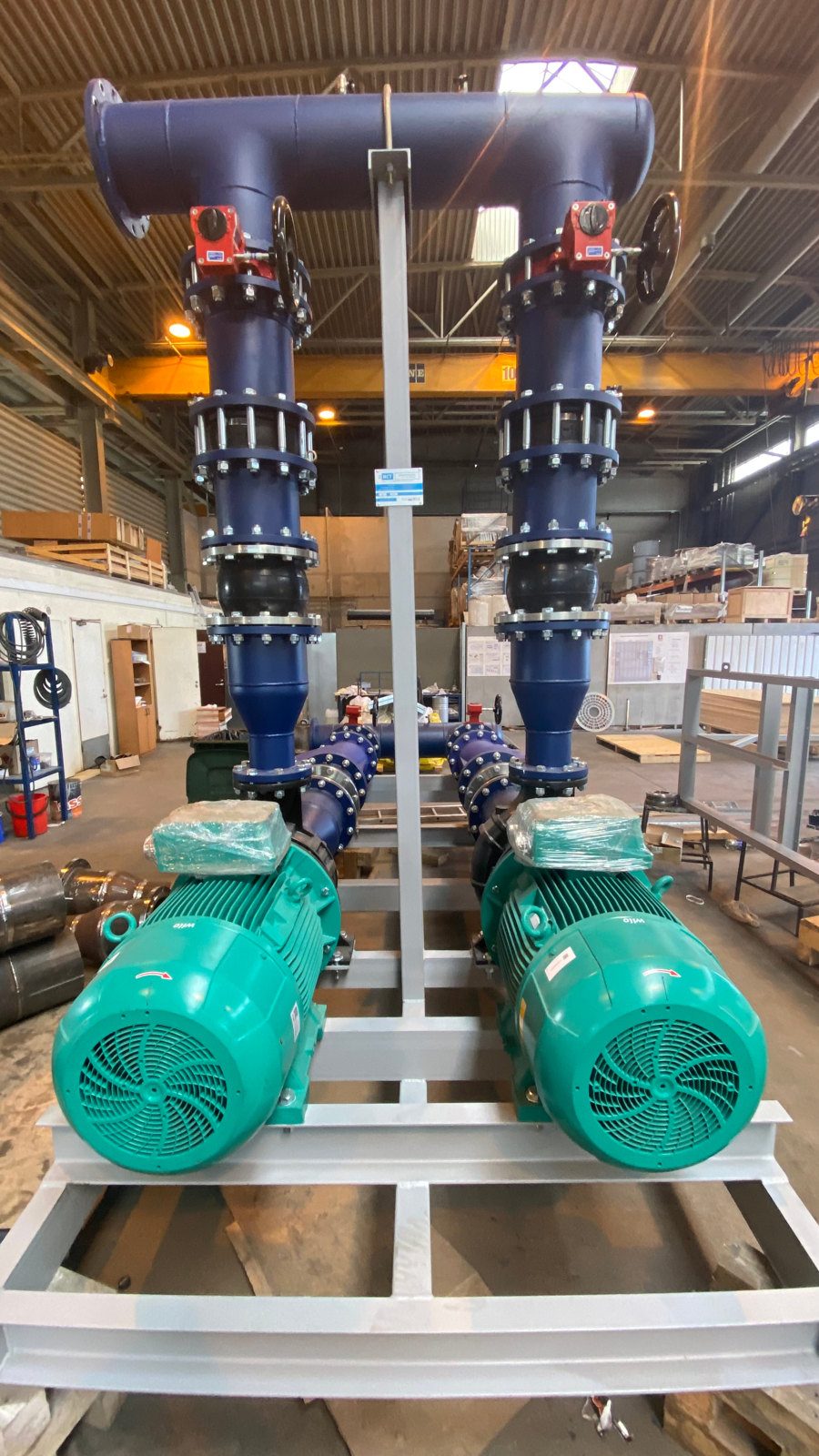
What does an NCT pump skid include?
| Assembly | What it is |
|---|---|
| Pumps | duty and standby, with automatic changeover |
| Piping | pipework on a single steel frame, flexible connectors |
| Valves | shut-off valves, a valve, a strainer, pressure gauges |
| Controls (option) | control panel, variable frequency drive or soft starter |
| Monitoring (option) | SCADA, Modbus RTU and Ethernet, connection to the plant's process control system |
The pumps are single-stage in-line centrifugal CNP TD pumps with a dry rotor and a mechanical seal; the motor is force-cooled. The skid switches to the standby pump by itself, via diaphragm valves with an electromagnetic actuator; no operator is needed.
The piping comes in three layouts. The U-shaped layout suits cramped rooms, the L-shaped layout gives access to both pumps from one side, and the in-line layout fits into an existing pipeline. Our design department engineers non-standard piping for a specific site.
What fluids and operating conditions can it handle?
| Parameter | Value |
|---|---|
| Flow | from 16 to 1,560 m³/h |
| Head | from 10 to 100 m of water column |
| Fluid | water without abrasive substances, aqueous solutions of ethylene glycol and propylene glycol |
| Fluid temperature | from −15 to +110 °C |
| Operating pressure | up to 16 bar |
| Lead time | from 4 weeks |
| Warranty | 1 year from the date of commissioning, but no more than 1.5 years from the date of shipment |
The skids are installed in plant recirculating cooling water systems, in chiller and fan coil circuits of shopping centers and offices, in the water supply to precision air conditioners in data centers, and on glycol lines in food production. NCT pump stations run, for example, at crypto mining farms in the Sverdlovsk and Tomsk Regions, dairy plants in Krasnodar Krai and Kazakhstan, ice cream factories in the Yaroslavl Region and Tatarstan, and many other sites.
Why is factory assembly better than piping on site?
At the plant it is easier to keep tolerances and to check the joints before shipment. Every station undergoes a hydraulic test at 0.675 MPa for at least 30 minutes, and the welds are made to quality level B under ISO 5817. NCT PU pump skids have an EAEU declaration to TR CU 004/2011, 010/2011 and 020/2011 (valid until 10.08.2028), and since August 2026 also a declaration to TR CU 010/2011 under scheme 5d based on a type certificate (valid until 13.08.2031).
- The pressure drop of the piping is already accounted for in the pump selection, so the design flow is not lost across the assembly.
- The pipework is painted with primer-enamel in a coat of 90 μm or more.
- Only galvanized fasteners, threaded joints. No self-tapping screws, and therefore no extra rust spots.
Assembly on site makes sense in two cases: on a retrofit, when working pumps are kept, or when the module does not fit through the openings.
When is a pump skid in a container needed?
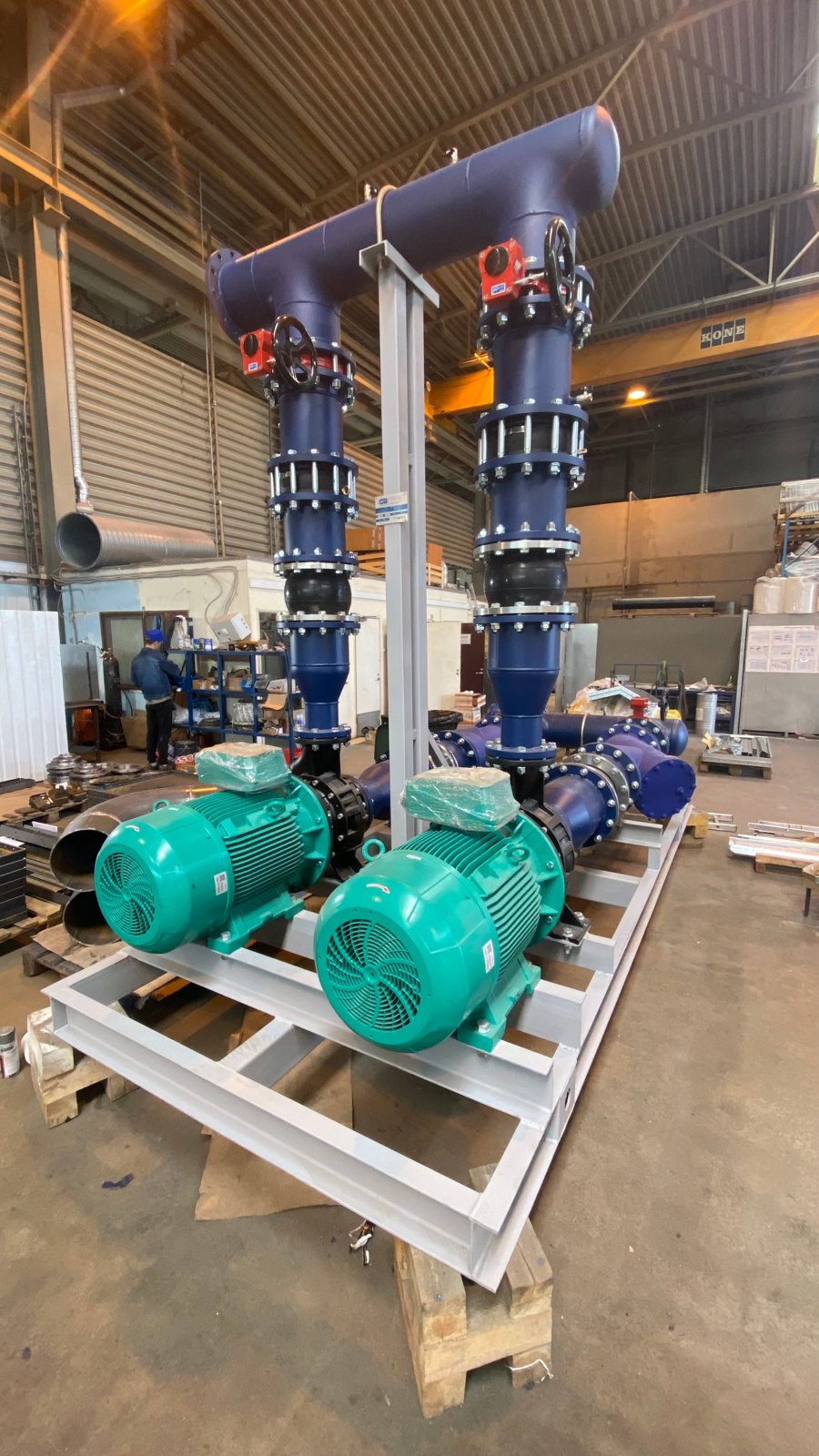
When there is no room for the pumps. The skid is placed in an insulated anti-vandal Sever-type block box with a frame rated for 14 tonnes, heating, ventilation, lighting and fire suppression. The block box operates at outdoor temperatures down to −60 °C. Instead of a pump room, the design provides a pad, pipe entries and power supply.
If you need to fit not just the pumps but the whole cooling station into a container, see containerized units. A pump skid can also be included in a turnkey chiller plant.
How much does it cost and how do you order?
NCT pump skids cost from RUB 500,000. The price is determined by the flow, the head, the redundancy scheme and the panel configuration. The calculation is free.
- Send the flow and head through the request form or call +7 (800) 333-49-96.
- We will select the skid and quote the price; you can look at the sizes in advance in the pump skid catalog on nc-t.ru (in Russian).
- Manufacturing takes from 4 weeks. The skid can be leased.
Frequently asked questions
Can pumps of different capacities be run in parallel?
No. On a common header the stronger pump will overpower the weaker one: the check valve of the weaker pump will close, and it will spin with no flow and overheat. Pumps in parallel are selected of the same size, with a check valve on each.
Can the cooling tower pumps be placed on the roof next to it to keep the pipes shorter?
Better not. At the design point the NPSH margin may be sufficient, but with warm water, a low level or a clogged strainer it no longer is. A pump above the water level also does not prime itself after draining. Open-circuit pumps are installed with flooded suction, below the minimum water level.
Why does a variable frequency drive on a pump save almost nothing?
Most often the location of the differential pressure sensor is to blame. If it is on the station headers, the pump holds full head at any load. The sensor is installed on the most heavily loaded branch. In an open circuit the savings are also limited by lifting the water to the cooling tower: this is needed at any flow.
What data do you need to calculate a skid?
- maximum flow and useful head for the most heavily loaded loop;
- fluid and glycol concentration, temperature;
- open or closed circuit;
- redundancy scheme and panel type;
- installation location.
Head estimated "by eye" is the main cause of failures at startup: the pump does not deliver the flow, and the machine trips on the flow switch.
Our design guide "NCT Pump Stations, Tanks, Water Treatment and Glycol" (85 pages, one of seven in the series for engineers) can be sent by email or via Telegram: order it on the resource page.
More questions from designers and operators are covered on the page "Pump stations: questions and answers" (in Russian) by Maxim Krasnov.
Watch: pump stations (in Russian)
NCT recirculating water pump station reviewLet us size a cooling system for your site
An engineer will select the equipment and send you a calculation. Free of charge, no obligation.