
Turnkey water cooling and recirculating cooling water systems
In brief. We take on the entire water cooling system for a plant: survey, water balance, design, NCT cooling towers, pumps and water treatment from our own plant, installation by our own crews, handover after integrated testing and 24/7 service. At a circulation of 1,000 m³/h the summer makeup is about 17 m³/h, so more than 98% of the water returns to the cycle.
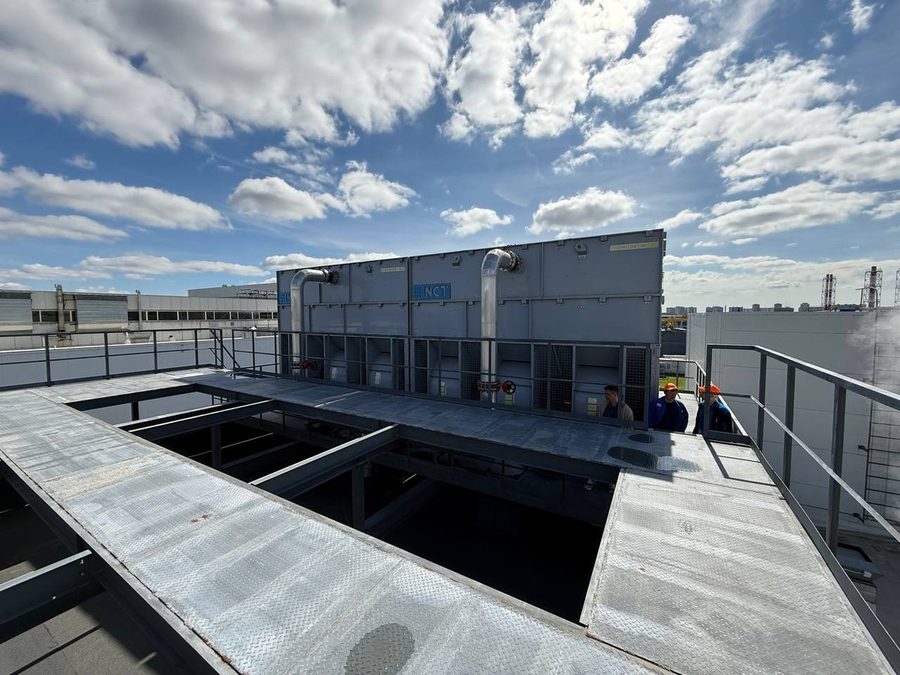
We take on industrial water cooling, that is, a turnkey recirculating cooling water system for a plant, in its entirety, and we alone are responsible for it. We survey the site, calculate the water balance, design the system, make the cooling towers, pump skids and water treatment panels at our own NCT plant in Sertolovo (Leningrad Region), install everything with our own crews and hand the system over after integrated testing. After that, our 24/7 service takes care of it. If the water does not reach its temperature in summer, the same company that calculated the system deals with it.
A recirculating system takes heat from the equipment, cools the water in a cooling tower and returns it instead of discharging it. At a circulation of 1,000 m³/h and a 7 °C temperature difference, makeup in hot weather is about 17 m³/h: more than 98% of the water returns to the cycle.
What does the work include, and who is responsible for what?
| Stage | What we do | Result for the customer |
|---|---|---|
| Survey | we collect the heat load and its seasonal profile, water flow and temperatures, installation site, winter mode and an analysis of the makeup water; if there are no data, we survey the existing system on site | input data that the design can rely on |
| Concept and feasibility study | we calculate the water balance and the permissible cycles of concentration and choose the scheme: open or closed loop, cooling tower, dry cooler or chiller | a clear scheme, water consumption and a water use limit based on the annual profile |
| Design | design documentation (Stage P) and working documentation (Stage R) are produced by our engineering center, which holds an SRO (self-regulatory organization) certificate and GOST ISO 9001 | documentation the system can be built from without rework |
| Manufacturing and supply | we make the cooling towers, pump skids and water treatment panels at our own NCT plant; cooling towers may be in stock, and if not, the lead time is 10–12 weeks; factory testing at the customer's request | equipment built for the design, with lead times and spare parts straight from the manufacturer |
| Installation | by our own crews: foundation, cooling towers, pump skid, tank, filters, piping, control panels and controls | one contractor on site, no interfaces between contractors |
| Commissioning and handover | hydraulic testing, tuning of water treatment and controls, integrated testing, usually 72 hours under process load | the system is handed over at operating parameters, not on the basis of installation alone |
| Service | 24/7 maintenance, online monitoring | after start-up, the company that built the system is the one responsible |
Why one company instead of three contractors?
When one firm supplies the cooling tower, a second designs the system and a third installs it, after a failed start-up each points at the others. We do not have that dispute: the calculation, the equipment, the installation and reaching the target temperature are the responsibility of one company.
- Our own NCT plant. We have been manufacturing in Sertolovo since 2015, so lead times and spare parts do not depend on intermediaries. Since April 2024 NCT has been a member of the Cooling Technology Institute (CTI, USA), the first in Russia and the CIS.
- Thermax machines from the official representative. If the water needs additional cooling, besides chillers we install Thermax absorption chillers: we have been the official and exclusive representative of Thermax in Russia and the CIS since 2011.
- Handover after integrated testing, usually 72 hours under process load.
- Track record. We have been working since 2011 and have completed more than 780 projects.
How does a recirculating water cooling system work?
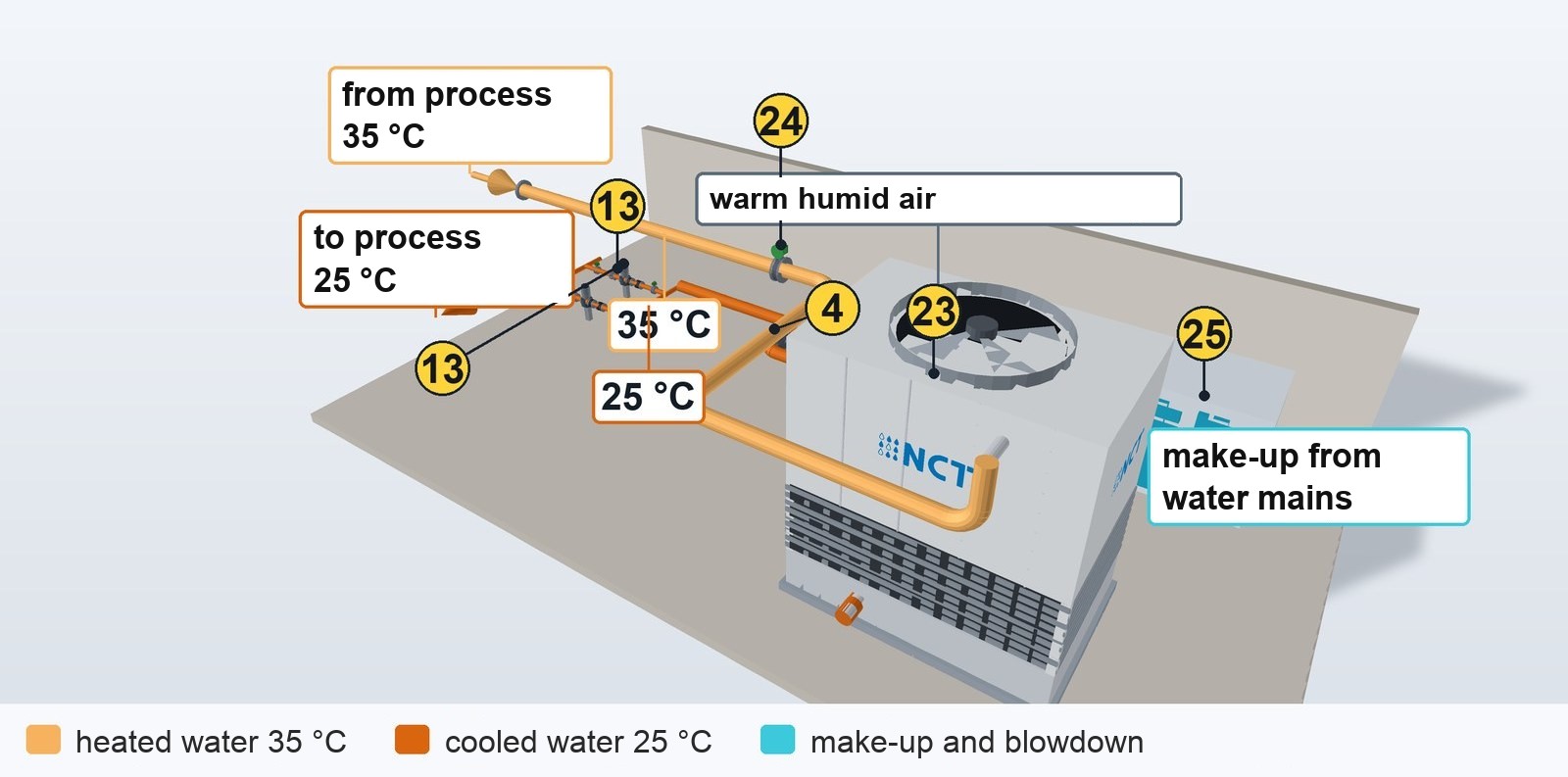
Hot water from machine tools, furnaces, compressors or chiller condensers comes to the cooling tower, flows down over the fill against the air and cools as a small part of it evaporates. The cooled water collects in the basin or tank, and a pump sends it back to the consumer.
An open cooling tower has four water flows:
- evaporation is the main loss and the way heat leaves: about 1% of circulation for every 7 °C of cooling, and up to 0.18% per degree at the summer peak;
- drift: drift eliminators in good condition keep it at 0.001–0.005% of the flow;
- blowdown is the discharge of part of the water so that salts do not build up to the point of scaling;
- makeup is fresh water that replaces the first three flows.
How much water does the system use?
An example for a circulation of 1,000 m³/h, a 7 °C temperature difference and four cycles of concentration:
| Flow | Summer peak | What affects it |
|---|---|---|
| Evaporation | 12.6 m³/h | heat load and weather |
| Drift | 0.05 m³/h | condition of the drift eliminators |
| Blowdown | 4.15 m³/h | makeup water quality and number of cycles |
| Makeup | 16.8 m³/h | sum of the three flows |
| Annual makeup at 8,000 operating hours | 69,440 m³ based on the actual load profile; 134,400 m³ if the whole year is calculated at the summer peak | — |
Two conclusions follow. We size pipes, valves and water treatment for the summer peak, and the water consumption limit in the utility specifications for the annual profile; otherwise the customer will pay for water it does not use. Second, raising the cycles above 5–6 makes little sense: going from 6 to 10 cycles reduces makeup by only 1.1 m³/h, while the risk of scaling grows.
The slides of the talk "Cooling Tower in Design" (36 slides: wet bulb for six Russian cities, a worked water balance, open-loop pumping and NPSH) go out by email or Telegram: get them on the resource page.
What does the system consist of?
- NCT cooling towers: open modular VR (in Russian) and SVA or closed-circuit VRC (in Russian). A single VR module handles 30–500 m³/h, a cascade of modules up to 5,000 m³/h, with a temperature difference of up to 40 °C per section.
- NCT dry coolers: we make them ourselves, from 300 kW; we use them where the site has no water for makeup or no discharge.
- NCT PU pump skids (in Russian): 16–1,560 m³/h, head 10–100 m of water column, 1+1 redundancy with automatic switchover.
- Water treatment: NCT W0C (in Russian), W2C or W3C panels with automatic blowdown by conductivity and dosing of inhibitor and biocide.
- Recirculating water tank: the NCT Select selection program recommends the volume for each cooling tower so that the water does not freeze in winter and no pump runs dry.
- Filtration: 3–7% of the circulation passes through a side-stream filter; for 1,000 m³/h that is about 50 m³/h.
- Control panels with variable frequency control of the fans and a winter package: basin heating, bypass, drain.
Open or closed loop?
In an open loop, the process water itself passes through the cooling tower and is in contact with the air. This is cheaper, but the water picks up dust: a 1,000 m³/h cooling tower moves about 610,000 m³/h of air through itself and, even at a dust concentration of 0.1 mg/m³, collects about 1.5 kg of dirt per day.
In a closed loop, the process water or glycol flows inside the coil of a closed-circuit cooling tower and never meets the air; only the spray water evaporates. We use this loop for equipment with narrow channels (plate heat exchangers, induction furnaces, compressors) and where glycol is needed in winter. For example, at the Omsk glass plant (in Russian) two closed-circuit VRC cooling towers cool the furnaces, and at the Huhtamaki packaging plant in Ivanteevka a closed-circuit VRC cools the compressors. The temperature difference is up to 45 °C for an open cooling tower and up to 60 °C for a closed-circuit one.
What is needed to calculate the system?
The heat load and its seasonal profile, the water flow rate and inlet and outlet temperatures, the installation site, the winter operating mode and an analysis of the makeup water. From the analysis we calculate the permissible cycles of concentration: the limit is set by the most sensitive material in the loop, usually the consumer's heat exchanger rather than the cooling tower. If there are no input data, we survey the existing system on site; this is the first stage of the work, not a separate order.
Which recirculating systems have we already built?
Here are some examples among many others:
- Molochny Mir dairy plant, Grodno (in Russian): an NCT VR cooling tower rated at 2.3 MW and 100 m³/h cools the water of vacuum evaporators from 45 to 25 °C.
- Navoi Mining and Metallurgical Combine (in Russian): an open VR cooling tower with a winter package, a pump skid and a water quality control system for the compressors of the oxygen plant.
- Moll-Elit wallpaper factory, Molodechno (in Russian): an SVA cooling tower with W0C water treatment, level control and basin heating.
- Trubodetal plant, Chelyabinsk (in Russian): VR cooling towers and W2C water treatment in place of old Soviet-era cooling towers.
- ASTON-Povolzhye, Buzuluk: six NCT SVA-12SW cooling towers on the roof of the oilseed crushing plant's own combined heat and power plant, at an elevation of +24.5 m. They cool 4,200 t/h of water for the steam turbine's oil cooler, air cooler and condenser from 40 to 27 °C at a wet bulb of 21.2 °C, 63.5 MW in total. Each tower has 12 fans of 7.5 kW: if one motor fails, the tower loses about 1.5% of its capacity. Makeup is chemically treated water, and blowdown is controlled by a salinity sensor.
- And many others: plants, industrial complexes and factories across Russia and the CIS countries.
If the water has to be cooled below what the weather allows, a chiller is added to the cooling towers; we build such systems on a turnkey basis too. For example, at a foundry in Tver, 180 m³/h of water for induction furnaces is cooled from 50 to 20 °C: an open cooling tower does the work, and above 25 °C outside a chiller downstream finishes the cooling.
How to reduce water losses in a cooling tower that is already running is covered in the article "Drift in a cooling tower" (in Russian). A detailed breakdown of the design is in the article "Industrial recirculating water system: how it works" (in Russian).
Frequently asked questions
Which water cooling system should we choose: a cooling tower, a dry cooler or a chiller?
It depends on the temperature the process requires and whether makeup water is available on site. A comparison for summer at a wet-bulb temperature of 22 °C:
| Scheme | Makeup water | What the process gets in summer | When we use it |
|---|---|---|---|
| Open cooling tower | for evaporation, drift and blowdown | wet bulb + 4–5 K, about 26–27 °C | the water tolerates contact with air, large flows |
| Closed-circuit cooling tower | only for the spray water | 27–28 °C | a clean loop or glycol is needed |
| Open cooling tower + heat exchanger | same as open | 28–30 °C | very large flows, an open cooling tower is already in place |
| Dry cooler | not needed | 5–11 K warmer than the outdoor air | no water or discharge available, hot water |
| Dry cooler or cooling tower + chiller | same as the chosen cooler | any temperature the chiller can hold | the process needs colder water than the weather provides |
If the process engineer needs 25 °C at a wet bulb of 22 °C, no scheme without a chiller will deliver it reliably: either the setpoint is agreed at 27–28 °C, or a chiller provides additional cooling. Closed-loop schemes are covered in detail in the article "Closed-loop water cooling system" (in Russian).
Can we fill the loop of a closed-circuit cooling tower with ordinary tap water?
Only after a water analysis. With tap water, the heat exchanger can corrode from the inside, especially in the upper, hotter part. Two causes are usually looked for: high dissolved oxygen and stray currents. This can be checked by analysis and on-site measurements. To avoid disputes later, agree on the requirements for the loop medium, including oxygen, right away. We protect the coils with hot-dip galvanizing, but it does not replace water monitoring.
Our water comes from a well. Can we do without water treatment for now?
Better not to put it off: on hard well water, cooling towers have failed within a year. Salts clog the fill and filters and damage the pumps, and deposits on screens and heat exchangers reduce performance by up to 20%. Start with an analysis of the well water: a dosing station is installed where the water quality requires it, not automatically on every cooling tower. If the budget for the station comes later, reserve the space and connections for the panel right away.
Can we do without makeup, or feed makeup to the cooling tower through the water distribution system by adjusting the pump?
No. Water physically leaves through evaporation, drift and blowdown, and the pump only circulates what is already in the loop. Makeup is fed through a separate line into the basin with an air gap so that loop water cannot flow back into the water supply. The level is held by a valve with a level switch or a float. Without makeup, the level drops and the pumps trip on protection. If the cause is a lack of water on site, we work out a different scheme; adjusting the pump will not help here.
Is Legionella a danger in a wet cooling tower, and what should be done about it?
The risk exists, and the regulations recognize it: SanPiN 3.3686-21 classifies cooling towers as potentially hazardous and requires periodic water testing. Legionella thrives at 25–45 °C, which is the normal operating range. Nobody achieves zero drift, so water treatment with a biocide and a monitoring plan are needed. Before the season, shock disinfection is carried out: free chlorine at 4–5 mg/L at pH 7.0–7.6, held for about 6 hours. Above 100 CFU/mL, hyperchlorination, cleaning and a repeat analysis are needed.
What is the warranty on the system, and does the extended warranty remain if another company services it?
The standard warranty is 12 months. With our installation and a service contract, it is up to 5 years, and 10 years against through-corrosion. The extended warranty depends on the service contract: if another company services the system, it does not apply. So it is better to settle the service question before the supply contract, not after start-up.
If the water needs a lower temperature than the cooling tower can provide, the recirculating loop becomes part of a cooling system with a chiller or a lithium bromide absorption chiller, and we handle that too, from design to service.
Selection and water balance calculation are free of charge. Send us the heat load, flow rate and water analysis: send a request or call +7 (800) 333-49-96.
Watch: cooling towers (in Russian)
VR-1-6-U cooling tower: customer reviewLet us size a cooling system for your site
An engineer will select the equipment and send you a calculation. Free of charge, no obligation.