
Buy an NCT dry cooler from the manufacturer
In brief. A dry cooler is a fluid cooler that uses no water in dry mode; an adiabatic version needs water for the nozzles only in hot hours. It fits when the coolant can be 3–5 °C or more warmer than the outdoor air. NCT dry coolers start at 300 kW and RUB 500,000, with a 10-week lead time; we select the unit for the site, install it and service it.
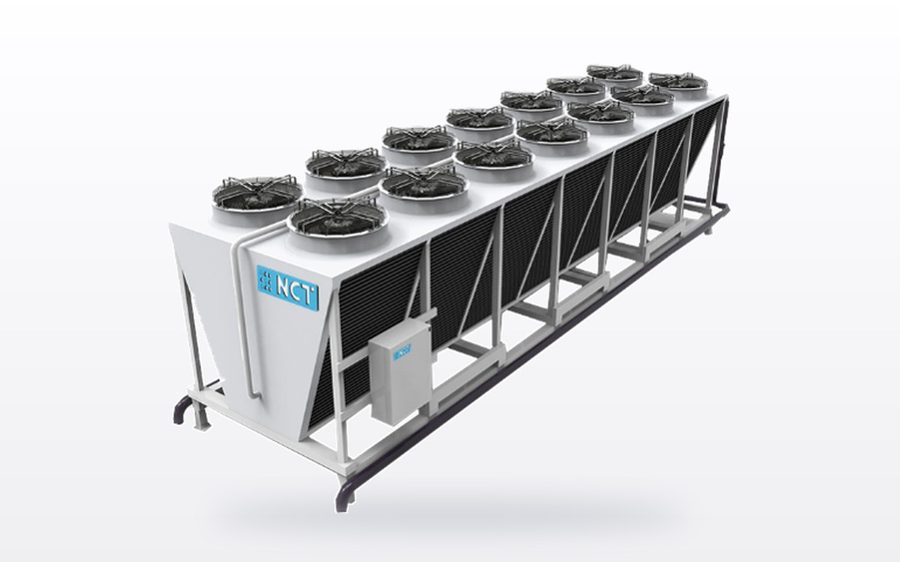
NCT dry coolers with a capacity from 300 kW cost from RUB 500,000. Manufacturing takes 10 weeks at our plant in Sertolovo (Leningrad Region), the warranty is up to 5 years, and selection is free. Cold Energy (NCT) selects the unit for the site, integrates it into the cooling system, installs it and services it.
A dry cooler (dry cooling tower) is an industrial fluid cooler: the coolant flows through the tubes of a finned heat exchanger, fans blow outdoor air across it, and in dry mode no water is consumed. The adiabatic version needs a water supply to the nozzles when spraying is switched on in hot weather. It fits when the fluid can be 3–5 °C or more warmer than the outdoor air, when there is no make-up water on site, or when the circuit must stay clean.
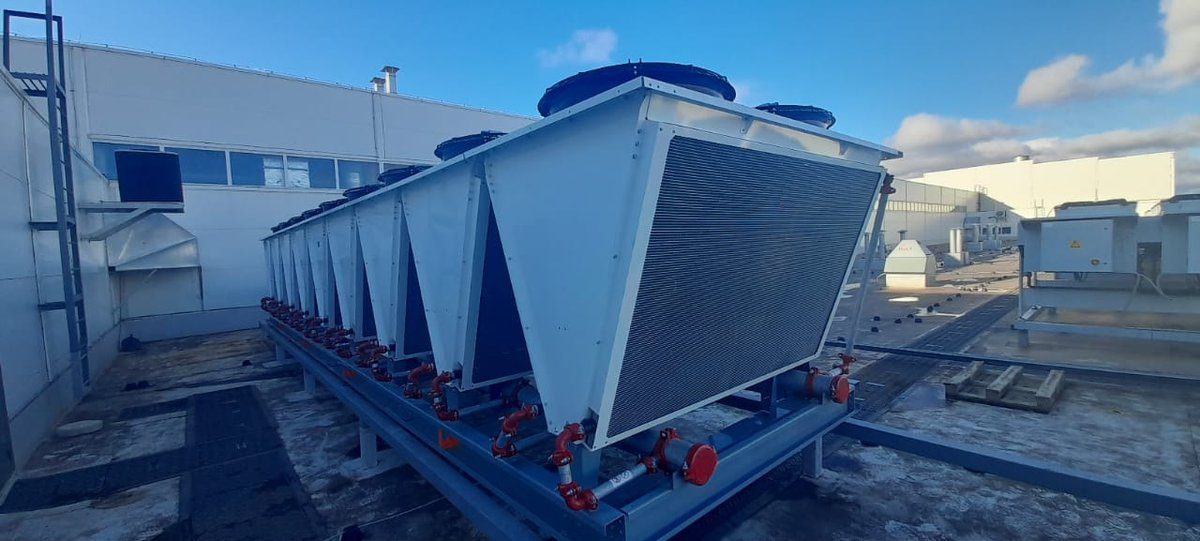
What is a dry cooler and how does it work?
The unit has four main parts: the casing, a galvanized steel frame, a finned water-to-air heat exchanger and axial fans. Hot fluid enters the heat exchanger, the fans drive outdoor air through the fins, the heat leaves with the air, and the cooled coolant returns to the equipment: a chiller, a machine tool or another consumer.
The fluid does not evaporate and does not come into contact with the atmosphere. That is why a dry cooler needs no make-up water, no blowdown and no chemical water treatment, and no dust or biological contamination gets into the circuit. This also sets the main limit: it cannot cool the fluid below the outdoor air temperature, however much surface area you add.
When to choose a dry cooler, and when a cooling tower or a chiller?
Choose a dry cooler when the fluid can be 3–5 °C or more warmer than the outdoor air; if it needs to be colder, choose an evaporative cooling tower or a chiller. A dry unit works from the dry-bulb temperature, that is, what an ordinary outdoor thermometer shows. An evaporative unit works from the wet-bulb temperature, the limit to which air can be cooled by evaporating water. On a hot day in central Russia the difference between the two reaches 7–10 °C.
An example for one summer day: dry bulb 30 °C, wet bulb 22 °C (textbook figures close to Moscow). A dry cooler will deliver fluid no colder than 33–35 °C, and in practice warmer. If the process needs it colder, a dry unit will not meet that point.
| Unit | Cooling limit | Water on site | When to choose |
|---|---|---|---|
| Dry cooler | dry bulb plus 3–5 °C or more | not needed | no make-up water, the circuit must stay clean, the coolant is glycol, hot fluid at 60–70 °C |
| Adiabatic dry cooler | in hot weather, between dry bulb and wet bulb | only in hot weather, treated | a dry unit is enough in winter and in the shoulder seasons but cannot handle the hottest hours |
| Closed-circuit cooling tower | wet bulb plus a few degrees | make-up, blowdown, water treatment | a clean circuit is needed and the fluid must be colder than a dry unit gives, and there is water on site |
| Open cooling tower | wet bulb plus a few degrees | make-up, blowdown, water treatment | the water may contact the air, recirculating cooling water system |
| Chiller | below the outdoor air and the wet bulb, for example chilled water 7/12 °C | depends on how the condenser is cooled | the process or air conditioning needs water colder than outdoors |
If water is available and the circuit allows contact with air, we first calculate an open cooling tower: in our experience it is noticeably cheaper. The difference between a cooling tower and a chiller is covered in the article "Chiller or cooling tower" (in Russian).
We will send the guide "Dry cooler, cooling tower or chiller" (selection in 3 steps by dry-bulb and wet-bulb temperature, a comparison matrix and three mistakes that cost millions of rubles) by email or Telegram: request it on the resource page.
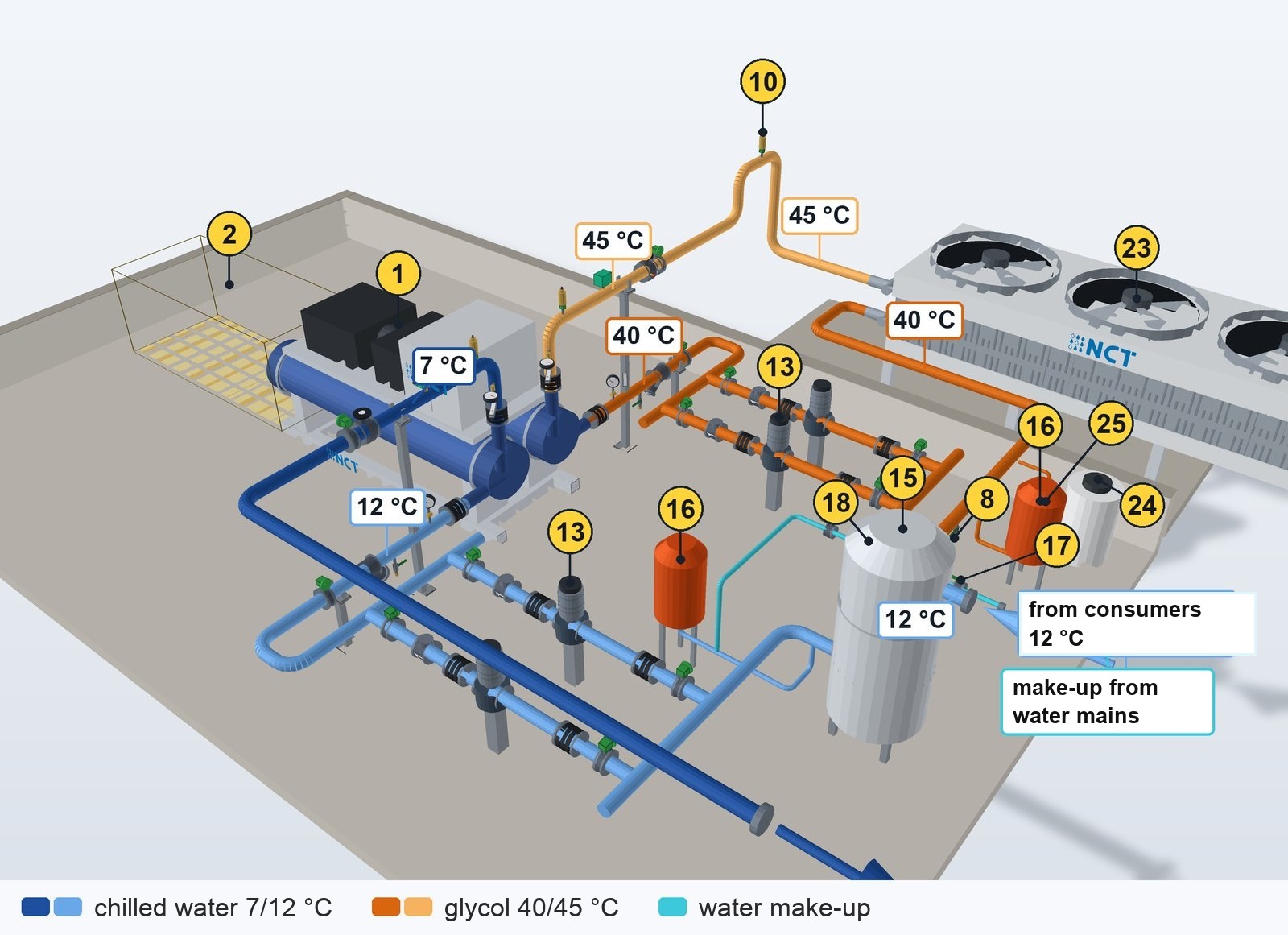
A dry cooler and a chiller often work together. In summer the dry cooler removes heat from the condenser of a water-cooled chiller, and in winter it can cool the circuit without the compressor. With chilled water at 7/12 °C and a combined approach of 7 °C for the dry cooler and the heat exchanger, partial free cooling (in Russian) starts below +5 °C and full free cooling below 0 °C. For process cooling there is another arrangement: the dry cooler goes first in the fluid flow and the chiller second, for trim cooling, and for most of the year the chiller is off or runs at a low stage. How these arrangements fit into a whole is shown on the "Cooling systems" page.
What are the pros and cons of a dry cooler?
The unit is dry, so it uses no water and does not contaminate the circuit, but it also cannot cool the fluid below the outdoor air.
| Pros | Cons and how we deal with them |
|---|---|
| No make-up water needed, no blowdown or chemical water treatment | The outlet fluid is 3–5 °C or more warmer than the outdoor air. If you need it colder, we add a chiller for trim cooling or use an evaporative cooling tower |
| The circuit is closed: dust, bacteria and salts do not get into the coolant | The closer the fluid must be to the air temperature, the larger the heat exchanger: cutting the difference from 10 to 6 °C almost doubles the surface area |
| Works on glycol and does not ice up in winter: there is no spray water | In hot hours the capacity drops as the air temperature rises. The margin comes from adiabatic cooling or from designing for hotter air |
| Cools hot fluids at 60–70 °C | For the same capacity the unit is larger than an evaporative cooling tower, so we check the footprint and the roof load in advance |
| Capacity is increased with modules, the design is simple | The fans make noise. We put the noise limit and the distance to the measuring point into the specification and add an acoustic screen if needed |
What types of NCT dry coolers are there, and when is adiabatic cooling needed?
We make DC dry coolers in three versions:
- Horizontal. The heat exchanger lies flat, the fans are on top. Installed on the ground or on a roof.
- V-type. Two heat exchangers at an angle and a row of fans on top: more surface per meter of length.
- Vertical. The heat exchanger stands upright, and the air flows horizontally. Suitable for narrow service driveways and spaces between buildings.
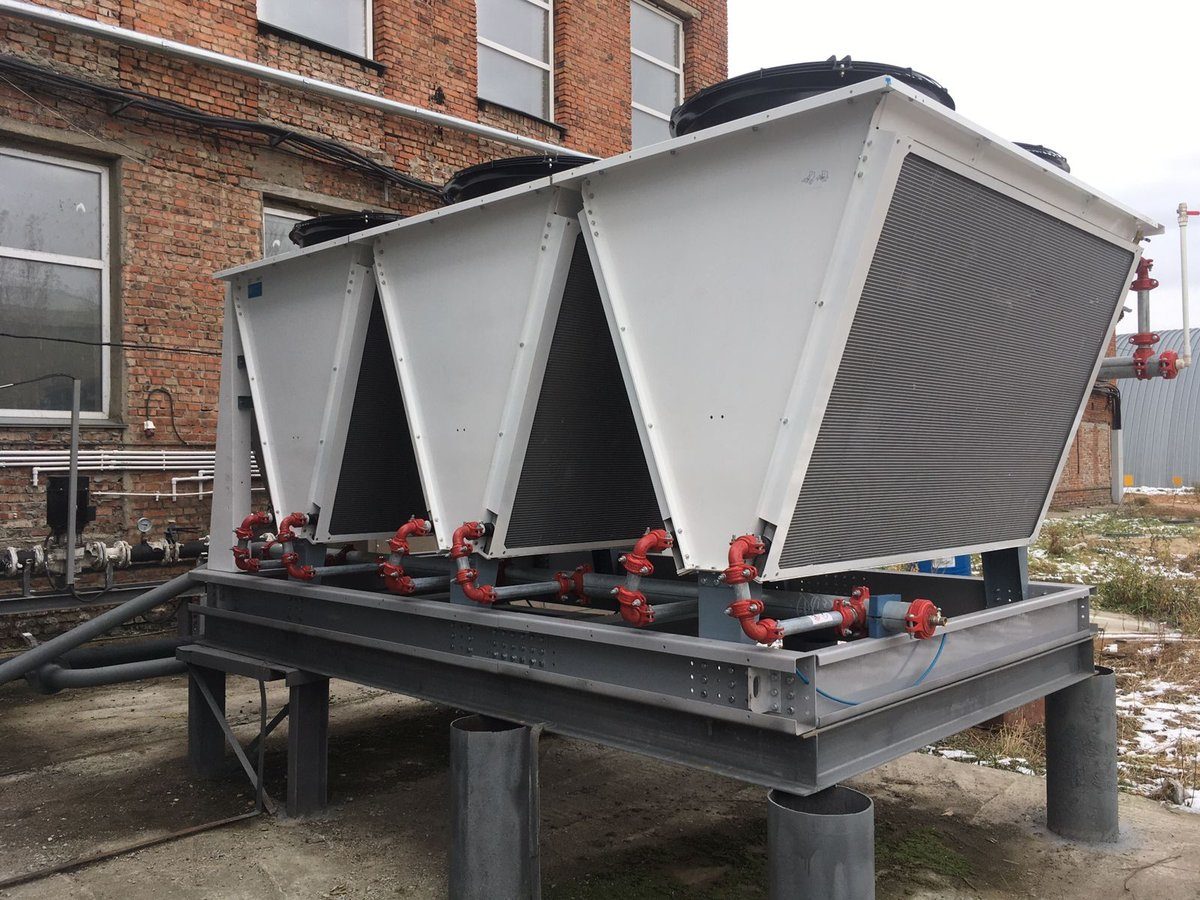
We choose the version to suit the site, and the system capacity can be increased: modules are added to a running installation. If growth is expected, we provide from the start headers with blanked-off branches, space, and shut-off valves for each heat exchanger.
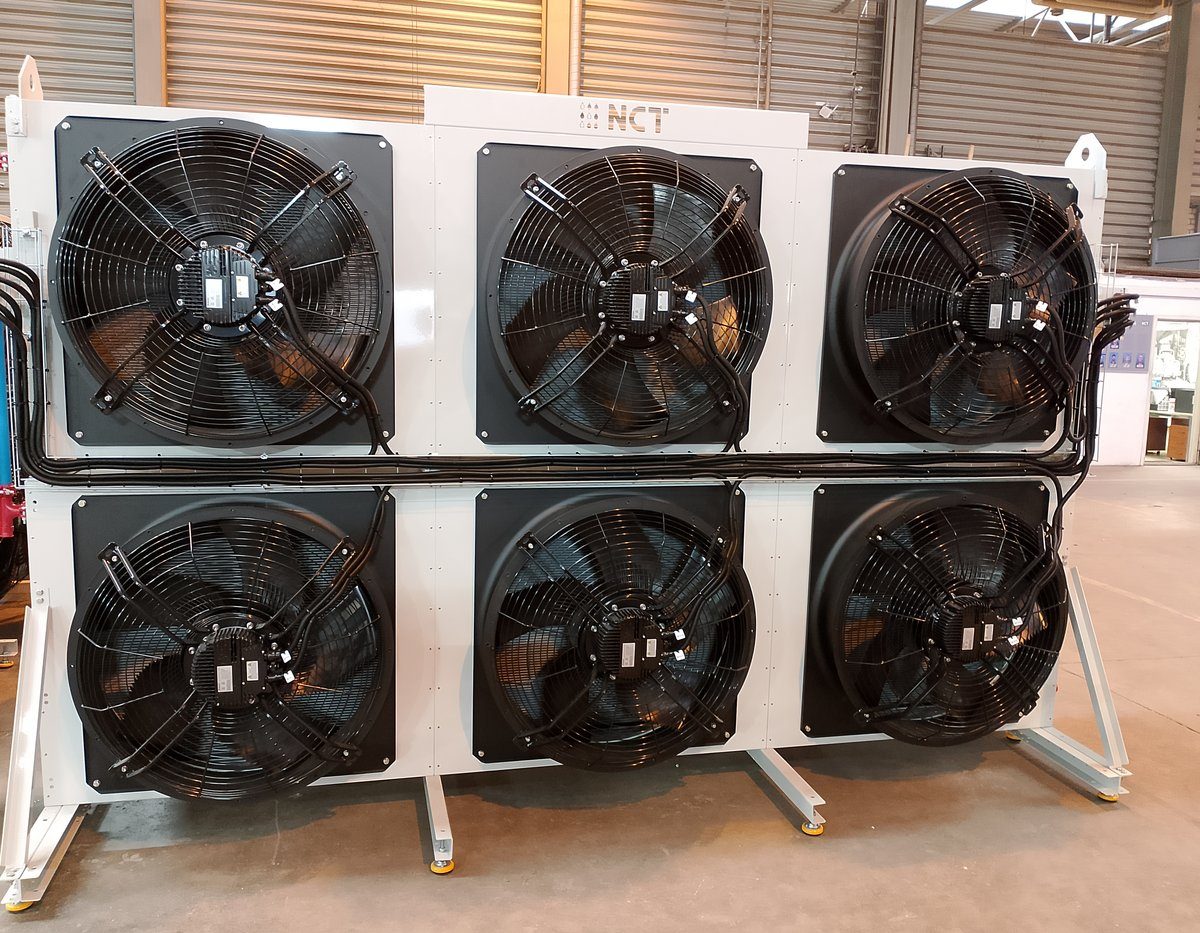
How does adiabatic cooling work?
An adiabatic dry cooler is the same unit with an inlet air humidification circuit. NCT uses a high-pressure system: a pump feeds water to the nozzles at 70–120 bar, and in front of the heat exchanger it is atomized into a mist with droplets smaller than 10 µm. The droplets evaporate in the airflow without wetting the fins, and the inlet air becomes colder: in the example from our leaflet, from +45 to +33 °C. The controls switch humidification on above a set outdoor temperature; in winter and in the shoulder seasons the unit runs dry.
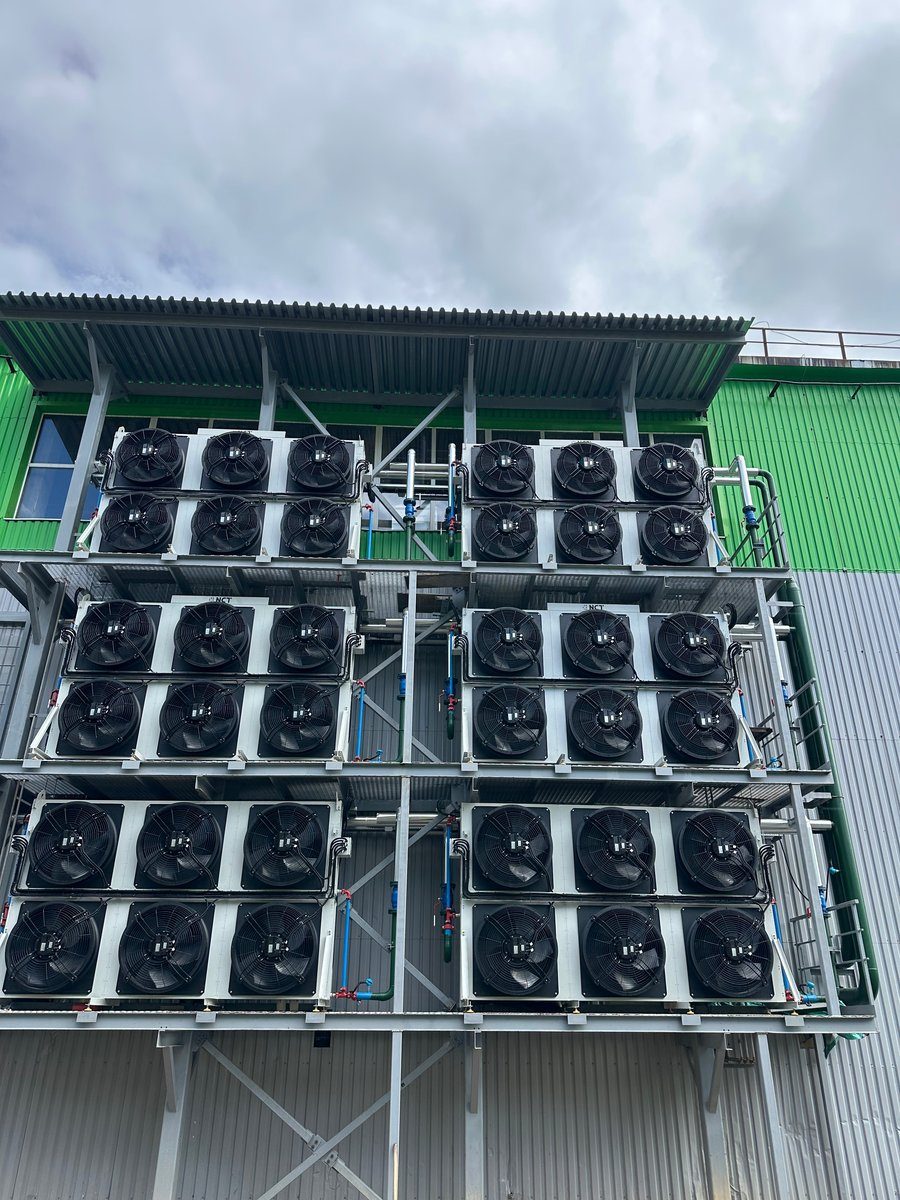
- How much the air temperature drops. By 5–15 °C depending on the climate. The limit is set by the wet bulb: in the design hot hour in Moscow the difference between dry bulb and wet bulb is 7.8 °C, so about 5 °C is realistic here, while 15 °C is for the dry, hot south.
- How much water. In our design example for 1,300 kW in the Moscow climate, it is 1.2 m³/h in the peak hour. If humidification is switched on above +28 °C (about 88 hours a year), the annual total is no more than 106 m³.
- What it gives. In Moscow and St. Petersburg, adiabatic cooling gives not annual savings but capacity and margin in the hottest hours. According to our data, the total energy consumption of the system in peak modes drops by up to 30 %.
- What to consider. We issue the water quality requirements and the nozzle pressure and flow together with the selection: salts from poor water settle on the fins and eat into capacity, and spraying water into the air creates an aerosol with its own sanitary issues. For winter, the nozzle line is drained.
For continuous processes we size the dry heat exchanger for the design temperature without adiabatic cooling and treat the adiabatic cooling as a margin. More details are in the article "Pros and cons of dry coolers with an adiabatic cooling system" (in Russian).
How does a dry cooler work in winter?
If the pump stops, water in the outdoor tubes can freeze and damage the coil. If the process requires water, a plate heat exchanger can separate the indoor water circuit from an outdoor glycol loop. Allow for the temperature difference across that exchanger when sizing the dry cooler. State the lowest site temperature and how long circulation may stop. The engineer uses these figures to select the glycol concentration and check the minimum fan start-up temperature against the fan data sheet.
- Control. Cold air cools more than needed, so a speed controller or a variable frequency drive reduces the fan speed, and some of the fans stop. The fluid temperature stays at the set point, and electricity consumption falls.
- Free cooling. Working with a chiller, in winter the dry cooler cools the circuit without the compressor: partial mode with chilled water at 7/12 °C starts below +5 °C, full mode below 0 °C. How many such hours there are in your city and how much this saves can be found in the free cooling calculator (in Russian).
- Adiabatic cooling. The nozzle line is drained for winter, and the unit runs dry.
- Glycol. Check the concentration annually. A solution rated for a lower temperature does not extend the operating range of the equipment. The standard fans listed below are rated down to −35 °C. Check the selected unit and its components for colder sites.
What does the customer get from an NCT dry cooler?
The main benefits of dry cooling for a site.
| Feature | What it gives | Benefit for the customer |
|---|---|---|
| Dry cooling | No make-up water needed | Savings on the water supply connection and on paying for water consumption |
| The cooled fluid is not contaminated | The fluid does not contact the outdoor air | Savings on heat exchangers |
Also:
- Glycol solutions can be cooled;
- Fluids above 60 °C can be cooled;
- No spray water, so no icing in winter;
- Simple installation and maintenance.
What are the specifications of NCT dry coolers?
The figures come from our catalogs and proposals. The selection sheet gives the actual values of the unit for your operating conditions.
| Parameter | Value |
|---|---|
| Cooling capacity | from 300 kW |
| Versions | horizontal, V-type, vertical |
| Coolant | water, ethylene glycol and propylene glycol solutions |
| Outlet fluid | 3–5 °C or more warmer than the outdoor air |
| Coolant temperature in the heat exchanger | from −35 to +80 °C |
| Outdoor air temperature for the fans | from −35 to +55 °C |
| Air leaving the heat exchanger | not above +55 °C, checked in the selection for hot fluids |
| Fans | axial, with a speed controller |
| Casing and frame | galvanized steel, protective polymer coating, color RAL 7040 or another on request |
| Warranty | up to 5 years, 10 years against perforation corrosion |
| Lead time | 10 weeks |
Included: wiring, fan speed controller, temperature sensors for each circuit, a control panel for installation in a climate-controlled room, anti-corrosion coating of the heat exchangers.
Options: control and protection panel, variable frequency drive for smooth fan control, emergency stop button, maintenance switches for each fan, vibration isolators, acoustic screen, shut-off valves for each heat exchanger, anti-vandal mesh, SCADA system with Modbus and Ethernet protocols, adiabatic circuit.
What data is needed to select a dry cooler?
- Heat load. If the unit serves a chiller condenser, we calculate the heat of condensation, not the cooling: with a coefficient of performance (COP) of 5, that is 1.2 kW per 1 kW of cooling. A unit selected "by the cooling" will turn out smaller than needed.
- Coolant. Water or glycol, type and concentration, mass flow, inlet and outlet temperatures.
- City and air. Temperature and humidity for summer, minimum temperature for winter, altitude above sea level, dust and salt in the air.
- Site. Ground or roof, limits on dimensions and weight, access for maintenance, the noise limit and the distance at which it is set.
- Electrical and options. Voltage, location of the panel, the options you need from the questionnaire.
How do you select a dry cooler for oil cooling?
Specify which fluid will flow through the dry cooler tubes. If a separate heat exchanger transfers heat from the oil to water or glycol, select the outdoor unit using the flow rate and inlet and outlet temperatures of that secondary circuit.
For oil flowing directly through the tubes, send the oil data sheet. Include the oil grade, viscosity at operating temperature and at cold start, flow rate, inlet and target outlet temperatures, design outdoor temperature and allowable pressure drop. Direct oil cooling requires a materials compatibility check and a pressure drop calculation for the specific model.
Which operating points should a test bench specification include?
For each test, list the heat load, fluid flow rate and dry cooler inlet and outlet temperatures. Specify the glycol concentration, design outdoor temperature and allowable pressure drop. For a V-bank unit, include a layout showing the available footprint and maintenance clearance. Each operating point needs a capacity and pressure drop check.
How can you estimate the capacity of a dry cooler yourself?
For water, the formula Q = G × 1.163 × Δt is enough, where Q is the capacity in kW, G is the flow in m³/h, and Δt is how much the fluid must be cooled, in °C. A textbook example: 50 m³/h of water from 40 to 35 °C is 50 × 1.163 × 5 ≈ 290 kW. Glycol has a lower heat capacity than water, so for the same capacity it needs a higher flow; the selection sheet gives the exact figure. For a chiller condenser, the heat of condensation goes into the formula, not the cooling (see above).
Two figures have the strongest effect on the size and price.
The first is how close to the air temperature the fluid needs to be. If this difference is cut from 10 to 6 °C, the heat exchanger grows almost twofold, and to 4 °C, fourfold. That is why we do not promise a dry cooler "2 degrees above outdoors".
The second is the design air temperature. For Moscow it is 26 °C under SP 131.13330 (Russian building code) and 29.9 °C under ASHRAE, and the absolute maximum is 38 °C. The difference between 26 and 30 °C is about a third of the surface area. For a process that must not stop, the design temperature is set by the process engineer, and we state in the specification what happens above it.
On a roof we also account for the discharge of neighboring machines: hot air that returns to the inlet goes almost entirely into the fluid temperature. As a guide, keep at least 1.2 m from a wall and between neighboring units.
Based on this data, we issue a selection sheet, basic technical solutions and piping diagrams free of charge, and we check the finished design section before the expert review.
Where are dry coolers used?
- Data centers. The dry cooler cools the condenser circuit and provides free cooling in winter, with no water consumption. For liquid cooling of servers, we also consider dry coolers with adiabatic cooling for the summer period. Solutions are on the "Data center cooling" page, and an overview of the approaches is in the webinar announcement (in Russian).
- Closed circuit. Where the coolant must be very clean, the dry cooler separates it from the atmosphere.
- Water shortage. Remote sites and facilities where a recirculating loop with an evaporative cooling tower cannot be arranged. If water is available after all, see our section on recirculating cooling water systems.
- Gas engines (gas engine generator sets) and lines with electric generators. The dry cooler is included in the cooling circuit of such equipment. If it pays more to turn the heat of a gas engine into cooling rather than dump it into the air, we calculate trigeneration (CCHP).
- Food production. A common arrangement is hybrid: in the cold months the dry cooler removes the heat, and the evaporative stage switches on only in hot weather. If the production allows only propylene glycol, we use it, and if there is a risk of it getting into the product, we separate the outdoor circuit with a plate heat exchanger.
- Chemicals and fertilizers. Circuits that must not mix with the atmosphere: petrochemicals, fertilizer production. More details are in the article on cooling chemical plants (in Russian).
- Mechanical engineering, compressors, hot fluids. Machine tools, automotive plants, compressors (in Russian), fluids at 60–70 °C.
If the tubes carry process gas, steam or a pressurized process product, it is a different unit: an air-cooled heat exchanger. We make air-cooled heat exchangers to order, based on the properties of the medium and a separate questionnaire. According to our leaflet, these are horizontal, zigzag, low-flow and delta-type units: the medium can be under pressure up to 32 MPa or under vacuum, the medium temperature up to 400 °C, climatic versions U1 and UKhL1 under GOST 15150, and sites with seismic intensity up to 7 points.
At which sites do NCT dry coolers operate?
- A paper mill (in Russian), Central Federal District. An NWSA53 chiller and a dry cooler cool variable frequency drives. In summer the dry cooler works as the chiller's condenser; in winter a three-way valve diverts the flow to its heat exchanger, and it cools the customer's water.
- MTZ Transmash plant (in Russian). An NCT unit cools the water in the recirculating cooling water system of the air compressors. According to the plant's feedback, the equipment meets the stated requirements and provides the design coolant temperature.
- Döhler food ingredients plant (in Russian), Lobnya. The chiller plant includes two dry cooling towers with plate heat exchangers; they run on free cooling.
According to our reference list, NCT dry coolers also operate at the following enterprises:
- oil and gas: equipment for oil production facilities (Perm Region), a drilling platform (Sakhalin Region);
- energy: a power company in Yakutia;
- chemicals: liquid pesticides (Tatarstan), nitrogen fertilizers and ammonia (Stavropol Territory), lubricants (Leningrad Region);
- metallurgy: aluminum production (Irkutsk Region);
- polymers and glass: polymer pipes (Omsk Region), a glass plant (Vologda Region);
- food industry: canned meat (Vladimir Region), mineral water (Kabardino-Balkarian Republic), confectionery production (Moscow Region, Tatarstan);
- data centers and telecoms: a data processing center (Moscow Region), a mobile network operator (Nizhny Novgorod Region);
- defense and government contracts: a defense enterprise (Arkhangelsk Region), a state enterprise (Novaya Zemlya);
- timber and machine building: a logging and woodworking company (Vologda Region), production of fitting platforms (Moscow Region);
- retail: a shopping center (Leningrad Region).
The geography runs from Yakutia and Novaya Zemlya to the south: a glycol dry cooler works where water outdoors would not survive the winter. Other projects are collected in the project catalog. If you need a similar example for your solution, including one with adiabatic cooling, write to us: we will check whether there is one in your region.
What is included in the work besides supplying the dry cooler?
Besides the unit, we build the whole system around it, and one company is responsible for all stages.
- Selection and design. Selection sheet, technical solutions, engineering design of building services.
- The system around the unit. Chillers, pump skids, a glycol circuit with a tank and solution make-up, control panels, SCADA. We also assemble all this into a turnkey chiller plant.
- Manufacturing. The plant in Sertolovo has been operating since 2015; we make the dry coolers ourselves and test them with aerodynamic and hydraulic tests before shipment. More details are on the "Equipment manufacturing" page.
- Installation and commissioning. Installation and installation supervision, startup on site.
- Service. Warranty and service maintenance of the systems we supply.
Cold Energy has been operating since 2011 and has completed more than 780 projects for more than 1,000 customers. General information on the versions is in the catalog on nc-t.ru (in Russian), while here we select the unit and the system for a specific site.
What information is needed to assess a damaged coil?
For an NCT dry cooler, send the model, serial number, a photo of the nameplate, a view of the whole unit and a close-up of the damage. These identify the original configuration so we can check whether a replacement coil is available. For another manufacturer's unit, include the technical data sheet and coil drawing so the engineer can check compatibility. Compare a coil replacement quote with one for a complete dry cooler. Include equipment, freight, removal, installation and downtime costs. If the coil cannot arrive by the planned shutdown, check whether the new unit can be delivered and installed in time.
How do you buy an NCT dry cooler?
- Request or questionnaire. Send us the load, the coolant, the city and the site: the list is in the section above.
- Selection sheet and proposal. We calculate the unit for your operating conditions and climate free of charge and propose the version and options, and if needed, variants with adiabatic cooling or with a chiller.
- Contract. We fix the operating conditions, warranty, lead times and scope of work: supply only, installation supervision or a turnkey system.
- Manufacturing and testing. 10 weeks at the plant in Sertolovo; aerodynamic and hydraulic tests before shipment.
- Installation and startup. The unit is set on legs or brackets; no separate unloading frame is needed, and the installation itself takes one day. Then commissioning and service.
How much does a dry cooler cost, and what are the lead times and warranty?
NCT dry coolers cost from RUB 500,000. The total depends on the capacity, the specified difference from the air temperature, the version, the fan type, the fin protection, adiabatic cooling and options. We calculate the exact price for your parameters.
The lead time is 10 weeks. The warranty is up to 5 years, and 10 years against perforation corrosion; the term and conditions are fixed in the contract. The quality management system is certified to ISO 9001:2015, and we hold Gazprom and Rosatom certificates (documents).
Selection and calculation are free: submit a request or call +7 (800) 333-49-96.
Frequently asked questions
A dry cooler is a simple thing, and Chinese suppliers quote several times cheaper, in stainless steel too. How come?
Often different units are being compared, although at small capacities the difference can be real. Ask them for a printout of the selection: design air, glycol type and concentration, noise, fan brand. On stainless steel, ask what exactly is made of it: the tubes, the fins or only the frame. Then ask about pressure testing of the heat exchanger, documents in Russian and who will come out if there is a leak. If the specification allows any unit and a shutdown is not a problem, the cheap option may be reasonable.
We want only a copper-aluminum heat exchanger. Why do you offer a microchannel one?
Because for your task it may turn out more compact and cheaper, but the decision is yours. There are two conditions: agree on the minimum operating temperature, and with spray water, check the water in advance; it is better to take samples before the contract. If copper and aluminum are written into the specification or your maintenance team is used to them, say so right away: we calculate to the specification, without pushing anything. Compare the options at the same operating point and with the same cleaning requirements.
Can the capacity be split between several dry coolers for redundancy?
Yes, this is a common solution. If one unit fails, part of the capacity remains, and the units can be serviced one at a time if each has its own isolation valves. We compare this with other redundancy schemes: a chiller with dry coolers, a chiller with free cooling, a chiller with a closed-circuit cooling tower. Decide in advance what percentage of cooling must remain in case of a failure and at what outdoor heat. The pumps also need redundancy: a standard NCT pump skid follows a 1+1 arrangement with automatic changeover.
Watch: dry coolers (in Russian)
Six dry coolers with adiabatic coolingLet us size a cooling system for your site
An engineer will select the equipment and send you a calculation. Free of charge, no obligation.