
NCT evaporative condensers
In brief. An NCT evaporative condenser rejects heat from the refrigerant by evaporating water and blowing air over the coil. The range runs from 250 to 3,500 kW on ammonia at a condensing temperature of 35 °C, with calculations also available for propane, butane, CO₂ and fluorocarbon refrigerants. Every unit is hydrotested for 24 hours; the warranty against perforation corrosion is 10 years.
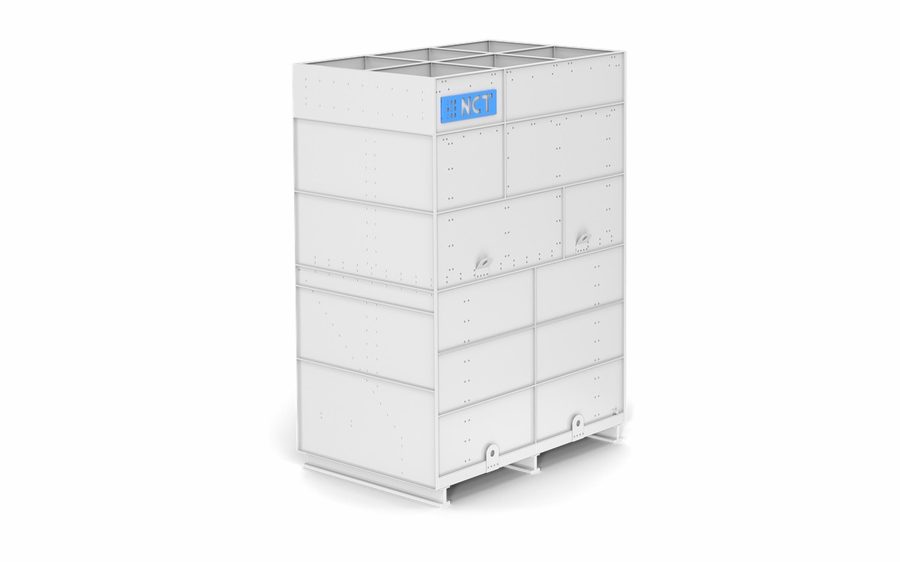
An evaporative condenser takes the place of an air-cooled condenser in a refrigeration plant. The refrigerant flows through the tubes, water is poured over them from above, and fans blow air through the section. Part of the water evaporates and carries the heat away. How it differs from a cooling tower is covered in a separate article (in Russian).
What series are there and how do they differ?
| Series | Fan | When to choose it |
|---|---|---|
| VRX | centrifugal, at the bottom | cold winters and installation close to a wall: the impeller sits outside the humid air stream, which lowers the risk of icing; high fan pressure |
| SVAX | axial, on top | best energy efficiency, mild climate: direct drive and minimal vibration |
| VAX | one shared axial fan | demand from 1 MW: the motor sits outside the humid air stream |
| HRX | centrifugal | compact solution up to 1 MW, width from 1,250 mm |
We select units in our own NCT Select program, taking refrigerant superheat into account. The series catalog is at nc-t.ru (in Russian).
Which refrigerants do they work with?
Ammonia R717, propane R290, butane, CO₂, and the fluorocarbons R22, R134a, R407C, R410A and R507A. The 250 to 3,500 kW range is stated for ammonia at a condensing temperature of 35 °C, outdoor air at 31 °C and 44% relative humidity, and a wet bulb of 22 °C. For other refrigerants we recalculate the capacity in the selection program.
How is the unit built?
- Casing. 2 mm hot-dip galvanized steel with powder coating on both sides, bolted assembly with sealant. There are no welds to act as rust starting points; the bolts are stainless steel.
- Heat exchanger. 26 × 1.5 mm hot-dip galvanized tube, bent on a machine with a minimum of welded joints. AISI 304 or AISI 316 on request.
- Water distribution and drift eliminators. HDPE pipes, "half-wave" drift eliminators with titanium dioxide.
- Testing. Every unit is hydrotested for 24 hours before shipment, and the heat exchange sections are shipped charged with nitrogen. At the customer's request we provide partial or full radiographic inspection recorded in the unit's passport, and the customer can attend factory tests: the basin is filled with water to check for leaks, and each fan motor is run for 15 minutes.
- Documents. ISO 9001:2015 quality management system. The heat exchange sections are certified to TR CU 032/2013 "On the safety of equipment operating under excess pressure": up to 4 MPa and up to 7.5 m³ volume, valid until 4 September 2027. The VRX, HRX and SVAX condensers are covered by a EAEU declaration under TR CU 004/2011, 010/2011 and 020/2011, valid until 14 April 2027. Seismic-resistant and explosion-proof versions are available.
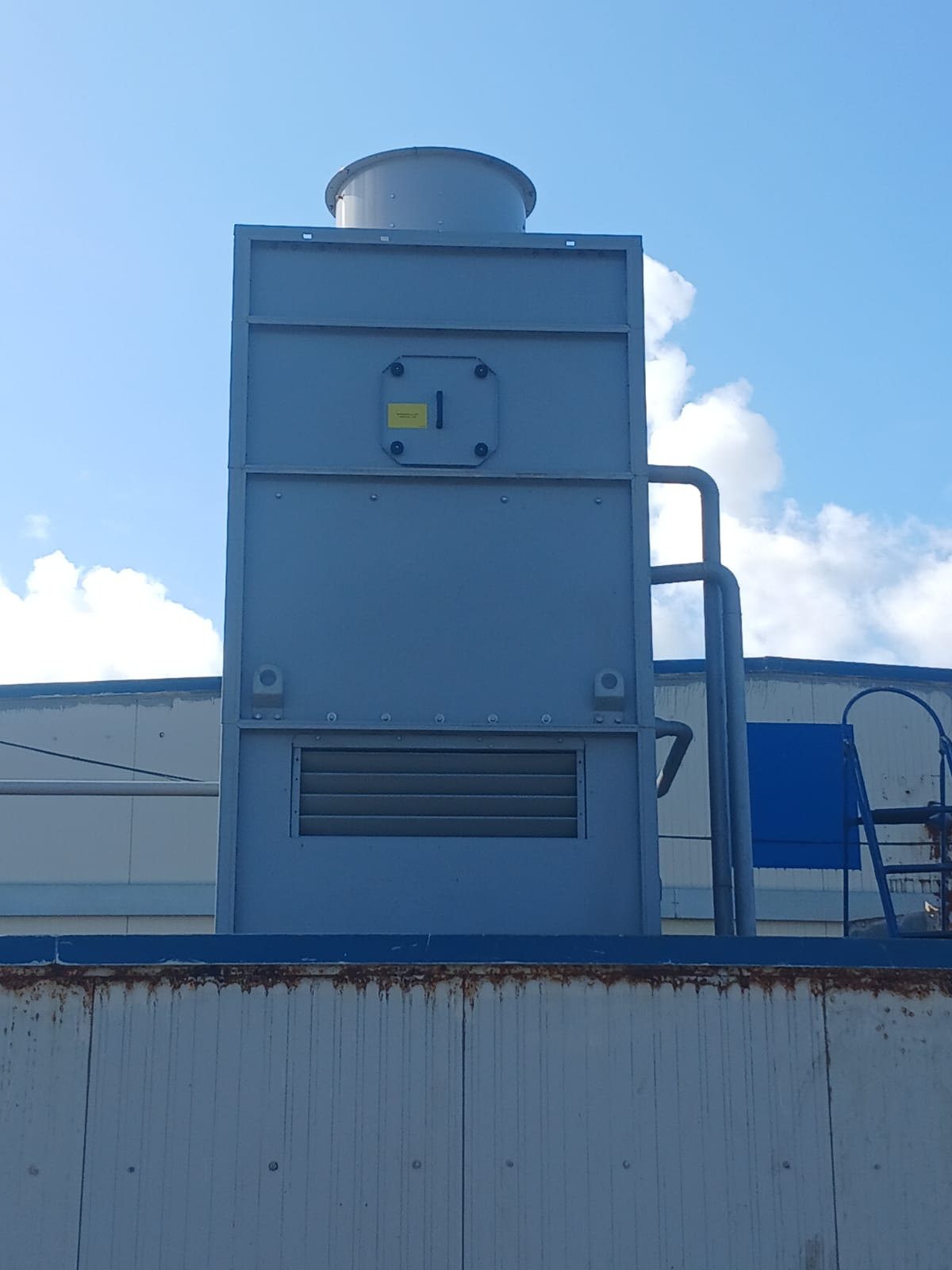
What the ammonia VRX configuration offers
| Design feature | What it does | Customer benefit |
|---|---|---|
| Bottom-mounted centrifugal fan | The impeller sits outside the humid exhaust air stream | Lower risk of impeller icing and associated winter downtime |
| High static pressure from the fan | The design can accommodate a deeper coil | A smaller footprint may be possible at the same heat rejection load, subject to selection |
| Single-side air intake | The air supply can be arranged on one side | More options for siting near a wall or indoors, with adequate clearances and exhaust air routing |
| Optional standby fan motor | The controller starts the standby motor if the main motor fails | The unit can keep cooling while the rest of the section remains operational |
| R717 units rated 250–3,500 kW at the catalogue rating point | Higher unit capacity can cover more of the required load | Fewer units and piping branches where the redundancy requirements allow |
| Optional finned desuperheater for discharge gas above 90 °C | It removes part of the superheat before the gas enters the sprayed coil | A lower load on the main coil, subject to selection |
| Optional AISI 304 or 316 stainless steel and basin coating | Materials can be specified for the water chemistry and site conditions | Reduced risk of corrosion-related repairs with the appropriate specification |
The catalogue rating point is 35 °C condensing temperature, 31 °C ambient dry-bulb temperature and 22 °C wet-bulb temperature. Verify performance and options for the actual duty.
Where do our condensers operate?
Examples, among many others:
- the AB InBev Efes brewery in Ivanovo: VRX2 ammonia condensers rated at 1,700 kW. In a letter of thanks dated 26 December 2025, the project contractor writes that the condenser reached the stated 1,700 kW at a wet bulb of 22 °C;
- the Syr Starodubsky cheese plant, Bryansk Region: two VRX1 ammonia condensers of 1,200 kW each. According to the plant's letter, condensing temperature and pressure held at the design values through the hot season.
How close to a wall can a condenser stand?
If the air intake side of a VRX unit up to 3.6 m long faces a wall, leave 2.1 m between them when the unit stands directly on the roof, 2.0 m on a 0.6 m support frame and 1.8 m on a frame of 0.9 m or higher. For 3.6 m wide models with the fan on one side, it is 2.4 m on the roof and 2.1 m on a frame. If each section of a VRX3 or VRX4 has a standby motor, leave 1.5–2 m between the sections to reach it.
What options can be ordered?
- Casing and heat exchanger in AISI 304 or AISI 316 stainless steel.
- Desuperheater for inlet vapor hotter than 90 °C: reduces plume and adds capacity in dry mode.
- A standby motor in each section with automatic switchover.
- 2 × 2 mm air intake screen against dust and poplar fluff.
- Polyurethane mastic coating for the basin in aggressive environments.
- Control panel with a variable frequency drive, a controller and an alarm log.
- Service platform with a ladder and railing.
How much does an evaporative condenser cost?
NCT evaporative condensers cost from RUB 1,500,000. The final price depends on capacity, refrigerant, condensing temperature, site climate and options. An exact price comes from a free calculation in NCT Select for your operating conditions. All items with prices are in the catalog (in Russian).
What is the warranty and how do you handle spare parts?
The warranty against perforation corrosion is 10 years. The standard equipment warranty is 12 months. It is extended to up to 5 years if we do the installation or installation supervision and commissioning and you sign a service contract with us for the same period. We keep key spare parts and consumables in stock in St. Petersburg: downtime of an ammonia plant often costs more than the condenser itself.
We supply, install and service the equipment ourselves: installation and service. Selection is free: send a request or call +7 (800) 333-49-96.
Frequently asked questions
Why does an air-cooled condenser fall short in summer while an evaporative one copes?
An air-cooled unit cools the refrigerant with dry air: in hot weather the condensing temperature rises and the compressor works harder. An evaporative unit cools down to the wet-bulb temperature, which is noticeably lower in hot weather. The price for this is water consumption and quality monitoring: without water treatment the tubes scale up.
Our old imported condenser has reached the end of its service life. Can you replace it with yours on the same site?
Yes, this is a common task since foreign suppliers left. For selection, send us:
- the refrigerant;
- the capacity;
- the condensing temperature;
- the dimensions and connection diagram of the old unit. If only the heat exchange section is being replaced, see heat exchangers for cooling towers and condensers.
What should a supplier show you before you can trust their condenser?
A calculation from the selection program for your operating conditions that accounts for refrigerant superheat, not a value from a table. Table capacity does not account for superheat, and at the summer peak the condenser may fall short of it. An emergency shutdown of an ammonia plant costs more than the savings on the purchase.
Our winters go down to −30 °C. Will we have to shut the condenser down and drain it?
No. In frost the spray is turned off and the condenser runs dry, on air alone. Two 1,630 kW VRX2 ammonia condensers for a potato processing plant being built in the Voronezh Region stop the spray below −5 °C. Order the bottom basin outlet: on shutdown the water then drains to an indoor tank on its own. Dry-mode capacity is calculated at the plant for your conditions.
Watch: evaporative condensers (in Russian)
NCT VRX evaporative condenser: all production stagesLet us size a cooling system for your site
An engineer will select the equipment and send you a calculation. Free of charge, no obligation.