
Fertilizer Production
In brief. At mineral fertilizer plants, a Thermax absorption chiller produces cooling from waste steam or hot water and cools granules, fluidized beds, compressor and gas turbine air, syngas and CO2. At a mineral fertilizer plant in Cherepovets, two absorption chillers with a total capacity of 3,766 kW run on waste steam.
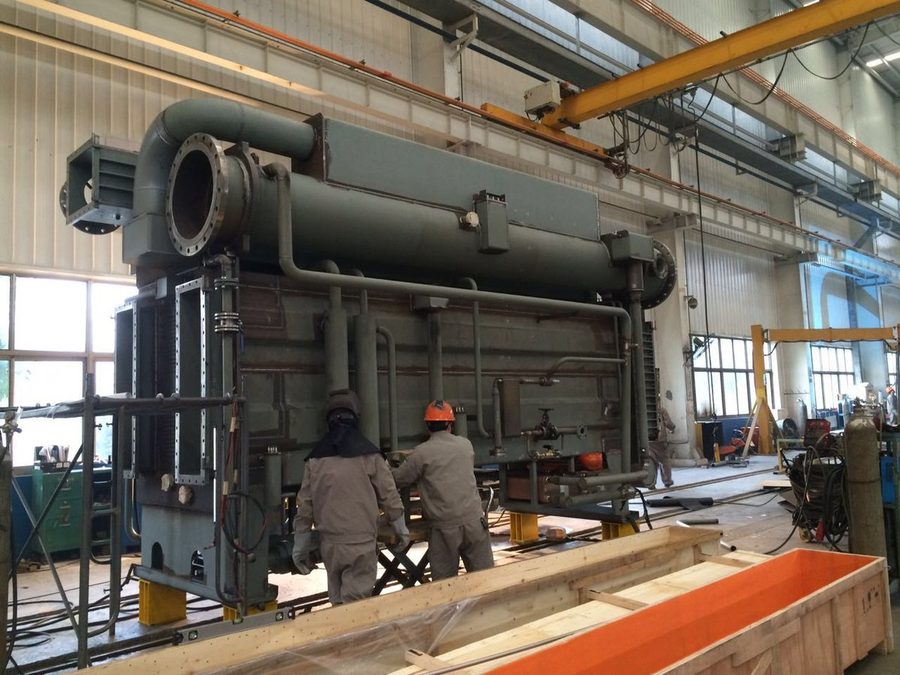
Mineral fertilizer plants consume a lot of cooling and at the same time have waste heat available: steam, hot water, exhaust gases. A lithium bromide absorption chiller turns this heat into cooling and improves production performance in the warm season. Worldwide, Thermax absorption chillers are widely used at such plants; in Russia, the first absorption chiller for mineral fertilizer production was introduced at a plant in Cherepovets.
Why does fertilizer production need cooling?
- cooling of mineral fertilizers and fluidized bed units;
- cooling of the intake air of air compressors;
- gas turbine inlet air cooling;
- syngas cooling;
- CO2 cooling.
Thanks to absorption chillers, production performance improves in the warm season.
What heat does an absorption chiller run on?
- hot water from a heating main;
- low- and high-pressure steam from a process or a boiler house;
- direct firing of fuel: diesel, gas and other types;
- exhaust gases from equipment.
Thermax machines can use several energy sources and combine them.
How does the system work, using the Cherepovets plant as an example?
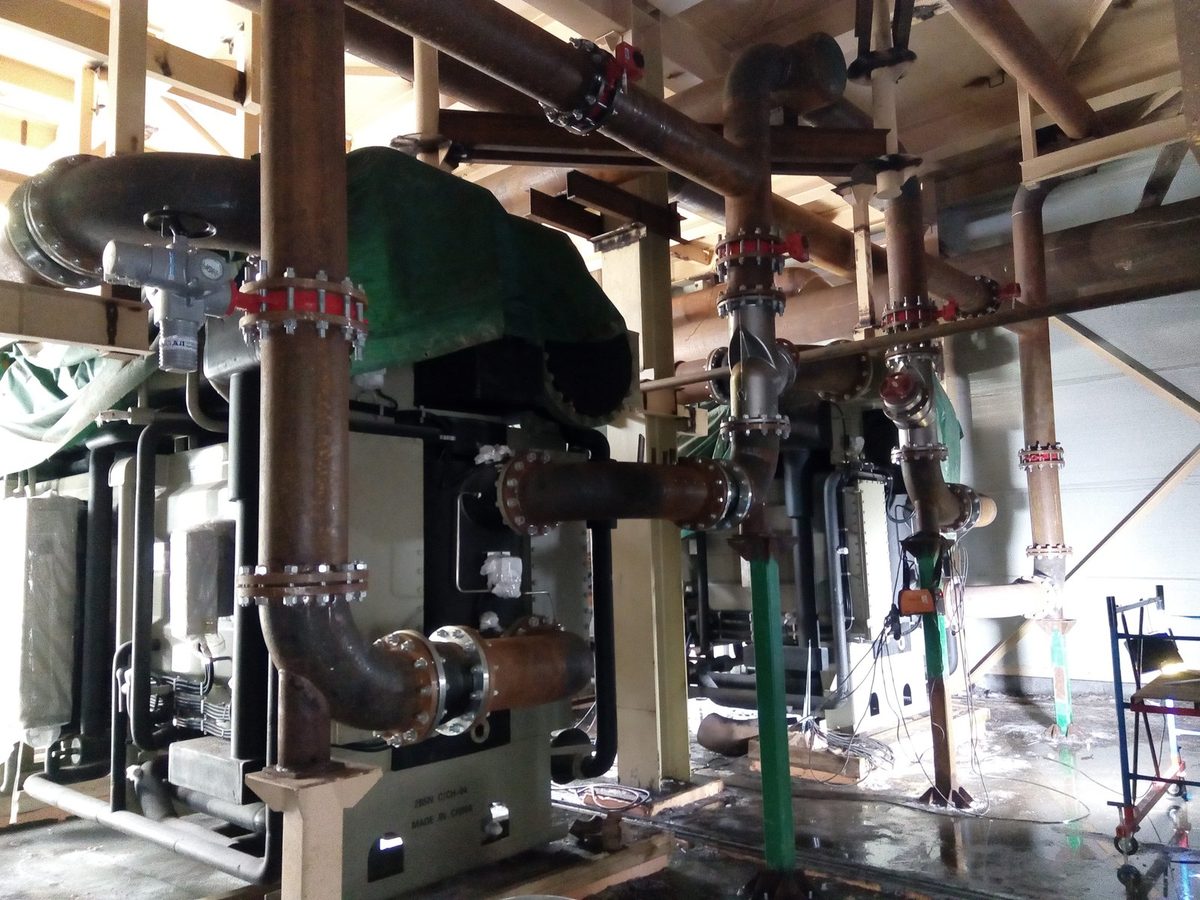
At a mineral fertilizer plant in Cherepovets, we carried out the design, supply, installation supervision and commissioning of an air cooling complex for mineral fertilizer production.
- Waste steam from production is fed to two Thermax 2B 5N C absorption chillers.
- The absorption chillers cool water from 10 to 5 °C; the total cooling capacity is 3,766 kW.
- The chilled water goes to air handling units with a total capacity of 360,000 m³/h of air.
- The cooled air is used in the process, for cooling fertilizer granules.
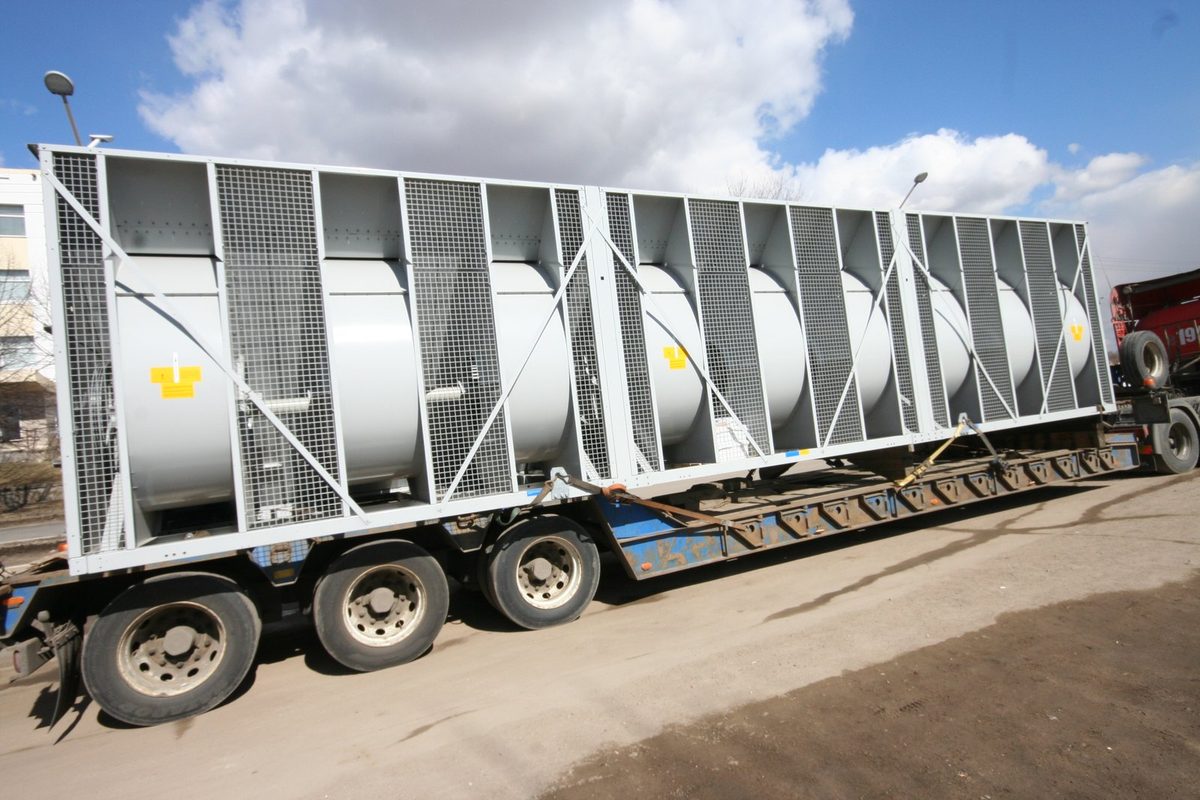
- The heat from the absorption chillers is rejected by a fan-assisted modular open cooling tower with three cells.
| Parameter | Value |
|---|---|
| Thermax absorption chillers | 2 units, model 2B 5N C, steam-driven |
| Total cooling capacity | 3,766 kW |
| Water temperature at the absorption chiller inlet/outlet | 10 / 5 °C |
| Air handling units | 360,000 m³/h of air |
| Additionally | cooling tower, pump skids, shut-off and control valves, tanks, control panels, instrumentation and controls |
The cooling goes to the fluidized bed units and the granule cooling drums: it rules out off-spec fertilizer caused by overheating. According to the plant's technical director and chief engineer, the chiller plant delivers better performance than specified in the design. More in the news item about the system's operation (in Russian).
Why are Thermax absorption chillers convenient for such plants?
Thermax machines are easy to adapt to the customer: for example, the tubes can be made of stainless steel instead of copper. At the Mikran plant (in Russian), absorption chiller tubes made of SS 430 Ti stainless steel ensured a machine service life of 25 years without major overhauls.
In 2015 our specialist spoke at the 3rd International Chemical Forum with a presentation on improving the energy efficiency of mineral fertilizer production with absorption cooling systems. More in the news item about the presentation (in Russian).
What equipment do we supply?
- Thermax absorption chillers driven by steam, hot water, exhaust gases and fuel; since 2011 we have been the official and exclusive representative of Thermax in Russia and the CIS.
- NCT cooling towers from our own production; for aggressive environments, with NCT Armour polymer coating.
- NCT dry coolers of our own manufacture, for closed circuits with no water consumption.
- Air handling units, pump skids, shut-off and control valves.
- Control panels, instrumentation and controls, and automation.
Which chemical industry projects have we completed?
- Mineral fertilizer plant (in Russian), Cherepovets: two Thermax absorption chillers running on waste steam, with a total capacity of 3,766 kW, for mineral fertilizer production.
- Petrochemical plant (in Russian), Bashkortostan: a 1,640 kW absorption chiller running on waste steam, water 12/6 °C. The goal of the project is fast payback through steam recovery.
- Petrochemical plant in Shymkent (in Russian), Kazakhstan: an NCT cooling tower of the SVA-2 type for cooling process water.
- Togliattiazot mineral fertilizer plant, Togliatti: NCT cooling towers for cooling process operations.
Selected projects are in the "Projects" section, and customer reviews are on the "Reviews" (in Russian) page. Solutions for a related industry are on the "Petrochemicals" page.
How does a project go?
- Engineer consultation and collection of input data on the process.
- Concept: we assess the waste heat sources and select a scheme.
- Technical specification, layout options and a feasibility study.
- Design, supply, installation supervision and commissioning.
The consultation, layout options and the feasibility study are free of charge.
Materials
- "Cooling system for a greenhouse complex" case study (PDF) (in Russian)
- The guide "5 industrial cooling schemes: cut cooling power use up to 10 times" can be sent to you by email or Telegram: request it on the guide page. The 1,000 kW task is calculated for the Cherepovets climate, including a scheme with an absorption chiller on waste steam.
Cooling system schemes
Typical schemes we use in this industry. The numbers on the scheme are piping elements; the key is under each scheme.
Steam-driven absorption chiller: cooling from waste heat
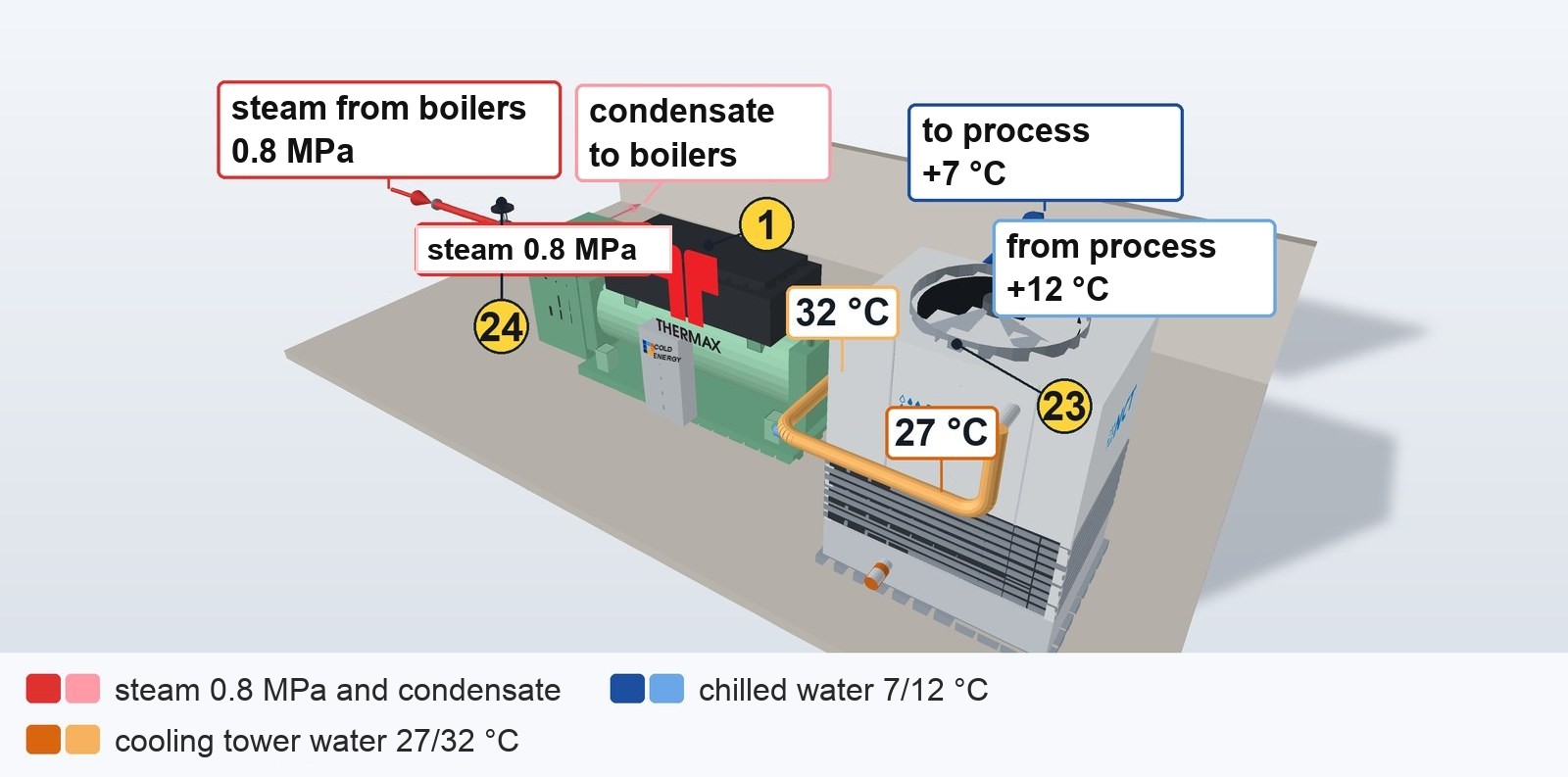
Steam heats the machine's generator, chilled water goes to the process, and the heat of absorption goes to the cooling tower.
Key to the numbers on the scheme
| No. | Element | Purpose |
|---|---|---|
| 1 | Steam-driven Thermax absorption chiller | steam heats the solution, and the machine delivers chilled water without a compressor |
| 23 | NCT cooling tower | rejects the heat of absorption: there is more of it than with a compressor machine of the same capacity |
| 24 | Steam control valve | meters the steam according to the load: the machine holds +7 °C at the outlet |
Open recirculating cooling loop
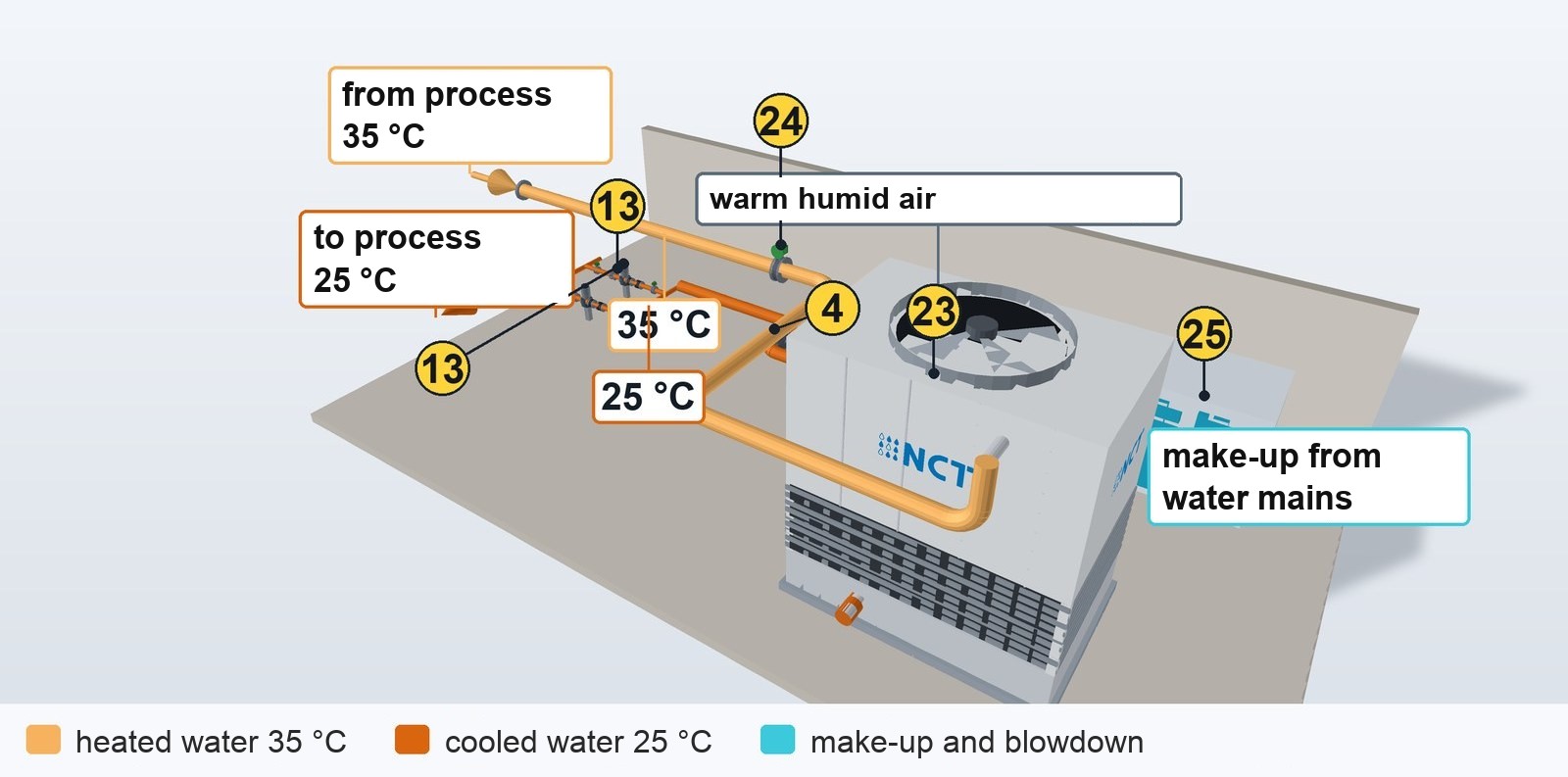
Heated water from the process is cooled in the cooling tower by evaporation and returns to the process; water is consumed only for makeup and blowdown.
Key to the numbers on the scheme
| No. | Element | Purpose |
|---|---|---|
| 3 | Butterfly valve | isolates the machine and pumps for repair and flushing; installed in pairs, at the inlet and the outlet |
| 4 | Y-strainer | catches scale and debris before the unit's tubes; at the INLET only |
| 5 | Flexible connector (vibration isolator) | right at the nozzle: dampens vibration and does not pass the weight and misalignment of the pipe on to the nozzle |
| 13 | In-line pump | circulates water through the loop; in pairs: duty + standby |
| 14 | Check valve | prevents water from flowing back through an idle pump |
| 23 | NCT open cooling tower | the water gives off heat to the air by evaporation: the cheapest way to reject megawatts |
| 24 | Butterfly valve on the supply line | isolates the cooling tower for repair without stopping the other cells |
| 25 | Water treatment and automatic blowdown | reverse osmosis or dosing: without it, scale eats up the heat transfer, and blowdown is done blindly |
Frequently asked questions
The machine runs only in the warm season. What should be done with it in winter and before the spring start-up?
In winter, preservation according to the manufacturer's instructions: without it, the idle period risks corrosion if there is not enough inhibitor or there is a micro-leak in the shell. In spring, first a solution analysis and a check of the valves, then a trial start under load at least two weeks before the hot weather. If a fault is found at the height of summer, there will be no time left for repairs. So the date of the trial start is put in the service plan in advance.
We have surplus steam. How far can the air at the turbocompressor intake be cooled?
Usually down to +15…+20 °C if the machine delivers water at +5…+10 °C: these are our figures for cooling the air upstream of gas turbines. The exact value depends on the humidity, the cooler surface and the allowable intake resistance, so we calculate it for your compressor. A gas-air mixture is considered separately: there are other safety requirements there.
At what steam pressure will the machine be single-stage, and at what pressure two-stage?
Low pressure gives a single-stage machine, about 0.7 kW of cooling per 1 kW of heat. At 4–9 bar a two-stage machine works, 1.30–1.45 kW, almost twice as much from the same ton of steam. Look at the pressure at the machine inlet, not in the boiler house. Waste steam has two more conditions: superheat of up to 10 °C is acceptable, above that a desuperheater is needed; 5% water in the steam means 4% less cooling and a damaged valve seat.
We will calculate the system for your site free of charge: submit a request or call +7 (800) 333-49-96.
Watch: absorption chillers (in Russian)
How Thermax absorption chillers workLet us size a cooling system for your site
An engineer will select the equipment and send you a calculation. Free of charge, no obligation.