
Chiller installation
In brief. We take on chiller installation in full: selection for the site climate, design, supply of an NCT chiller from our own plant, pad, piping, electrical, controls, commissioning and handover after integrated testing (usually 72 hours under load), then 24/7 service. Warranty on installation is 24 months; on the chiller, 12 months, up to 5 years with our installation and a service contract.
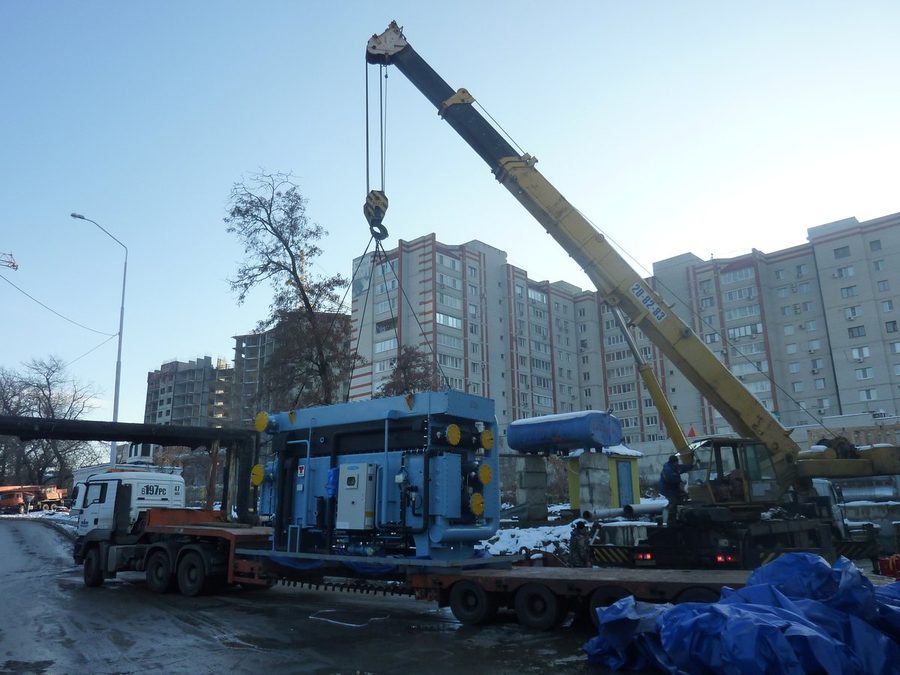
We carry out turnkey chiller installation from design to start-up and beyond, to service, and we alone are responsible for the result. We select the machine for the actual climate of the site, design the system, supply an NCT chiller from our own plant, install it with our own crews and hand it over after integrated testing, usually 72 hours under process load. One company is responsible for the design, the equipment and the start-up. The warranty on installation work is 24 months; on the chiller, the standard is 12 months, and up to 5 years if we do the installation or installation supervision and commissioning and you sign a service contract with us.
Chiller installation means a pad or frame, evaporator and condenser piping, electrical installation, controls and commissioning. The modular machine itself is set in place in 1–3 days, but the quality of the piping and tuning determines whether it delivers its rated capacity in hot weather.
What does the work include, and who is responsible for what?
| Stage | What we do | Result for the customer |
|---|---|---|
| Survey and selection | we look at the site and climate, the condenser type, the installation location and the rigging path | the machine is selected for the site's summer peak, not for an average +30 °C |
| Design | the Cooling and Automation sections are produced by our engineering center, which holds an SRO (self-regulatory organization) certificate and GOST ISO 9001 | piping and controls are calculated before installation starts |
| Manufacturing and supply | an NCT chiller comes from our plant factory-assembled, in one piece or in several blocks; it may be in stock, and if not, the lead time is 10–12 weeks; factory testing at the customer's request | lead times and spare parts straight from the manufacturer |
| Civil works | foundation or frame, steel structures, service platforms | the base is ready when the machine arrives |
| Piping | pipework to the evaporator and condenser, shut-off valves, filters, flow switch, insulation | the machine can be isolated, flushed and serviced |
| Electrical and controls | power supply, panels, cable routes; connection of the controller, sensors, pumps and signals to the control room | the chiller is visible and controlled from the control room |
| Commissioning and handover | hydraulic testing, tuning of controls, integrated testing, usually 72 hours under process load, bringing the system to design parameters | the system is handed over at operating parameters |
| Service | 24/7 maintenance, online monitoring | after start-up, the company that installed the system is the one responsible |
An NCT chiller comes factory-assembled: on site we bring the cable into the panel and connect the consumer pipes. We install with our own crews, to our own design.
Why one company instead of three contractors?
When the supplier, the designer and the installer are different companies, after a failed start-up each points at the others. A typical case: a chiller is selected for +30 °C but stands where it reaches +45 °C in summer, and in hot weather it delivers half its capacity. We design for the actual climate of the site and are responsible for the whole path: for example, for a food factory in the Rostov Region we designed, supplied, installed and started up a chiller (in Russian) for a 1,600 kW air conditioning system, rated for +44 °C.
- Our own plant. We have been making NCT (in Russian) chillers in Sertolovo since 2015, so lead times and spare parts do not depend on intermediaries, and the machine's dimensions can be matched to the openings at the factory.
- Thermax machines from the official representative. We supply and install Thermax absorption chillers as the official and exclusive representative of Thermax in Russia and the CIS since 2011.
- Handover after integrated testing, usually 72 hours under process load, not on the basis of connection alone.
- Track record. We have been working since 2011 and have completed more than 780 projects.
Where should a chiller be installed?
The location depends on the condenser type:
| Chiller type | Where we install it | What we consider during installation |
|---|---|---|
| Air-cooled packaged NASA, NARA | outdoors, on a pad or roof with free airflow | winter kit, glycol or draining of the outdoor circuit, roof load |
| Remote-condenser NCSA, NCRA | unit indoors, condenser on the roof | line up to 15 m without a separate calculation, oil return, GOST EN 378-2014 requirements for the room |
| Water-cooled NWSA, NWRA, NWCV | machine room and a pad for the cooling tower | water treatment, cooling tower winter mode, tube pull zones |
Around NASA packaged units and indoor NCSA units we leave at least 1.5 m on the control panel side and at least 1 m on the other sides. In a machine room we first mark out the tube pull zones for the evaporator and condenser and the rigging path, then set the equipment, and only at the end run the piping and cable routes. We place the refrigerant leak detector and the emergency exhaust intake low down: the vapors of common refrigerants are heavier than air.
How to pipe a chiller correctly?
At the evaporator inlet and outlet we install a pair of butterfly valves to isolate the machine for repair and flushing. The flow switch prevents the compressor from starting without water and protects the evaporator from freezing. Sensors, filters and balancing valves are covered with removable insulation, not sealed in: otherwise they cannot be serviced. We use only inhibited glycol approved for heat exchangers and select the pump with a correction for it: with 40% propylene glycol, the pressure drop across the evaporator rises almost 1.8 times.
A closed circuit must have a diaphragm expansion tank: when the coolant heats up, the tank absorbs the excess volume, and when it cools down, returns it. Without a tank, expansion threatens to burst joints, and when the coolant shrinks, the pump runs underfilled and fails. A scheme with an open intermediate tank is simpler, but contact with air makes it corrode faster, so we use calcium chloride brine only in a closed circuit. Tank schemes are also used for cold storage that covers peaks, for example at dairy plants during the morning and evening milking.
The atlas of cooling system schemes (32 schemes with full piping on 46 pages, from an open cooling tower to an absorption heat pump) is available by email or Telegram: get it on the resource page.
How do we install in difficult conditions?
Large refrigeration machines do not always fit through openings in one piece. If an NCT chiller does not fit through a doorway or corridor, we supply it dismantled and assemble it inside: our machines have a bent, bolted frame, not a welded one, and the dimensions can be designed to match the width of the openings at the factory. Among many other examples:
- at the Triumph Plaza shopping and entertainment center (in Russian), the Thermax absorption chiller was dismantled at the factory, lifted by crane to the 12th floor in parts, assembled and started up;
- in the building of the Central Customs Administration (in Russian), the machines were brought into the basement in parts through narrow passages;
- for the ATI plant (in Russian), we installed a NASA packaged chiller with a winter kit in an unheated workshop and carried out commissioning.
Frequently asked questions
How many days in advance should we call your specialists for commissioning, and what must be ready when they arrive?
As early as possible: we agree on the date based on the service team's workload, and the most start-ups happen before summer. For a water-cooled chiller with a cooling tower we come once, because they have to be checked together. By the time we arrive, you need a stable power supply, water in the circuit, the design flow rates, a heat load and above-zero temperatures in the rooms. Power outages during start-up are dangerous for the equipment, so we record such events in a letter, with dates. Specify in advance what stock of spare parts you want to receive at start-up.
Why does installation cost this much? Others quote two and a half times less. Is installation 10% of the equipment cost or 30%?
There is no such percentage: the price depends on the plant, the length of the piping run, the tie-in with the existing system and whether structures are needed. Put the two estimates side by side and compare the lines: crane and rigging, steel structures, insulation, controls, testing. See who is responsible for reaching the temperature. If a difference remains, we will go through the estimate together, and we may turn out to be more expensive. We do not estimate installation from a video: a site visit is needed for the calculation.
We have our own installer. Can we remove installation supervision and commissioning from the price to stay within budget?
We do the installation ourselves, but if you want your own installer to do it, installation supervision can be removed. Keep chiller commissioning in the scope of work. Without tuning, the machine will not reach its parameters, and if the chiller arrived without a factory refrigerant charge, the refrigerant is charged precisely at this stage. Keep the warranty in mind too: we give the extended chiller warranty, up to 5 years, when we carry out the installation or the installation supervision and commissioning and a service contract is signed with us; otherwise the standard 12 months applies. Without installation supervision, your installer is responsible for the piping, and mistakes will surface in the finished system. The price of installation supervision depends on its duration: the trip takes from one to eight weeks, so with an experienced installer try to shorten the period first.
During pressure testing of a system installed by our contractor, the pressure drops. Who sorts it out: the contractor or the supplier?
First the installer and the customer find the leak, and only then is it clear whose case it is. More often it is an installation joint that leaks rather than the factory piping, and then the installer fixes it. If the leak is in a factory assembly, the supplier decides after an inspection. Photograph the spot, note the serial number and send them to the service team. Do not charge the system until it has been tested again.
At start-up the flow does not reach the design value. Is the pump too small or is the chiller to blame?
First check the filters: sometimes they were not flushed and checked after testing, although cleaning the filter elements is part of pipeline testing under SP 73.13330.2016 (Russian building code). Next we look at the dirt separator, air in the circuit and the position of the balancing valves, then the pressure drop across the evaporator. Specify flushing in the installer's scope in writing in advance: then it is clear who fixes it.
We want to put the chiller inside the workshop so the installation is not outdoors. Will a packaged unit work?
An air-cooled packaged unit is cheaper and more compact, but inside a building it needs ventilation: the condenser heat has to go somewhere. If it cannot be released into the workshop, we use a remote-condenser chiller, with the unit indoors and the condenser on the roof, or a water-cooled chiller with a cooling tower. Which option is cheaper to install becomes clear after a site survey.
Installation is part of our turnkey services, and after start-up the machine is maintained by our chiller repair service (in Russian). We will calculate the scope of work free of charge: submit a request or call +7 (800) 333-49-96.
Watch: chillers (in Russian)
Chiller set: project walkthroughLet us size a cooling system for your site
An engineer will select the equipment and send you a calculation. Free of charge, no obligation.