
Other Solutions
In brief. If a facility has waste steam, hot water or exhaust gases, they can be turned into cooling in Thermax absorption chillers. We use this for heat recovery, for cooling in fertilizer production and for reducing the power consumption of vapor-compression chillers.
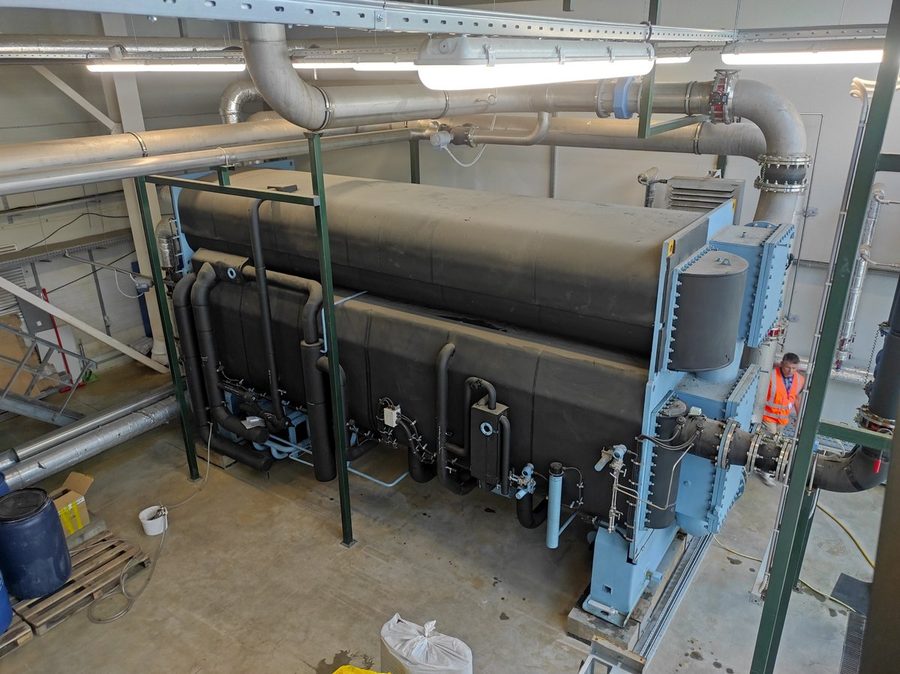
Besides industry solutions, we build systems united by one idea: cooling is produced from heat that the facility already has and that usually goes to waste. This is done with Thermax lithium bromide absorption chillers, which run on steam, hot water, exhaust gases or natural gas rather than electricity.
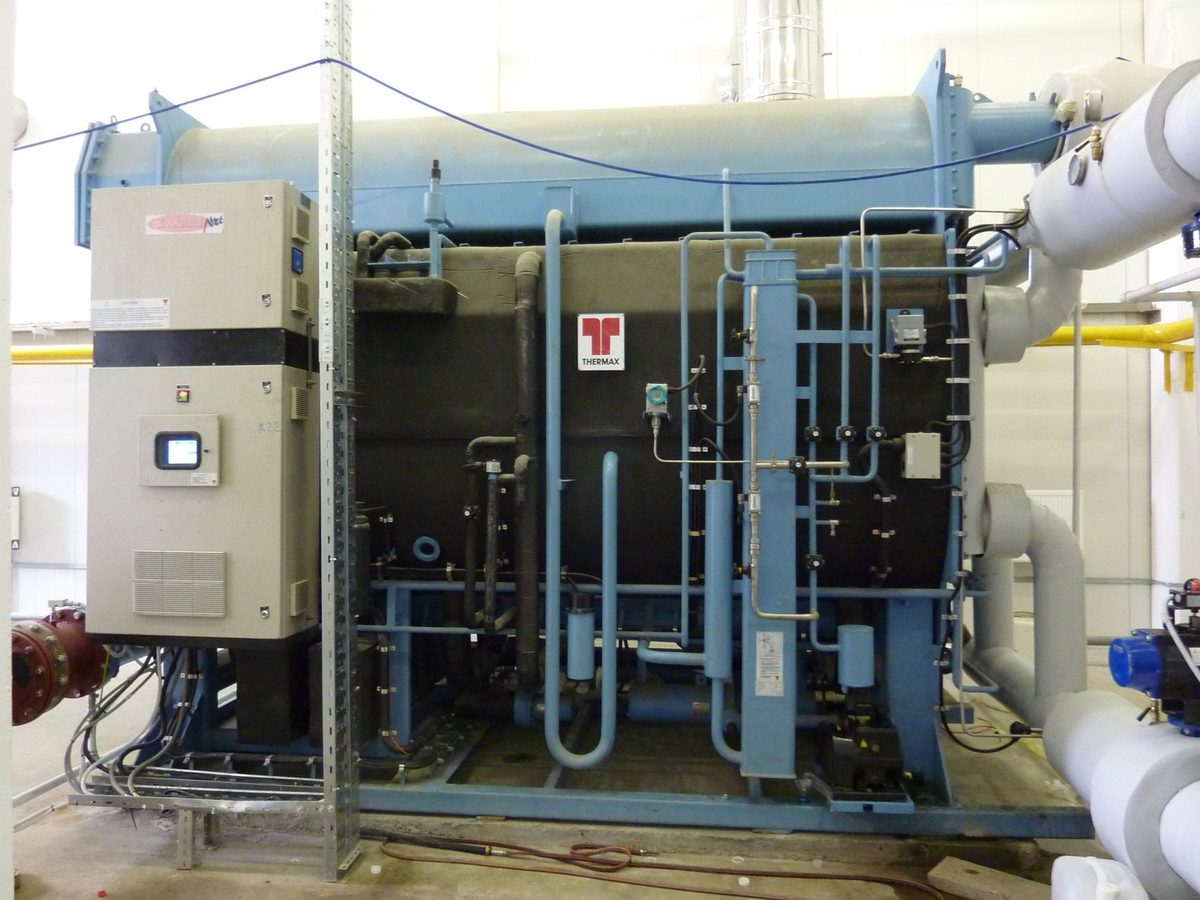
What problems do we solve?
Why turn waste heat into cooling?
Many plants have steam from a boiler house, waste process steam or hot water that has nowhere to go in summer. An absorption chiller turns this heat into chilled water for air conditioning or process needs. Almost no electricity is consumed, and the payback period is short.
Examples:
- Petrochemical plant (in Russian), Bashkortostan: SS 40A-CU absorption chiller on waste steam, 1,640 kW, water 12/6 °C. The project pays back quickly thanks to steam recovery.
- Uralkhimplast plant (in Russian), Nizhny Tagil: Thermax 2B 3M C absorption chiller on steam from a boiler house, 1,250 kW, for industrial air conditioning. The waste heat source keeps the payback period to a minimum.
- Woodworking complex in Apsheronsk (in Russian), Krasnodar Territory: a 1.5 MW Thermax 2B 4L C absorption chiller runs on steam from boilers that burn sawdust and cools the resin production equipment.
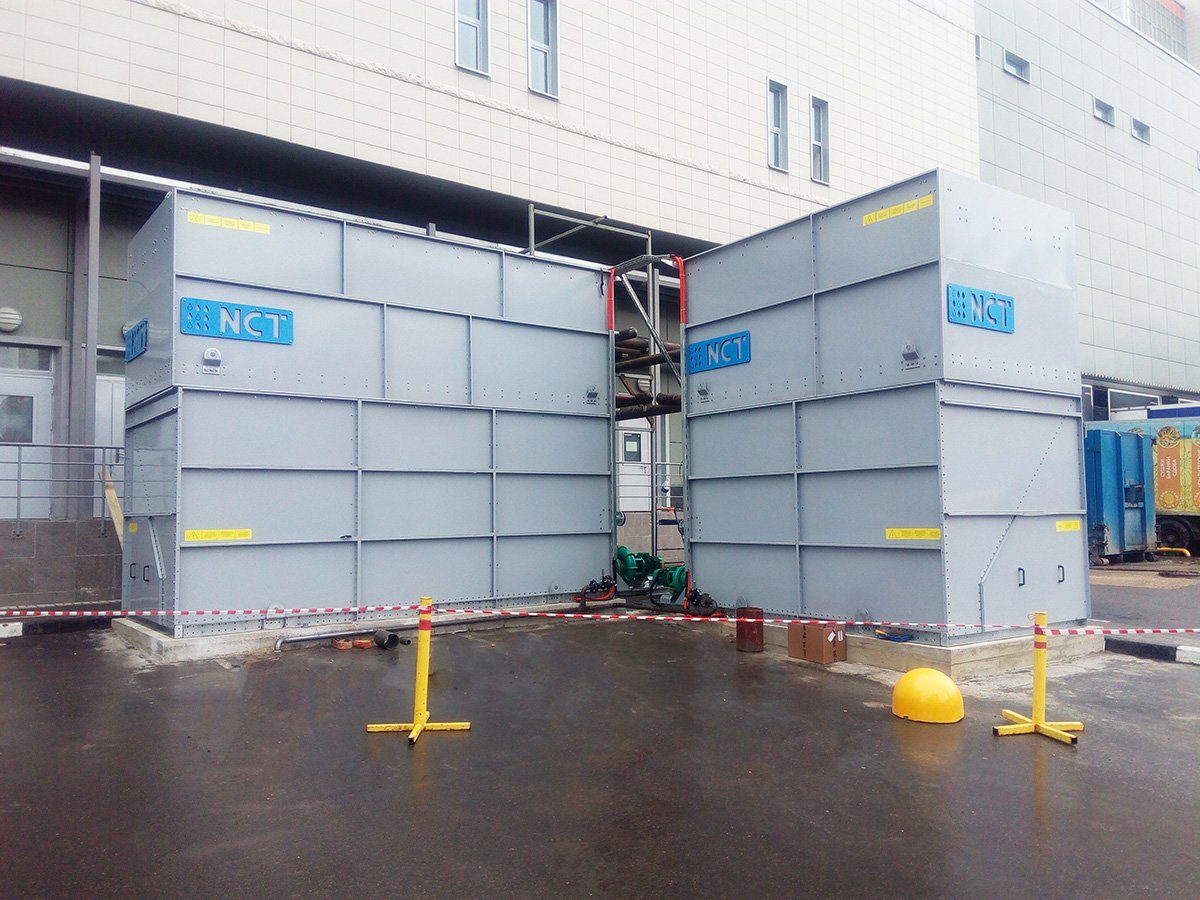
- Khrom leather production, Yaroslavl: a 360 kW Thermax TAC S1 N2 absorption chiller on steam from a boiler house cools the leather production process, and an NCT VR0 cooling tower carries its heat away.
How does an absorption chiller work in fertilizer production?
At a mineral fertilizer plant in Cherepovets (in Russian), absorption chillers running on waste heat improve production performance in the warm season. The machines are used in the process of making mineral fertilizers.
| Equipment | Parameters |
|---|---|
| 2 Thermax 2B 5N C absorption chillers on water steam | total cooling capacity 3,766 kW, water 10/5 °C |
| Cooling tower | fan-assisted, block-modular, with centrifugal fans |
| Supply air handling units | total air flow 360,000 m³/h |
| Piping | pump skids, shut-off and control valves, tanks, switchgear, instrumentation and controls |
We designed the system and supplied the equipment.
How do you get cooling from hot water?
Absorption chillers on hot water are installed where there is a boiler house, a cogeneration unit or waste heat boilers. In summer the heat is not dumped but used for air conditioning.
- Triumph Plaza shopping and entertainment complex (in Russian), Obninsk: Thermax 5G 5K C absorption chiller on hot water for central air conditioning of the complex.
- Maskarad shopping and entertainment center (in Russian), Stary Oskol: LT 16C absorption chiller on hot water from a boiler house that runs year-round.
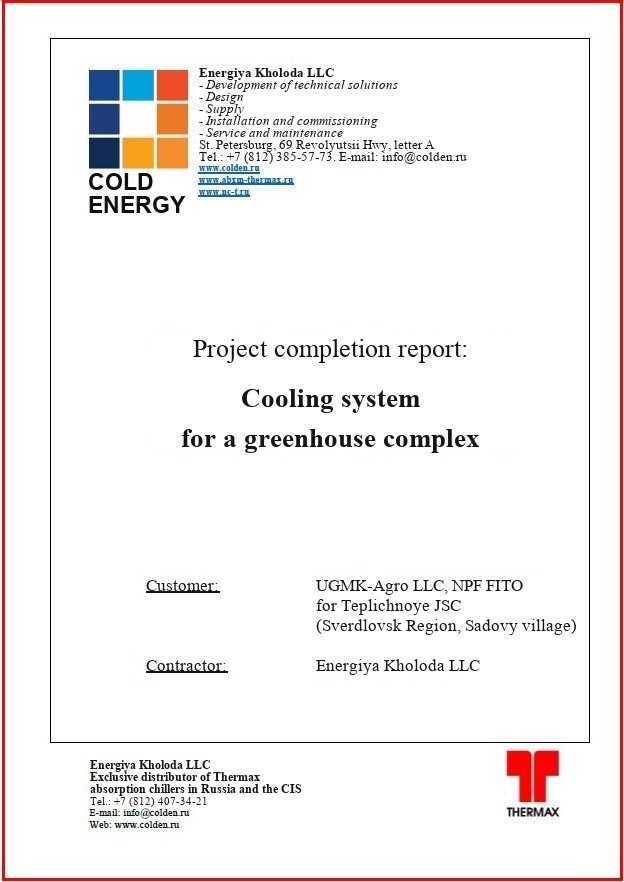
- Teplichnoye JSC greenhouse complex (in Russian): two LT 12 C absorption chillers of 400 kW each on waste hot water from gas engines and a boiler house, water 8.5/3.5 °C. This is the first trigeneration (CCHP) system for a greenhouse complex in Russia, with energy efficiency of up to 92% and a payback period of 5 years.
- Office and warehouse complex of the Indigo technology park, Moscow Region: a 200 kW Thermax LT 5 absorption chiller runs on waste hot water from the process, with an open cooling tower and NCT W2C water treatment.
How do you reduce chiller power consumption?
With a hybrid plant: an absorption chiller works together with a vapor-compression refrigeration machine. The evaporator of the absorption chiller serves as the condenser for the vapor-compression machine, so the condensing temperature of the refrigerant drops and the compressor consumes less electricity.
The scheme works both with direct expansion of the refrigerant and with an intermediate coolant at temperatures below −5 °C. The lower the required temperature, the more noticeable the gain.
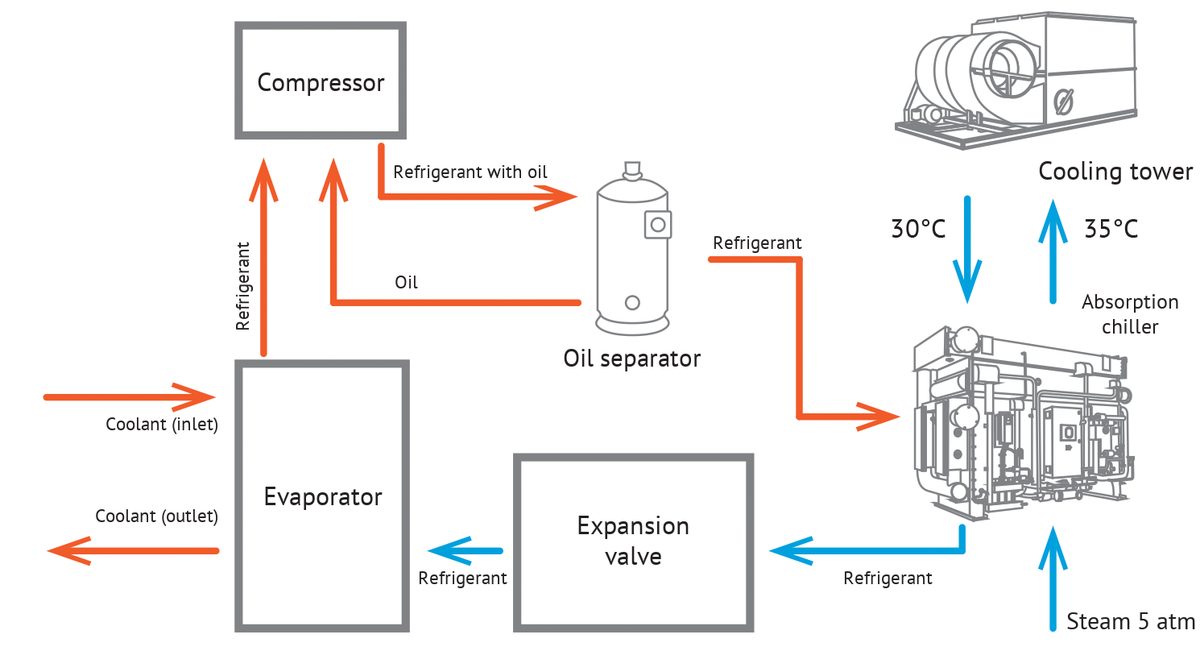
A hybrid plant makes economic sense if:
- the facility is short of electricity;
- there is a waste or cheap heat source.
The detailed scheme is on the "Food processing" page.
How does a project go?
- Engineer consultation: what heat sources the facility has and how much cooling is needed.
- Concept: absorption chiller type and connection scheme.
- Technical specification, layout options and feasibility study.
- Design, supply, installation supervision and commissioning.
The guide "Absorption Chiller or Electric Chiller" goes out by email or via Telegram: economics for 1,000 kW of cooling (on cheap heat the absorption system costs RUB 1.66 million a year to run versus RUB 2.68 million for an electric chiller), a three-step selection memo and seven common doubts over absorption chillers: get it on the resource page.
The consultation, layout options and feasibility study are free. All industry areas are on the "Solutions" page, and all projects are in the "Projects" section.
Cooling schemes
Typical schemes we use in this industry. The numbers on the diagram are the piping components; the key is under each diagram.
NCT closed-circuit cooling tower, cutaway view
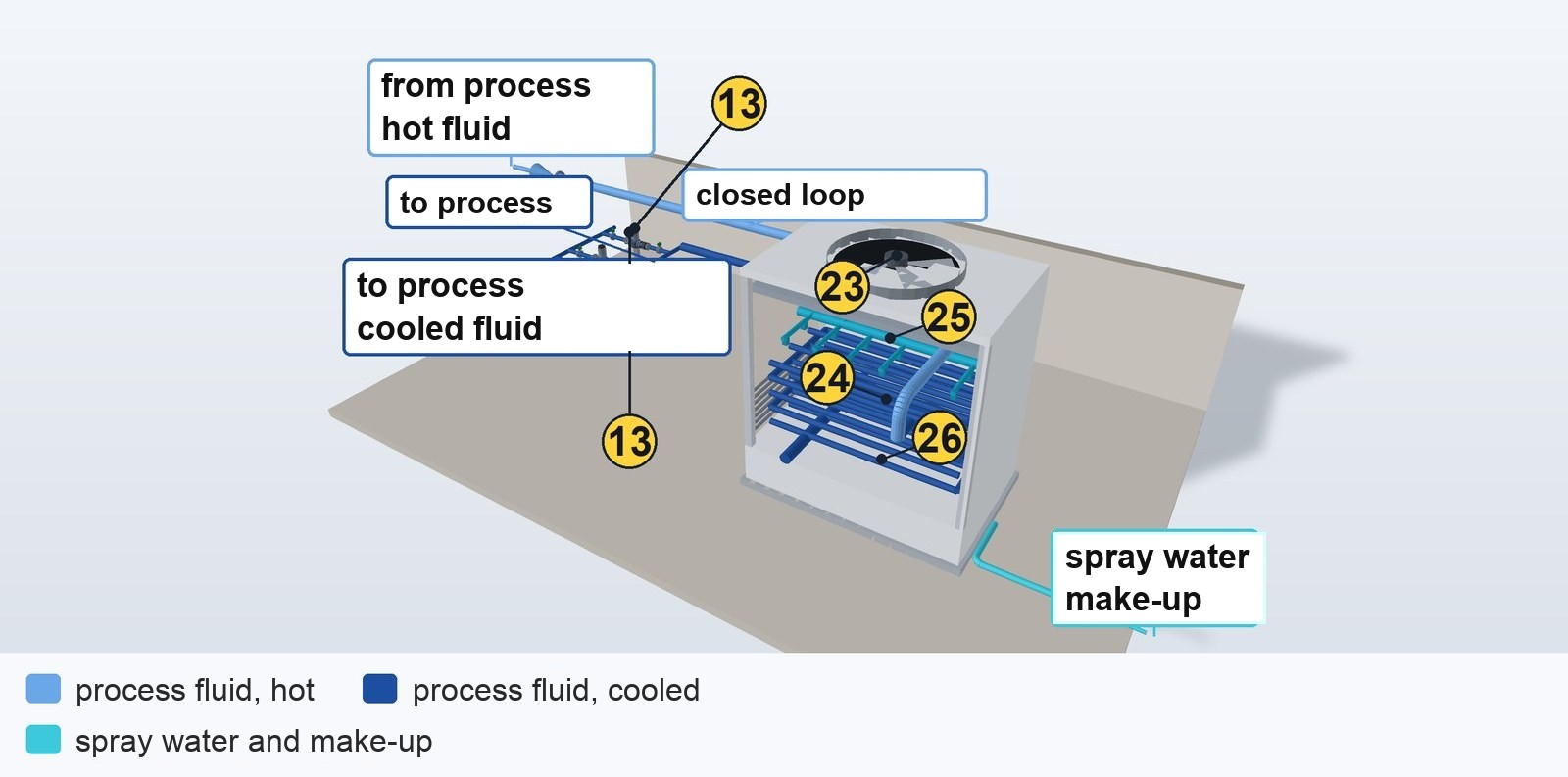
The process fluid flows inside the coil and the spray water outside it: the circuit stays clean and no heat transfer fluid is lost.
Key to the numbers on the diagram
| No. | Component | Purpose |
|---|---|---|
| 3 | Butterfly valve | isolates the machine and pumps for repair and flushing; installed in pairs, inlet and outlet |
| 5 | Flexible connector (vibration isolator) | right at the nozzle: damps vibration, does not transfer the pipe's weight and misalignment to the nozzle |
| 13 | In-line pump | circulates water through the circuit; in a pair, duty + standby |
| 14 | Check valve | prevents water from flowing back through the idle pump |
| 23 | NCT e-VRC series closed-circuit cooling tower | the casing is shown cut away to reveal the inside |
| 24 | Coil: process fluid inside the tubes | it does not contact the air, is not lost to evaporation and does not get contaminated |
| 25 | Spray over the outside of the coil | water pours onto the tubes and evaporates, carrying heat away: this is a separate circuit, and it is the one that is consumed |
| 26 | Spray water basin | only this water needs make-up, blowdown and water treatment |
Hybrid scheme: dry in winter, wet in summer
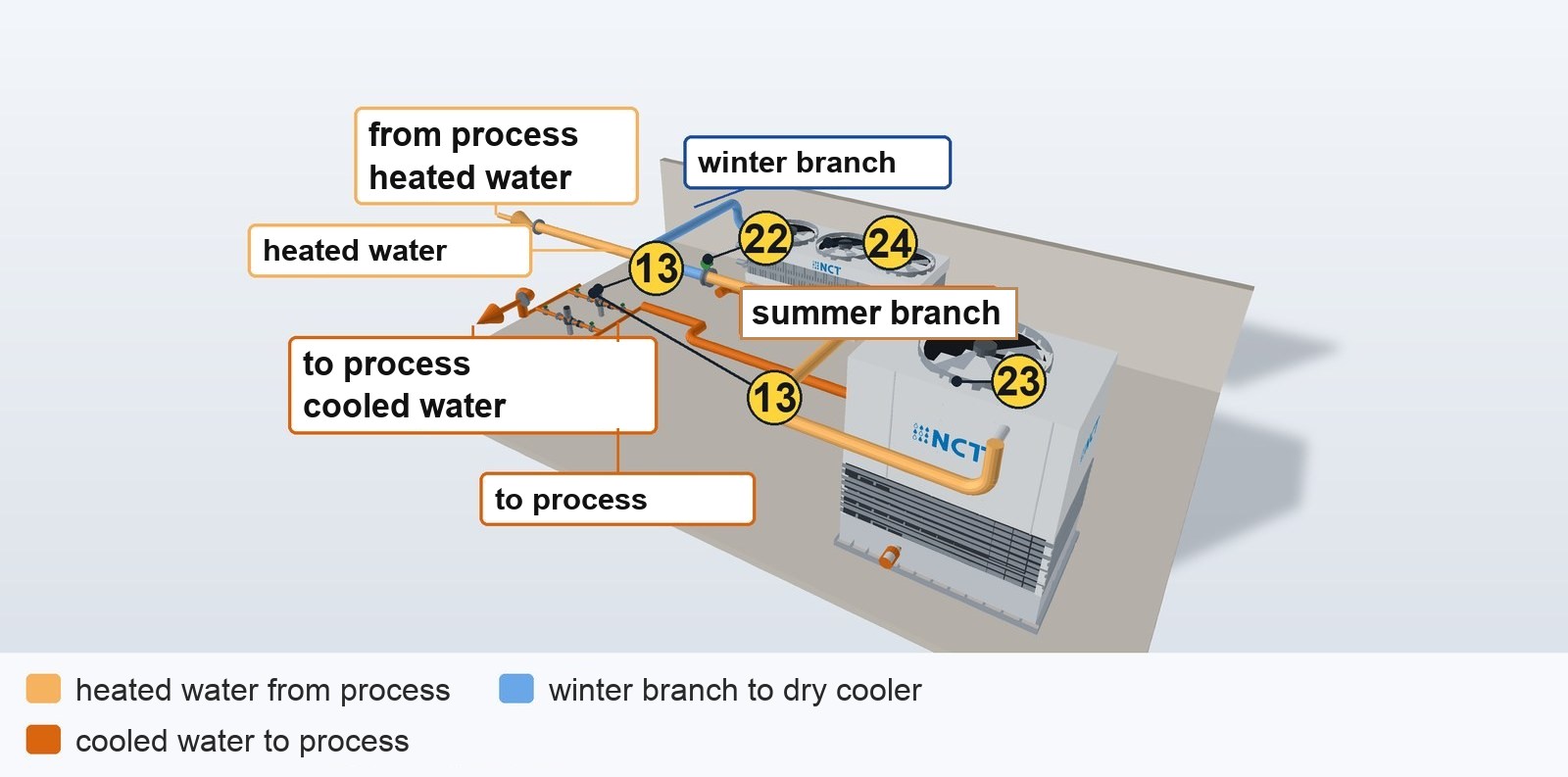
In the cold months the dry cooler removes the heat and no water is consumed; the evaporative stage switches on only in hot weather.
Key to the numbers on the diagram
| No. | Component | Purpose |
|---|---|---|
| 3 | Butterfly valve | isolates the machine and pumps for repair and flushing; installed in pairs, inlet and outlet |
| 5 | Flexible connector (vibration isolator) | right at the nozzle: damps vibration, does not transfer the pipe's weight and misalignment to the nozzle |
| 13 | In-line pump | circulates water through the circuit; in a pair, duty + standby |
| 14 | Check valve | prevents water from flowing back through the idle pump |
| 22 | Cooling tower three-way bypass valve | sends part of the water past the cooling tower so the water to the machine is not overcooled (for absorption chillers, a crystallization risk) |
| 23 | NCT cooling tower, summer stage | switches on when dry cooling is no longer enough |
| 24 | NCT dry cooler, dry stage | runs without water: no blowdown, no chemicals, no freezing |
Frequently asked questions
How much cooling do you get from 1 MW of heat?
From 0.7 to 1.45 MW, depending on the heat source. Hot water and a single-effect machine give about 0.7–0.8 MW. Steam at 4–9 bar or gas and a double-effect machine give 1.30–1.45 MW. That is why the coefficients are only compared for the same type of heat. There is also a downside: a single-effect machine rejects about 2.45 kW to the cooling tower per 1 kW of cooling, while a chiller with a COP of 5 rejects only 1.2 kW.
The design calls for five chillers. Can they be replaced with a pair of absorption chillers on gas or hot water?
Yes, but this is a new calculation, not an edit to the specification. Two machines instead of five mean that if one fails, half of the cooling is lost, so the redundancy has to be reconsidered. The cooling towers and their water circuit will get bigger. Gas or hot water is chosen by price and availability: a gas-fired machine gives almost twice as much cooling per unit of heat, but it needs a flue and a room that meets boiler house codes. Often one chiller is kept alongside.
Do the solution and water in an absorption chiller need to be replaced periodically?
No, that is a myth. Lithium bromide and deionized water are charged for the entire service life; only the lithium molybdate-based inhibitor is topped up. The solution has to be replaced only after gross violations of the operating instructions. It is monitored constantly: the service team takes samples twice a year for 10 parameters and, if the solution is contaminated, prescribes filtration with a magnetic filter. Acid is not poured into the machine during maintenance: that is exactly what damages it.
We will calculate a system for your facility free of charge: submit a request or call +7 (800) 333-49-96.
Let us size a cooling system for your site
An engineer will select the equipment and send you a calculation. Free of charge, no obligation.