
Data center cooling: a turnkey cooling system for a data center
In brief. We remove heat from server halls around the clock and lower PUE with NCT free-cooling chillers and dry coolers with N+1 or 2N redundancy; where waste heat is available, Thermax absorption chillers produce cooling with almost no electricity, and a 5 MW plant pays back from 1 year.
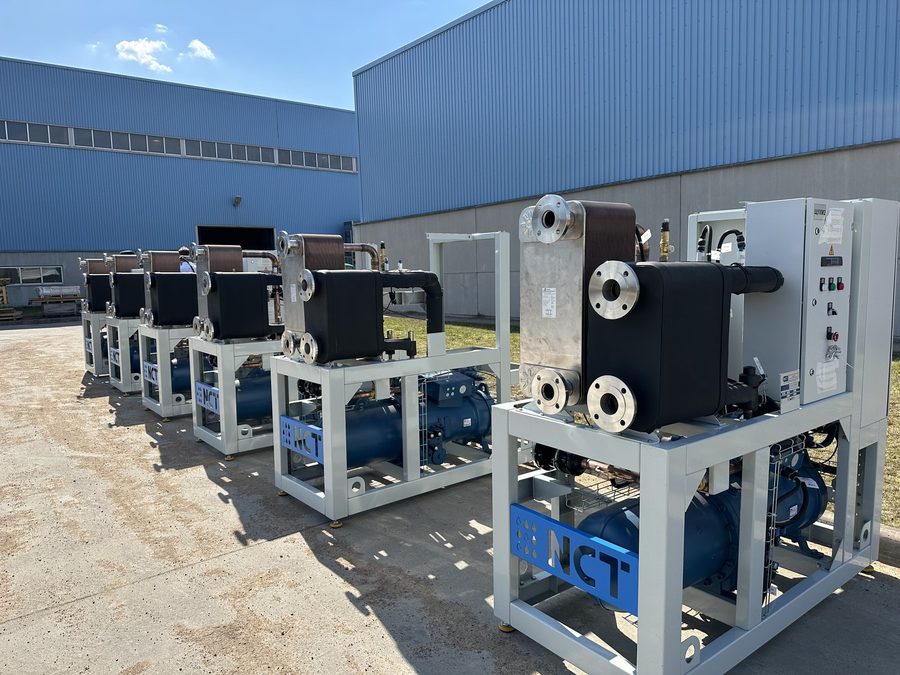
We build data center cooling on NCT free-cooling chillers and dry coolers with N+1 or 2N redundancy, and if there is waste heat on site, Thermax lithium bromide absorption chillers provide cooling with almost no electricity. We design the cooling system for a data center or a crypto mining site, manufacture it at our own plant, and install and maintain it ourselves. Below: how we calculate the cooling capacity, when to choose N+1 and when 2N, where free cooling ends and what to do with dry coolers in hot weather.
| Parameter | Value |
|---|---|
| Payback of a 5 MW absorption chiller plant | from 1 year |
| Thermax absorption chiller capacity | 350 kW – 10.5 MW |
| Redundancy | N+1 / 2N |
| Operating mode | 24/7/365 |
Why does a data center need a well-designed cooling system?
Because a cooling failure overheats the racks within minutes, and the cooling system itself is the largest energy consumer after the IT load. Every fraction of PUE (the ratio of the facility's total energy to the energy of the IT equipment) costs millions of rubles a year.
Five tasks we solve at every data center:
- PUE and electricity costs. The longer the compressors run, the higher the PUE. Solution: NCT free-cooling chillers.
- 24/7/365 fault tolerance. N+1 or 2N and a smooth switchover to standby are needed. Solution: NCT multi-module chillers on common headers.
- The Russian climate. For most of the year the air is colder than the setpoint, and without free cooling the compressors run for nothing. Solution: free-cooling chillers and dry coolers.
- Heat recovery. Data center heat usually goes into the atmosphere, although it can be turned into cooling or hot water. Solution: Thermax absorption heat pumps and absorption chillers.
- Fast commissioning of phases. Data centers grow in modules, and the halls cannot be shut down. Solution: factory-built packaged NCT chiller plants.
Data center temperature map:
| Circuit | Parameters |
|---|---|
| Hall cooling | +12/18…+18/24 °C |
| Free cooling | outdoor air colder than the supply temperature by the approach of the dry cooler (3–5 °C or more) and of the intermediate heat exchanger, if there is one |
| Return water for heat recovery | +30…+45 °C |
Which schemes do we use?
Five schemes: hall cooling, free cooling, heat rejection, cooling from waste heat, and hybrid.
Server hall cooling. Chillers produce chilled water for in-row and precision air conditioners with N+1 redundancy.
Free cooling. In the cold season, dry coolers cool the circuit without the compressors running.
Heat rejection. Cooling towers dissipate the heat from the chiller condensers.
Cooling from waste heat. If the site has steam, hot water or exhaust gas from gas turbines and gas engine generator sets, a Thermax absorption chiller turns this heat into cooling. The machine itself consumes about 5 kW of electricity per 1,000 kW of cooling, while a compressor chiller consumes about 300 kW.
Hybrid. Where there is little heat or it is unstable, the absorption chiller covers the base load and a compressor chiller covers the peaks.
| Task | Solution | Effect |
|---|---|---|
| Server hall cooling | NCT free-cooling chillers | Stable setpoint, lower PUE |
| Waste heat recovery | Absorption chiller on steam or hot water | Cooling at almost no electricity cost |
| Circuit without contact with air | Closed-circuit cooling towers, dry coolers | Clean heat transfer fluid |
| Cooling of recirculating water | NCT open cooling towers | Low temperature, simple operation |
| Water shortage on site | NCT dry coolers | Dry cooling with no water consumption |
How do you calculate the cooling capacity for a data center?
The starting point is the electrical power of the IT equipment: almost everything the servers consume turns into heat. Heat loss through the building envelope is small and variable, and you cannot count on it.
Calculation procedure:
- Hall heat. We add up the power consumption of the racks by commissioning phase, not just the final project figure.
- Other heat gains. UPS units, lighting, people, solar gain through the envelope: we add them to the IT load.
- Circuit temperatures. For halls usually +12/18…+18/24 °C; for direct liquid cooling of chips, water at 25–35 °C is enough. The higher the circuit temperature, the more hours a year free cooling works.
- Summer design point. The air temperature and humidity on site: they determine the size of the dry coolers and cooling towers and the chiller margin.
- Redundancy. We add standby machines to the design capacity according to the chosen scheme, N+1 or 2N.
- Steps by phase. An oversized machine at low load goes into short cycling, and many chillers are allowed no more than two starts per hour. So we size the first phase for the actual start-up and calculate the buffer tank from the smallest step.
Send us the load by phase, the circuit temperatures and the city, and we will calculate it free of charge.
Common data center cooling design mistakes
- Selecting equipment only for the final build-out. Check how the system runs at the initial load and how much cooling remains if one unit fails at each phase.
- Treating a spare chiller as the entire redundancy plan. Check whether a pump, common pipe section or control panel can be taken out of service while keeping the data halls cooled.
- Estimating free cooling from the annual average outdoor temperature. Use hourly weather data and coolant temperatures to estimate hours of full and partial free cooling.
What information is needed to size a data center cooling system?
For preliminary sizing, send the site location, IT load by phase, rack cooling method, supply and return temperatures, and redundancy requirements. If the temperature range is still open, provide the server models or the manufacturer's operating requirements.
For detailed selection, provide the site layout and any limits on available power, water and noise. For an existing data center, include the cooling system schematic and any measured load data.
N+1 and 2N redundancy: which to choose?
Most data centers are fine with N+1; 2N is chosen where downtime is unacceptable even for the duration of a pipeline repair.
N+1: one standby machine is added to the machines that cover the design load, and the failure of any machine does not drop the load. The scheme is cheaper and suits most commercial data centers and crypto mining sites.
2N: two independent circuits, each for the full load, with their own machines, pumps, piping and power supply. The failure or repair of an entire circuit does not stop the halls, but the scheme is more expensive.
In both schemes, NCT multi-module chillers sit on common headers, and the controls switch over to standby smoothly, without a temperature jump in the hall.
Where does free cooling end?
Full free cooling works as long as the outdoor air is colder than the circuit by the dry cooler's approach; above that, the compressors make up the cooling. Free cooling is cooling the circuit with outdoor air through a dry cooler without the compressors running, and it is the main way to lower PUE. Its limits:
- It works when the air is colder than the circuit. A dry cooler delivers fluid 3–5 °C or more warmer than the outdoor air at design load, so the threshold depends on the required supply temperature and the approach of the selected dry cooler. In a direct glycol circuit, for +12 °C supply full free cooling needs outdoor air at about +7…+9 °C or colder; for +18 °C supply, about +13…+15 °C or colder. With an intermediate heat exchanger, subtract the approaches of both the dry cooler and the heat exchanger from the supply temperature, so the threshold is lower. Above this limit the compressors make up the cooling.
- Shoulder season: mixed mode. Part of the heat is removed by the dry cooler, the rest by the chiller. The benefit depends on the number of hours a year, not on the winter peak.
- Freeze protection is needed. The outdoor circuit is filled with glycol, or an intermediate heat exchanger is installed. Glycol reduces heat transfer, and this is taken into account in the selection.
- Surface margin. When the approach is narrowed from 10 to 6 K, the dry cooler needs roughly twice the surface. Saving on it means losing free cooling hours.
The higher the allowable circuit temperature, the longer the free cooling season. For liquid cooling of chips with water at 25–35 °C, the main cooling can come from a dry cooler or a closed-circuit cooling tower, and the compressor machine remains as standby.
Which schemes drop out before prices are compared?
First we look at what the site has: power, water, gas, and what supply temperature it needs. This rules out some schemes at once:
- Supply temperature. At 7 °C a refrigeration machine is needed: a compressor chiller or, if a heat source is available, an absorption chiller. At 10–18 °C, a chiller with free cooling. At 25–35 °C with liquid cooling, the chiller can be dropped altogether.
- No water connection. Only a packaged chiller and a chiller with free cooling remain.
- Limited grid connection. PUE is an annual energy ratio and does not show the peak load on the connection. Compare the available kW with the simultaneous design peak of the IT load, cooling and other consumers. If a refrigerant chiller scheme exceeds the limit at the summer peak, look at schemes with a lower electrical load at summer design conditions: evaporative cooling or a gas-fired absorption chiller. Dry free cooling lowers the summer peak only if the dry cooler still removes heat at the required fluid temperatures at the summer design point, as with liquid cooling at 25–35 °C; otherwise the connection is sized for full mechanical cooling, including pumps and fans.
For a 10 MW data center, the refrigerant chiller option spends about 17.5 million kWh and RUB 122 million a year on cooling, while a closed evaporative cooling tower without a chiller spends about 2.6 million kWh and RUB 18 million. A backup chiller of 10–20 % of capacity covers 100–500 peak hours a year, and the difference in capital cost pays back in 1.5–2.5 years. Such a chiller does not replace the whole cooling tower at design load: tower maintenance is planned section by section, at a load that the remaining sections and the backup chiller cover together. A full stop of the tower at design load needs a reserve sized for the full load.
A second standby cooling tower is not always needed. NCT VR cooling towers have a hot standby motor option: two motors on one shaft, and if one fails the other takes over rotation on its own, without an operator. This is cheaper than a second tower with full piping. The VR fan sits in the lower dry section, separate from the evaporation zone, so in winter it does not ice up or trip on the vibration switch. The standby motor does not cover maintenance of the tower itself; that is planned as described above.
All 7 schemes and the 25 questions worth answering before a tender are in the white paper "Data Center Cooling: 25 Questions and 7 Options" (19 pages, a comparison matrix for 1,000 kW and a cost of ownership model for a 10 MW data center). It goes out by email or via Telegram: get it on the resource page.
How do you keep dry cooler capacity in hot weather?
With adiabatic spraying. In summer a dry cooler loses capacity as the outdoor temperature rises, and spraying restores it without switching to an evaporative cooling tower: nozzles spray water in front of the heat exchanger, the air cools by 5–10 °C, and the unit gets back its design capacity. Energy consumption drops by up to 30%, and water is used only in the hot hours.
What to take into account in the design:
- The limit is the wet bulb. Spraying will not cool the air below the wet-bulb temperature; in humid heat the effect is smaller.
- Water quality. Salts from untreated water deposit on the fins, so we take a water sample before the contract and include water treatment in the operating costs.
- Wind on the roof. Fine mist gets blown away; on high roofs, wind screens are installed.
More in the article "Pros and cons of dry coolers with an adiabatic cooling system" (in Russian); prices and lead times are on the "Buy a dry cooler" page.
What equipment do we install?
| Product | Application | Capacity |
|---|---|---|
| NCT chillers | Server hall cooling, free cooling, closed circuits | 69 kW – 7 MW, depending on the series |
| NCT dry coolers | Free cooling and dry circuits with no water consumption | 300 kW – 2 MW |
| NCT open cooling towers | Cooling of recirculating water and condensers | from 100 kW |
| NCT closed-circuit cooling towers | Closed circuits with no contact with the atmosphere | from 150 kW |
| Thermax absorption chillers | Cooling from steam, hot water, gas turbine and gas engine exhaust, trigeneration | 350 kW – 10.5 MW |
| Thermax absorption heat pumps | Heat at 60–90 °C from waste heat for space heating, domestic hot water and process needs | from ~0.5 MW, transformation ratio up to ~1.7 |
| NCT pump skids and controls | Hydraulic piping and dispatch monitoring of the chiller plant | to project |
NCT chillers
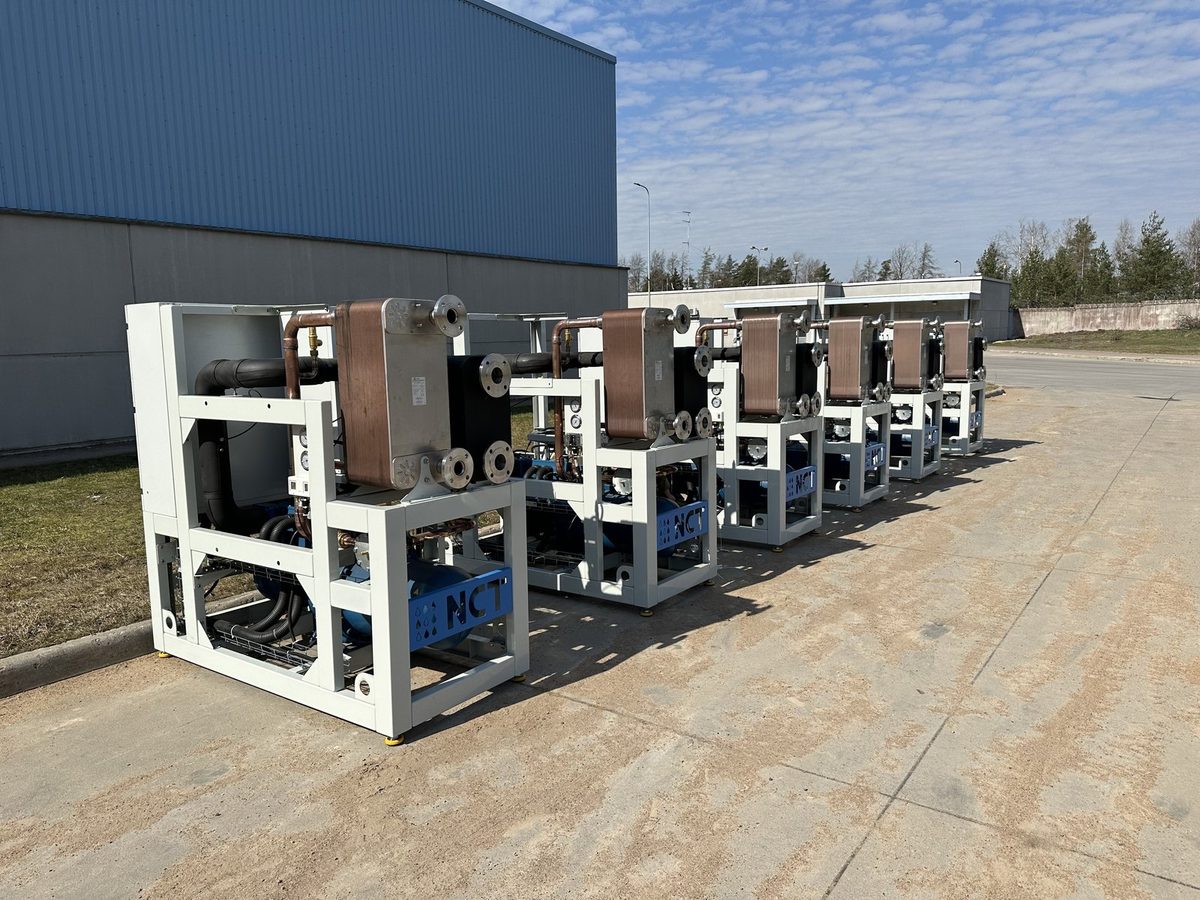
Capacity from 69 kW (scroll NASA, NCSA and NWSA series) to about 7 MW (modular NWCV units) in the NCT 2026 catalog, a stable cooling temperature for server halls and closed circuits. Up to 85% of the components are Russian-made, a modular chiller is installed in 1–3 days, and the warranty against perforation corrosion is 10 years. We select to the technical specification, with no overpaying for excess capacity, and the Danfoss and Wilo components are available on the open market.
NCT cooling towers and dry coolers, including adiabatic ones
Dry coolers (300 kW – 2 MW) provide free cooling and cool circuits with no water consumption. Open cooling towers (from 100 kW) reject the heat from condensers; closed-circuit ones (from 150 kW) keep the heat transfer fluid clean. Adiabatic spraying with high-pressure nozzles keeps the capacity in hot weather and cuts energy consumption by up to 30%; the spray water is treated so that salts do not deposit on the fins. We select the fan type and the scheme for the task so that you do not overpay for electricity.
Thermax absorption chillers
Lithium bromide absorption machines produce cooling from heat (steam, hot water or exhaust gas) with almost no electricity. Cold Energy (NCT) is the official and exclusive representative of Thermax in Russia and the CIS; more than 50 absorption chillers with capacities from 350 kW to 10.5 MW have been installed. On waste heat, operating costs are 40–60% lower, and the data center's connected electrical capacity charge does not grow.
Thermax absorption heat pumps
An absorption heat pump on the same Thermax platform raises low-grade heat (data center return water at +30…+45 °C, recirculating water, condensate) to 60–90 °C. Transformation ratio up to ~1.7: for 1 kW of driving energy we get up to 1.7 kW of heat and reduce the boiler house's fuel consumption. SS-430 Ti stainless steel, Teikoku pumps, 25-year service life.
How much does an absorption chiller save in a 5 MW chiller plant?
About RUB 42.5 million a year compared with a compressor chiller; the additional investment pays back in 1–1.5 years.
| Parameter | Compressor chiller | Absorption chiller |
|---|---|---|
| Electrical power | 1,261 kW | 230 kW |
| Driving heat (waste heat) | — | 3,571 kW, ≈ RUB 0 |
| Annual energy costs | RUB 52.0 million | RUB 9.5 million |
- Savings: about RUB 42.5 million a year.
- Additional investment in the absorption chiller: about RUB 45 million.
- Payback period: 1–1.5 years.
The assumptions are averaged: Q 5,000 kW, 7/12 °C, electricity RUB 7.5/kWh, gas RUB 7/m³, chiller COP 4.5, absorption chiller COP 1.4. We do an exact calculation with the load profile, the site's tariffs, NPV and IRR in an individual feasibility study.
Why can a data center be entrusted to NCT and Thermax equipment?
- Our own production. St. Petersburg, ISO 9001 standard, our own quality control department, R&D and test laboratory. The NCT brand has been produced since 2015, and the equipment runs at Rosatom and Gazprom sites.
- Rated performance or replacement. The machine delivers the parameters from the calculation; if it does not, we repair or replace it. Each one goes through quality control and 3D modeling; factory testing of the chiller is done at the customer's request.
- Built for the Russian climate and 24/7 operation. Anti-corrosion protection with a 10-year warranty, SKF bearings, assembly without self-tapping screws.
- Spare parts and factory service. A spare parts warehouse of more than 2,000 m² with consumables and spare parts; a factory engineer comes out to the site. Service is in rubles, with no dependence on supplies from China or Turkey.
- One contract. Design, manufacturing, installation, commissioning and first-year service: one party responsible for the result.
Which projects have we already completed?
Data centers and crypto mining sites with NCT equipment:
- Mobil Telecom data center (Leningrad Region)
- A data center in the Republic of Mari El
- A data center in St. Petersburg
- Gromov crypto mining farm (Samara)
- Miner Park (Tomsk Region)
- Miner (Moscow Region)
- and many others
From the news: an NCT SVA cooling tower with a pump skid and controls for a data center (in Russian), end of 2021; a pump skid control panel for a data center in Irkutsk Region (in Russian), autumn 2021.
The "absorption chiller on waste heat" scheme already works at other sites:
- Mikran plant (in Russian), Tomsk: a 1.7 MW gas engine generator set and two 1,100 kW Thermax absorption chillers on hot water for air conditioning.
- Central Customs Administration (in Russian), Moscow: two 500 kW absorption chillers in the historic center, where electrical capacity is in short supply.
How does a project run?
Five steps from survey to service, all under one contract.
- We survey the site, calculate the load and the redundancy scheme, and prepare a feasibility study.
- We design the chiller plant: chillers, cooling towers or dry coolers, absorption chillers, pump piping, controls.
- We manufacture the equipment at the plant; factory acceptance is possible.
- We deliver, and carry out installation supervision and commissioning with engineers holding occupational safety and industrial safety clearances.
- We train the customer's staff and maintain the system with our own service team.
The warranty is up to 5 years and starts from commissioning, so the equipment can be stored until start-up. We provide bank guarantees for performance and for the return of the advance payment.
What do engineers, finance people and buyers ask?
Trough distribution of LiBr or nozzles? In Thermax absorption chillers, lithium bromide is distributed by gravity through troughs, without nozzles. In cheap alternatives the nozzles clog and leak, causing crystallization and shutdown, while a trough has nothing to clog. Without power to its pumps and controls, an absorption chiller stops: it rides through a dip of up to 3 minutes, and anything longer needs a solution dilution cycle, so in a data center the chiller panel is fed from a UPS or a backup power feed. The generator tubes are SS-430 Ti stainless steel, with a service life of 25+ years.
A Chinese absorption chiller is 15–25% cheaper. Why pay more? To avoid downtime: cheap machines have LiBr spray nozzles, a carbon steel generator, cooling no lower than +4…+5 °C and no service in Russia. Thermax has trough distribution, SS-430 Ti stainless steel, cooling down to −5 °C and on-site service.
Imports, sanctions, prices in foreign currency? Prices are in rubles, and for absorption chillers there is exclusive certified Thermax service in Russia through Cold Energy: a spare parts warehouse in Russia, a site visit within 24–48 hours, a Siemens controller in Russian. Cooling towers, dry coolers and piping are NCT's own production.
Which refrigerant, and what about the environment? In an absorption chiller the refrigerant is water (R718) and the sorbent is lithium bromide. The ozone depletion and global warming potentials are zero, and the medium is non-flammable. Heat recovery reduces heat discharge into the atmosphere and the data center's carbon footprint.
Can you find it cheaper? With honest performance, the price is comparable. We do not take part in procurements where the price is lowered by understating the specifications.
Which typical cooling schemes do we use in data centers?
Three schemes: a chiller with a dry cooler, a chiller with a cooling tower, and an absorption chiller on steam. The numbers on the diagram are the piping components; the key is under each diagram.
NCT water-cooled chiller + NCT dry cooler
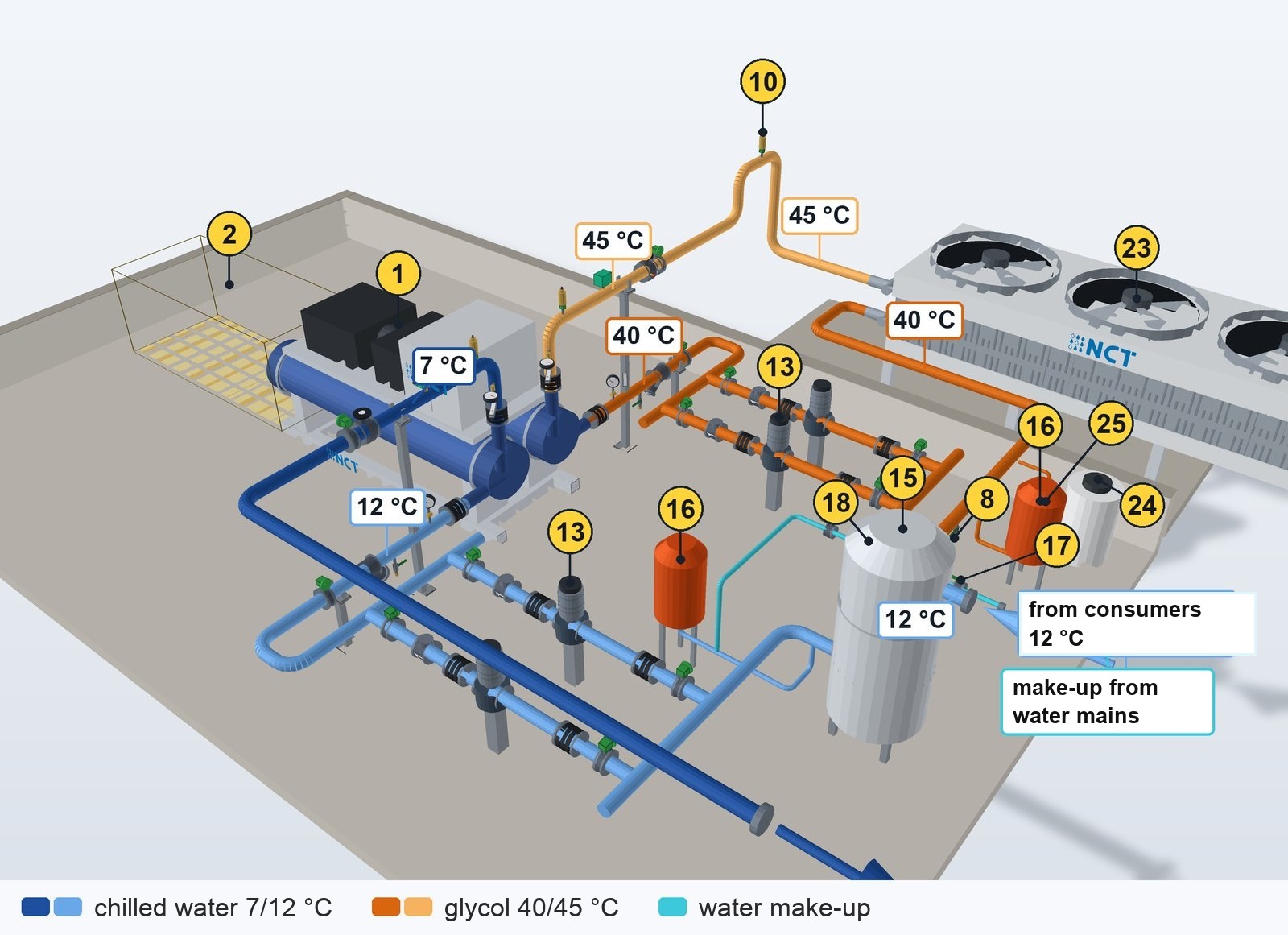
The condenser is cooled not by cooling tower water but by glycol in a closed circuit: the dry cooler rejects the heat to the air, and the tank and make-up are separate, for glycol.
Key to the numbers on the diagram
| No. | Component | Purpose |
|---|---|---|
| 1 | NCT water-cooled chiller | the evaporator takes heat from the water, the condenser gives it to the glycol |
| 2 | Tube pull zone (keep clear) | free space the length of the unit at its end: tube cleaning and replacement |
| 3 | Butterfly valve | isolates the machine and pumps for repair and flushing; installed in pairs, inlet and outlet |
| 4 | Y-strainer | catches scale and debris before the unit's tubes; on the INLET only |
| 5 | Flexible connector (vibration isolator) | right at the nozzle: damps vibration, does not transfer the pipe's weight and misalignment to the nozzle |
| 6 | Thermometer in a thermowell | inlet and outlet temperature: the difference shows the load |
| 7 | Pressure gauge with a valve | pressure before and after: the pressure drop = flow and tube fouling |
| 8 | Drain valve | drains water from the unit and the circuit; at the lowest point |
| 9 | Pipe support | carries the weight of the pipe and valves: the machine's nozzle is not loaded |
| 10 | Automatic air vent | at the highest point: releases air (noise, corrosion, pump cavitation) |
| 11 | Flow switch | no flow means the machine is not allowed to start; a paddle switch needs straight runs of ≥5 DN |
| 12 | Balancing valve | sets the design flow through the unit; the test points are for the instrument |
| 13 | In-line pump | circulates water through the circuit; in a pair, duty + standby |
| 14 | Check valve | prevents water from flowing back through the idle pump |
| 15 | Buffer tank | a reserve water volume: the machine does not cycle on and off often |
| 16 | Diaphragm expansion tank | takes up the expansion of the fluid when heated and holds the pressure at the pump suction |
| 17 | Make-up assembly: valve | circuit make-up; the valve is for manual shut-off |
| 18 | Make-up assembly: backflow protection (shown on the drawing as a check valve for simplicity) | the circuit fluid must not get into the drinking water supply: one ordinary check valve is not enough; a double check valve, a reduced pressure zone (RPZ) valve or an air gap is needed; with glycol or chemicals, only an RPZ valve or an air gap; the type is set by the water utility's technical conditions |
| 23 | NCT dry cooler (dry cooling tower) | cools the glycol with outdoor air through finned tubes; no water evaporation |
| 24 | Glycol make-up assembly: solution tank | make-up only with ready-mixed glycol solution; not with water, or the solution will be diluted |
| 25 | Make-up pump + check valve | pushes the solution into the circuit up to the working pressure; the glycol does not flow back |
Compressor chiller with a cooling tower
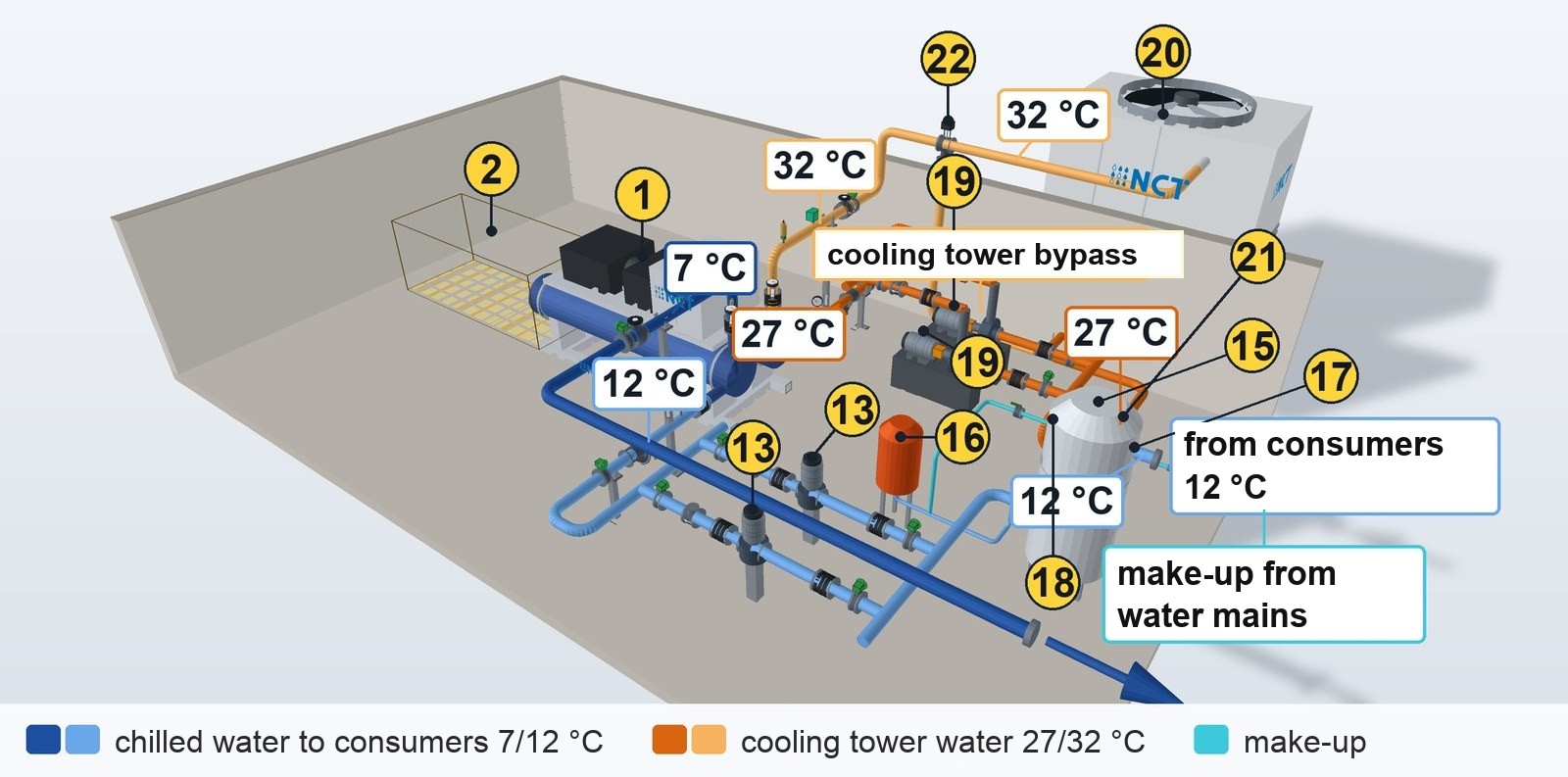
When you need a lower temperature than a cooling tower can deliver: the evaporator cools the consumer's water, and the condenser rejects the heat to the cooling tower.
Key to the numbers on the diagram
| No. | Component | Purpose |
|---|---|---|
| 1 | NCT water-cooled chiller | the evaporator takes heat from the consumer's water, the condenser gives it to the cooling tower water |
| 2 | Tube pull zone (keep clear) | free space the length of the unit at its end: tube cleaning and replacement |
| 3 | Butterfly valve | isolates the machine and pumps for repair and flushing; installed in pairs, inlet and outlet |
| 4 | Y-strainer | catches scale and debris before the unit's tubes; on the INLET only |
| 5 | Flexible connector (vibration isolator) | right at the nozzle: damps vibration, does not transfer the pipe's weight and misalignment to the nozzle |
| 6 | Thermometer in a thermowell | inlet and outlet temperature: the difference shows the load |
| 7 | Pressure gauge with a valve | pressure before and after: the pressure drop = flow and tube fouling |
| 8 | Drain valve | drains water from the unit and the circuit; at the lowest point |
| 9 | Pipe support | carries the weight of the pipe and valves: the machine's nozzle is not loaded |
| 10 | Automatic air vent | at the highest point: releases air (noise, corrosion, pump cavitation) |
| 11 | Flow switch | no flow means the machine is not allowed to start; a paddle switch needs straight runs of ≥5 DN |
| 12 | Balancing valve | sets the design flow through the unit; the test points are for the instrument |
| 13 | In-line pump | circulates water through the circuit; in a pair, duty + standby |
| 14 | Check valve | prevents water from flowing back through the idle pump |
| 15 | Buffer tank | a reserve water volume: the machine does not cycle on and off often |
| 16 | Diaphragm expansion tank | takes up the expansion of the fluid when heated and holds the pressure at the pump suction |
| 17 | Make-up assembly: valve | circuit make-up; the valve is for manual shut-off |
| 18 | Make-up assembly: backflow protection (shown on the drawing as a check valve for simplicity) | the circuit fluid must not get into the drinking water supply: one ordinary check valve is not enough; a double check valve, a reduced pressure zone (RPZ) valve or an air gap is needed; with glycol or chemicals, only an RPZ valve or an air gap; the type is set by the water utility's technical conditions |
| 19 | End-suction pump (duty + standby) | axial inlet, top outlet; motor on a common base frame |
| 20 | NCT open cooling tower | cools the water by evaporating part of it into the air |
| 21 | Strainer at the cooling tower pump suction | an open circuit collects dust and leaves: a screen before the pumps |
| 22 | Cooling tower three-way bypass valve | sends part of the water past the cooling tower so the water going to the machine is not overcooled (for an absorption chiller, a risk of crystallization) |
Absorption chiller on steam: cooling from waste heat
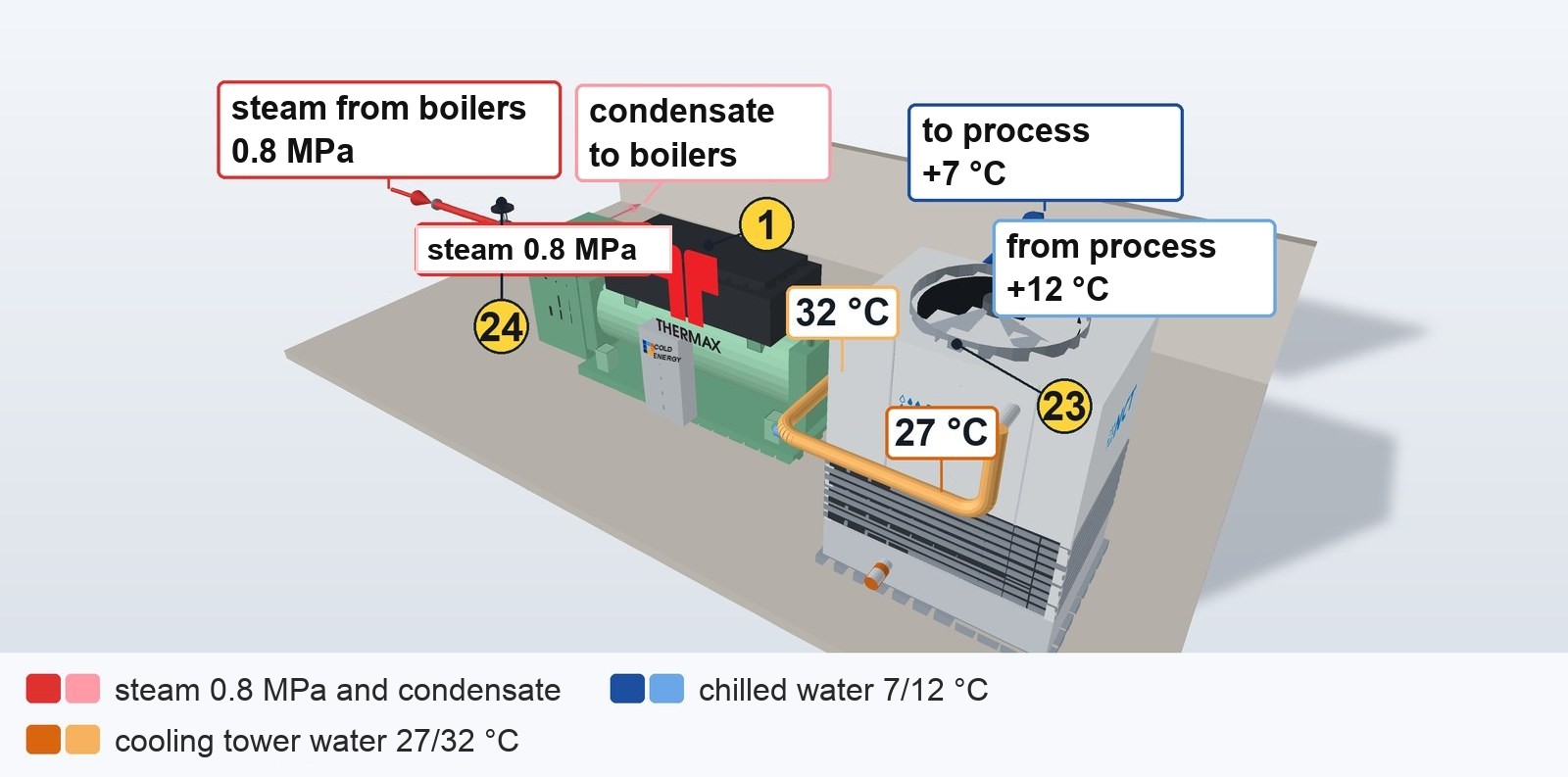
Steam heats the machine's generator, chilled water goes to the process, and the heat of absorption goes to the cooling tower.
Key to the numbers on the diagram
| No. | Component | Purpose |
|---|---|---|
| 1 | Thermax steam-fired absorption chiller | steam heats the solution, and the machine delivers chilled water without a compressor |
| 23 | NCT cooling tower | rejects the heat of absorption: there is more of it than from a compressor machine of the same capacity |
| 24 | Steam control valve | meters the steam according to the load: the machine holds +7 °C at the outlet |
Frequently asked questions
We need to cool a server room, and the equipment has to fit through the door without disassembly. Will you take it on?
Yes, we cool server rooms at many sites and check the openings right away: sometimes the selected machine does not fit through them. Send us the door dimensions and the delivery route, the heat load in kW, the required temperature in the room, and what can be installed outside. If the task turns out to be too small for our equipment, we will tell you right away so that you do not lose time.
We are considering air, rear-door water heat exchangers and direct liquid cooling. What can you do?
We are responsible for the cold side: everything that carries heat from the hall to the outside. Direct-to-chip cooling is fine with water at 25–35 °C; the main cooling can come from a closed-circuit cooling tower or a dry cooler, and the compressor machine remains as a 10–20% standby. Ordinary servers cannot be converted this way: a cold plate with channels on the chip is needed. What goes inside the rack is decided by the IT equipment supplier; we take the parameters of its circuit as input data.
We are bringing in racks in stages, and the load grows gradually. How do we avoid buying too much and get the heat right?
Calculate the heat from the power consumption of the devices: heat loss through the enclosure is small and variable, and you cannot count on it. Then split the plant into phases. An oversized machine at low load goes into short cycling, and many chillers are allowed no more than two starts per hour. The first phase is sized for the actual start-up, space and tie-ins are left for the next ones, and the buffer is calculated from the smallest step.
The dry coolers will come as a package with the mining racks, so we do not need yours. What should we check?
The package will do if it keeps your site going in hot weather. Check three things and decide right away who is responsible for overheating:
- The design point. What air and fluid temperatures are assumed: the unit delivers fluid noticeably warmer than the outdoor air.
- The margin. When the approach is narrowed from 10 to 6 K, twice the surface is needed.
- Winter. How the circuit is protected from freezing: glycol is expensive and does not suit everyone.
We will calculate the system for your site free of charge: send a request or call +7 (800) 333-49-96.
Watch: data centers (in Russian)
Cooling for data centersLet us size a cooling system for your site
An engineer will select the equipment and send you a calculation. Free of charge, no obligation.