
Chiller plant modernization: what to repair, what to upgrade, what to replace
In brief. Chiller plant modernization is a decision for each component of the plant, not only for the chiller. We survey the plant and take measurements, compare repair, upgrade and replacement in roubles over 10–15 years, and replace components in stages, so cooling stops only for short planned switchovers.
A chiller plant built in the mid-2000s is about twenty years old. For comparison, the service life of our NCT chillers is 15–20 years. The whole plant ages at once: the chillers, cooling towers of the same age, pumps and controls. So we decide on chiller plant modernization, or cooling system retrofit, component by component: what to repair, what to upgrade, what to replace. Components are replaced in stages. That is how it went at the Volzhsky Pipe Plant (in Russian): two absorption chillers had run for 25 years by 2012, longer than usual; we supplied and commissioned the first new 1,650 kW Thermax absorption chiller in 2012, and the customer signed the contract for the second one in 2013.
Why plan chiller plant modernization for the whole plant, not one machine?
In an old plant, a new chiller is held back by the old cooling towers, pumps and controls. The cooling tower was sized for the condenser heat of the previous machines, the pumps run without speed control, and the controls cannot share the load between machines of different generations. If only the chiller is replaced, the rest of the plant holds it back.
This usually shows up in three places:
- Cooling tower. Per 1 kW of cooling, a water-cooled vapor-compression chiller rejects 1.20 kW of heat to the condenser water, a double-effect absorption chiller 1.72 kW and a single-effect one 2.45 kW. A double-effect absorption chiller rejects 43 % more heat than a vapor-compression chiller and a single-effect one about twice as much, so after a switch to an absorption chiller the old tower may not be enough: we check it against the summer duty. A tower as old as the machines often cannot hold its design temperature on its own either.
- Pumps and controls. New chillers and pumps with variable speed drives deliver their full savings when one control panel runs the plant: it rotates machines and pumps by run hours, switches to standby on a fault and holds the setpoint. An old relay panel cannot do this. See what a new one includes on the control panels page.
- Grid connection. A new machine of the same type draws almost the same power. A noticeable amount of grid capacity is freed by a different plant configuration, covered below.
Repair, upgrade or replace: how to choose for each component of the chiller plant?
Each component of the plant has three possible decisions. Measurements and a cost comparison show which one to choose, not the component's age.
| Component | Repair if | Upgrade if | Replace if |
|---|---|---|---|
| Chiller | spare parts are available and the machine holds its capacity after the heat exchangers are cleaned | cooling is needed in winter: free cooling with a dry cooler in parallel, so the compressors stay off in freezing weather | spare parts take months and the calculation, including downtime risk, favours a new one |
| Cooling tower | the fill, nozzles or drift eliminators are worn | the fans run at full speed all year: variable speed drives and section control | after cleaning it does not hold the temperature, ices up in winter, or the casing is corroded through |
| Pumps and piping | worn seals and bearings | pumps without speed control or standby: variable speed drives, 1+1 or 2+1 standby | the pump does not reach its flow after repair, or no spare parts are available |
| Controls | single sensors and relays fail | manual operation: a common panel, machine rotation, remote monitoring | the controller is discontinued and nobody can support the program |
| Cooling source | not applicable | not applicable | the site has waste steam or hot water, or air-cooled machines run many hours a year |
A change of cooling source pays back more often than other decisions. An air-cooled chiller is replaced with a water-cooled one on a cooling tower, or an electric machine with an absorption chiller if the site has waste heat. At a petrochemical plant in Blagoveshchensk, Bashkortostan (in Russian), a 1,640 kW steam-fired Thermax absorption chiller replaced a vapor-compression machine and makes cooling from waste steam.
How do you assess a chiller plant before modernization or a retrofit?
Chiller plant modernization starts with a survey and measurements. Nameplate figures from twenty years ago differ from what the plant does today: the load has grown or fallen, the heat exchangers are fouled, some machines run in manual mode.
During the survey we record:
- the actual load by season and the water temperatures at the inlet and outlet of each machine;
- electricity use from the meters of the chillers, pumps and cooling tower fans;
- the cooling tower approach: leaving water temperature against the wet-bulb temperature;
- the condition of the heat exchangers, the refrigerant, compressor run hours and the alarm log;
- the electrical supply: how much capacity cooling takes and how much is in reserve;
- the space and openings: whether new equipment will fit next to the old.
From the customer we need the machine datasheets or nameplate photos, the plant diagram, a year of electricity bills and plans for production growth over the next few years.
How to compare repair, upgrade and replacement in money?
Compare the options over the same period, usually 10–15 years, on five cost lines: one-off costs, electricity, scheduled service, downtime and grid connection capacity. The price of a new machine is only the first line: over 15 years the chiller itself accounts for 5–15 % of all cooling costs. A change of plant configuration saves millions of roubles a year, a new machine of the same type an order of magnitude less.
An example for a 1,000 kW plant, RUB 10 per kWh, compressors only:
| Option | What changes | Compressor savings |
|---|---|---|
| New machine of the same type | almost the same consumption at full load, the gain is at part load | about RUB 0.4 million a year in our part-load example |
| Water-cooled centrifugal chiller with a cooling tower instead of an air-cooled one (if the plant has air-cooled machines) | the compressors need about 167 kW instead of 333 kW | about RUB 7.3 million a year at 4,380 full-load hours |
The cooling tower, pumps and water treatment are not included in the table.
Replacing a machine with one of the same type rarely pays back; reliability and the cost of downtime justify it. A change of plant configuration pays back more often. On the compressors it frees about 166 kW; how much grid capacity is freed in the end depends on the pumps and tower fans and is shown by the survey. If the grid connection is relieved by the full 166 kW, then with a grid connection fee of RUB 50,000–100,000 per kW a new connection of that capacity would cost RUB 8.3–16.6 million. The cooling tower, pumps and water treatment for the new configuration go into the same calculation. A detailed repair-or-replace calculation for one machine is in the article by Cold Energy's CEO, chiller repair or replacement.
An upgrade is also counted in kilowatt-hours. Variable speed drives on cooling tower fans that used to run at full speed in winter save about 26,000 kWh over 3,000 winter hours for every 10 kW of fan power, if about half speed is enough for them in winter.
We put the options into a pre-design study with a technical and economic comparison, which takes 2–4 weeks. It makes the budget easier to defend: it shows what each step gives and in which year it pays back.
How to modernize a chiller plant without stopping production?
Replace components one at a time and install new equipment next to the old while the old keeps running. If there is space for the new equipment and the running machines cover the load, only the switchover is left for a shutdown window agreed with the customer. If a machine has already failed or there is no standby, the survey determines how long the shutdown will be. The sequence:
- In the design we provide tie-in points, temporary bypasses and the start-up sequence in advance.
- The machine or cooling tower that limits the plant most is replaced first. While one machine is being replaced, the others carry the load, so the schedule is built around the summer peak: machines are usually replaced in the cold season, when the load is lower, and the cooling tower when a shutdown window allows.
- New equipment goes next to the operating one. We install a modular NCT chiller in 1–3 days; a cooling tower module is assembled on site in 1–2 days.
- During a planned shutdown we switch the circuit over and start the new equipment.
- The next component goes in the next window or the next budget year.
We confirm stock of NCT chillers and cooling towers on request. If the model is not in stock, it is manufactured, and the old plant, if it works, keeps running all that time.
What does turnkey chiller plant modernization include?
We do the survey, design, equipment, installation and service ourselves, so we answer for how the plant runs:
| Stage | What we do | Time |
|---|---|---|
| Survey | engineer's visit free of charge; measurements of load, energy use, condition of chillers, towers, pumps and controls | depends on plant size |
| Pre-design study | options by component, 10–15 year cost comparison, sequence | 2–4 weeks |
| Design | design and working documentation by our engineering department | 2–3 months design, 2–4 months working documentation |
| Equipment | NCT chillers, cooling towers, dry coolers, pump skids and panels from our plant in Sertolovo, Thermax absorption chillers | NCT chillers and open cooling towers from stock or 10–12 weeks, closed cooling towers 16–18 weeks |
| Installation and commissioning | our own crews, switchovers in agreed windows | per stage schedule |
| Handover | integrated test run under process load | usually 72 hours |
| Service | scheduled maintenance, monitoring, 24/7 emergency service | under contract |
How a complete chiller plant is built, with N+1 or 2N machine redundancy, is on the turnkey chiller plant page. Service for NCT and Thermax machines is on the service page.
Frequently asked questions
Production will grow in a couple of years. Modernize the chiller plant for today's load or for the future one?
We calculate both. If the whole plant is sized for the future load at once, part of the equipment will be underloaded for years with money tied up in it, and at low load the machines also start and stop more often. It usually pays better to install machines for today's load and to provide space, tie-ins, cable and a panel slot for the next machine in the design. Then the expansion does not need another reconstruction.
Can the old machines stay as standby after replacement?
Yes, if they work and spare parts are available at least for an emergency. The standby must be started by the controls, not by hand, and it has to be run on a schedule, otherwise it may fail to start on the day it is needed. If spare parts for the old machine are no longer available, a new machine in an N+1 scheme is a more reliable standby: the old machine's place is freed for it.
Send us the machine datasheets, the plant diagram and the electricity bills, and we will survey the chiller plant and prepare a pre-design study with options. Contact us or call +7 (812) 332-53-66.
Watch: chillers (in Russian)
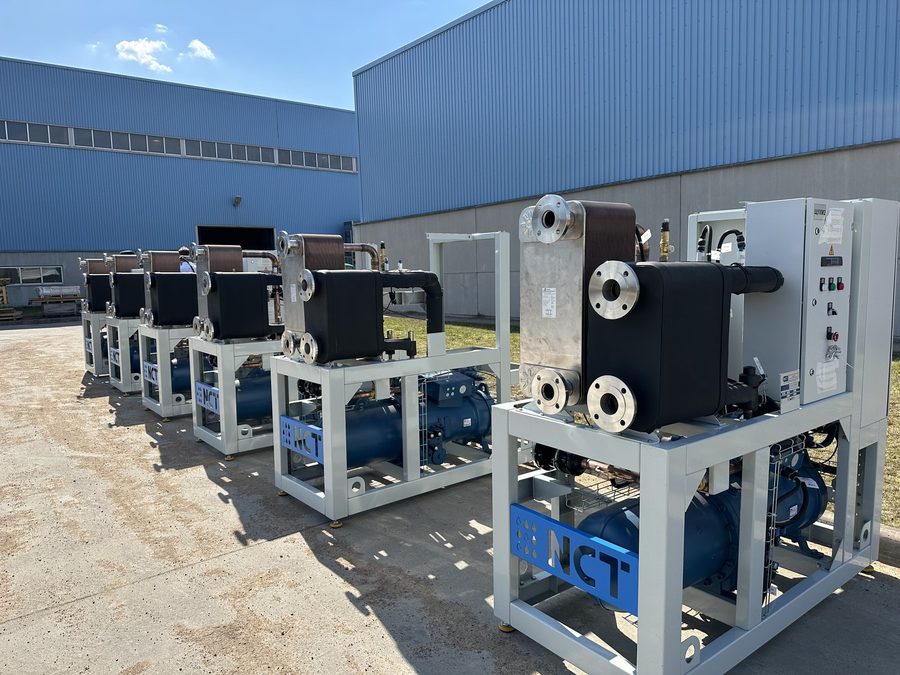 Chiller set: project walkthrough
Let us size a cooling system for your site
An engineer will select the equipment and send you a calculation. Free of charge, no obligation.