
Chiller with a remote condenser: when to use it and what to calculate
In brief. A remote-condenser chiller has two parts. The refrigeration unit stands indoors, the air-cooled condenser outside or on the roof, joined by refrigerant piping. It is used when there is no room outdoors for a packaged unit. The NCT plant builds these machines as a standard product: the NCSA series, 11 models.
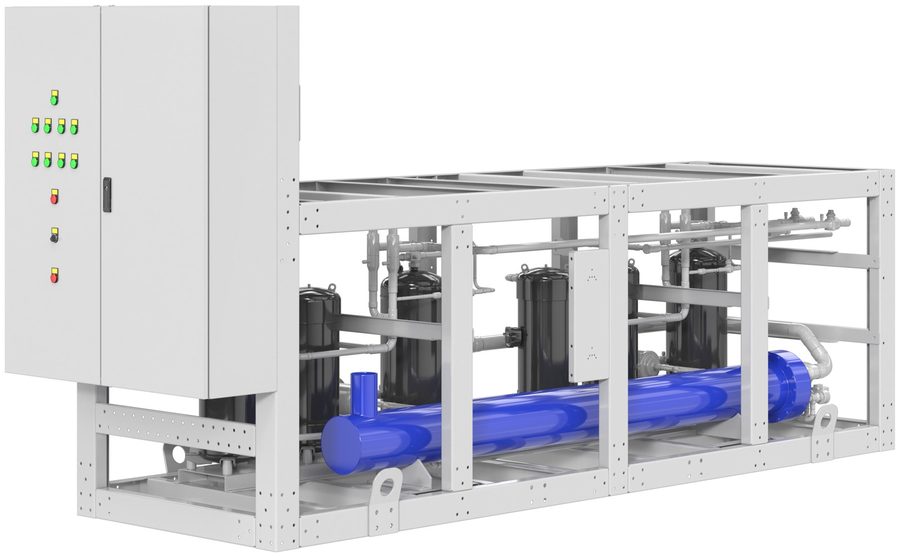
A chiller with a remote condenser, also called a condenserless or split chiller, is a refrigeration machine made of two parts. The refrigeration unit with compressors, evaporator and receiver stands indoors, close to the process load. The air-cooled condenser is placed outside or on the roof. Refrigerant piping connects the unit and the condenser. Heat leaves the building through the condenser, while the chilled water or glycol loop stays indoors. This machine is used when the refrigeration unit has to stand indoors and there is no room outside for a packaged unit, or water cannot be run outdoors. It is a standard product of the NCT plant: the 2026 catalog lists the NCSA series with 11 models.
When do you need a chiller with a remote condenser?
Four typical cases:
- The machine goes into a workshop or a plant room. An air-cooled packaged unit placed in a workshop rejects condensing heat straight into the room: about 1.25 kW for every kilowatt of cooling; at other water and air temperatures the ratio changes. With 300 kW of cooling, that is about 375 kW of heat into the workshop. A remote condenser sends this heat outside.
- The roof cannot take a packaged unit, or there is no service access around one. Only the condenser goes outside. It is lighter than a packaged unit, and the heavy refrigeration unit stands on the floor indoors.
- Water must not be run outdoors. In frost there is no need to fill the whole loop with glycol or to fear freezing the consumer's pipes: only refrigerant lines are outside.
- Cold climate. The compressors, evaporator and the unit's control panel work in a warm room, and the service engineer maintains them there, not on the roof in winter. Only the condenser faces the frost, and winter options are available for it.
When is another layout better?
If there is room outside and the loop can be filled with glycol, an air-cooled NASA packaged unit is simpler. It is one machine without refrigerant piping, installation is shorter, and the refrigerant can be charged at the factory.
If the site has a recirculating cooling water system or a cooling tower is being installed, choose a water-cooled NWSA chiller or the screw NWRA. With a cooling tower the condensing temperature is lower and the machine uses less power for the same cooling. A dry cooler does not give this gain; it is chosen when evaporative water losses and water treatment are not acceptable and a closed glycol loop is preferred. How to cool a water-cooled condenser is covered in the article Chiller condenser cooling: cooling tower or dry cooler.
| NASA packaged unit | NCSA remote condenser | NWSA water-cooled condenser | |
|---|---|---|---|
| Where the machine stands | outdoors | unit indoors, condenser outdoors | indoors |
| Where the heat goes | to the air at the machine | to the air through the outdoor condenser | to water, then to a cooling tower or dry cooler |
| Water or glycol outdoors | yes | no | only in the cooling tower or dry cooler loop |
| Refrigerant piping on site | no | yes, calculated for the site | no |
| Refrigerant charging | at the factory on request | on site, after the piping is installed | at the factory on request |
What is calculated during selection?
A packaged unit is fully assembled at the factory. With a remote-condenser machine, part of the refrigerant circuit is installed on site, so the machine is selected together with the piping.
- Piping length and height difference. They determine the refrigerant pipe diameters, oil return to the compressors and the refrigerant charge. The length limit comes from the calculation for the specific model, so the piping run is stated in the chiller selection data sheet.
- Oil traps. If the condenser is above the unit, traps are installed on the discharge riser, and the horizontal runs of the discharge line slope in the direction of gas flow, toward the condenser. Otherwise oil logs in the piping, and the compressors run short of oil, which wears them out.
- Receiver. The amount of liquid refrigerant in the circuit changes with the weather and the load. On the NCSA, a liquid receiver is part of the standard design.
- Winter operation. Without options, the NCSA works at outdoor air from +10 °C. With a heated condenser control panel and fan speed control, from −5 °C. For operation down to −30 °C, a condensing pressure regulator and a receiver pressure regulator are added. The summer design point is taken from the site climate.
- Noise. A quiet courtyard or nearby housing is handled through the condenser choice: a larger coil and lower fan speeds.
- Refrigerant for the piping. The extra refrigerant for the piping is a separate line in the specification. When comparing offers, check whether it is included in the price.
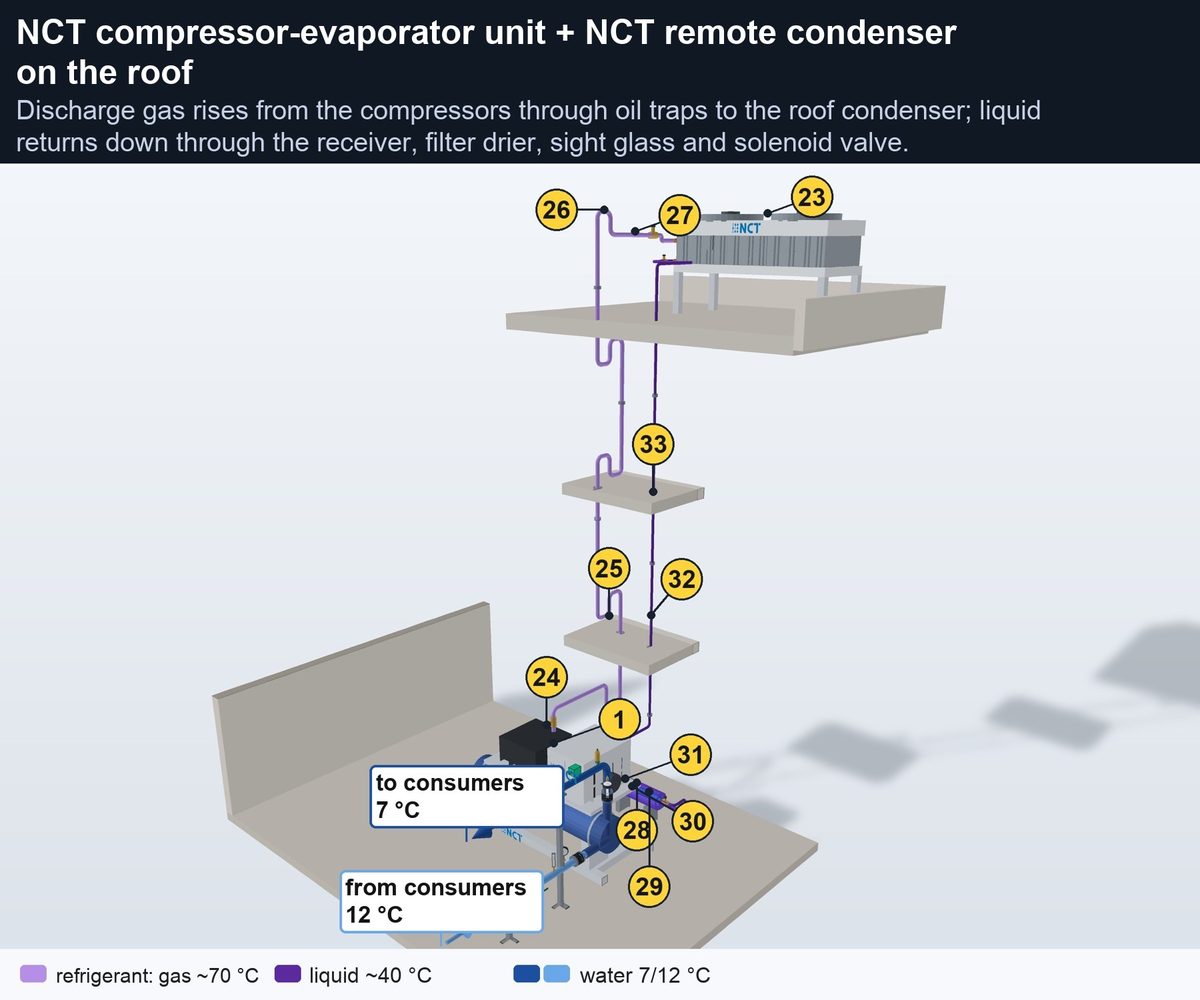
The refrigeration unit (1) stands indoors, the condenser (23) on the roof. Discharge gas rises up the riser with oil traps (25, 26), liquid flows down to the receiver (28) and on to the evaporator through the filter drier (29), sight glass (30) and solenoid valve (31).
Which remote-condenser machines does NCT build?
The NCSA series: scroll compressors, two to six per machine, R410A refrigerant. 11 models, from NCSA23 to NCSA128. With water at 12/7 °C and +35 °C outdoors, the cooling capacity is 74–436 kW. The catalog tables range from 69 kW (NCSA23, glycol 10/5 °C) to 621 kW (NCSA128, water 20/15 °C, +30 °C). For lower leaving temperatures, the capacity is calculated for the site. Leaving water or glycol is from −15 to +20 °C; below +6 °C, glycol only.
| Unit size | Models | Cooling at 12/7 °C, kW | W × L × H, mm | Unit weight, kg |
|---|---|---|---|---|
| small | NCSA23–NCSA43 | 74–145 | 820 × 1,670 × 1,205 | 480–550 |
| medium | NCSA52–NCSA86 | 178–291 | 1,270 × 2,420 × 1,860 | 1,050–1,220 |
| large | NCSA91–NCSA128 | 309–436 | 1,470 × 3,020 × 1,860 | 1,470 |
Data from the NCT Chillers catalog, May 2026. Dimensions and weight are for the refrigeration unit without the condenser. This information is for reference only and does not constitute an offer. Exact specifications are given in a technical proposal for the site.
The condenser is selected from the NCT condenser catalog for the site's climate and noise limits. On request we add a pump module with a standby pump, an electronic expansion valve, free cooling through a separate dry cooler, anti-corrosion coating and a condenser control panel. Model details are on the NCSA series page on the plant's website (in Russian).
Where do these machines already work?
NCSA chillers work at a bakery plant, a craft brewery, a foundry, a food production site and many other facilities. For example, at a printing house in St. Petersburg an NCSA cools printing equipment: the unit stands in the workshop, the condenser outside. More in the news about this project (in Russian).
Frequently asked questions
Can the condenser go on the roof and the unit in the basement?
Yes. If the condenser is on the roof, a large rise requires oil traps on the riser and an oil return calculation. If the condenser is below the unit, the limits are usually stricter: liquid refrigerant has to be lifted to the unit. The height difference and piping length go into the selection data sheet before selection, not after. So do the required cooling, water temperatures, site climate and noise limits.
Is glycol needed if the condenser is outdoors?
Not always. If the consumer's water is not colder than +6 °C and its pipes run only through heated rooms, the loop can be water. Glycol is needed below +6 °C, for free cooling through a dry cooler, or if water pipes pass through cold areas.
Who installs the refrigerant piping and is responsible for it?
The piping is part of the refrigerant circuit, and the compressors depend on it. If the piping and the machine come from different contractors, warranty disputes after a compressor failure drag on. So it is better to order the machine, the piping and commissioning from one contractor. We install ourselves and see the project through to start-up.
Can an old remote-condenser machine be replaced without changing the piping?
Sometimes. The old piping is checked for diameters against the new model, for the working pressure of the new refrigerant (for R410A it is about 1.6 times higher than for R22), for tightness and for cleanliness: residual mineral oil from R22 is not compatible with the POE oil used with R410A. If it does not fit, sections are replaced. The decision is made after an on-site survey.
Watch: chillers (in Russian)
NCT NARA monobloc chiller reviewLet us size a cooling system for your site
An engineer will select the equipment and send you a calculation. Free of charge, no obligation.