
Process water cooling at a plant in summer at +35 °C: what a cooling tower, dry cooler and chiller deliver
In brief. In summer a cooling tower cools process water to a limit set by the wet-bulb temperature, not the air temperature, and at a wet bulb of 22 °C delivers about 26–28 °C, while a dry cooler gives 40–46 °C at +35 °C; if the process needs colder water, a chiller is added for the hot hours or for the sensitive consumers only.
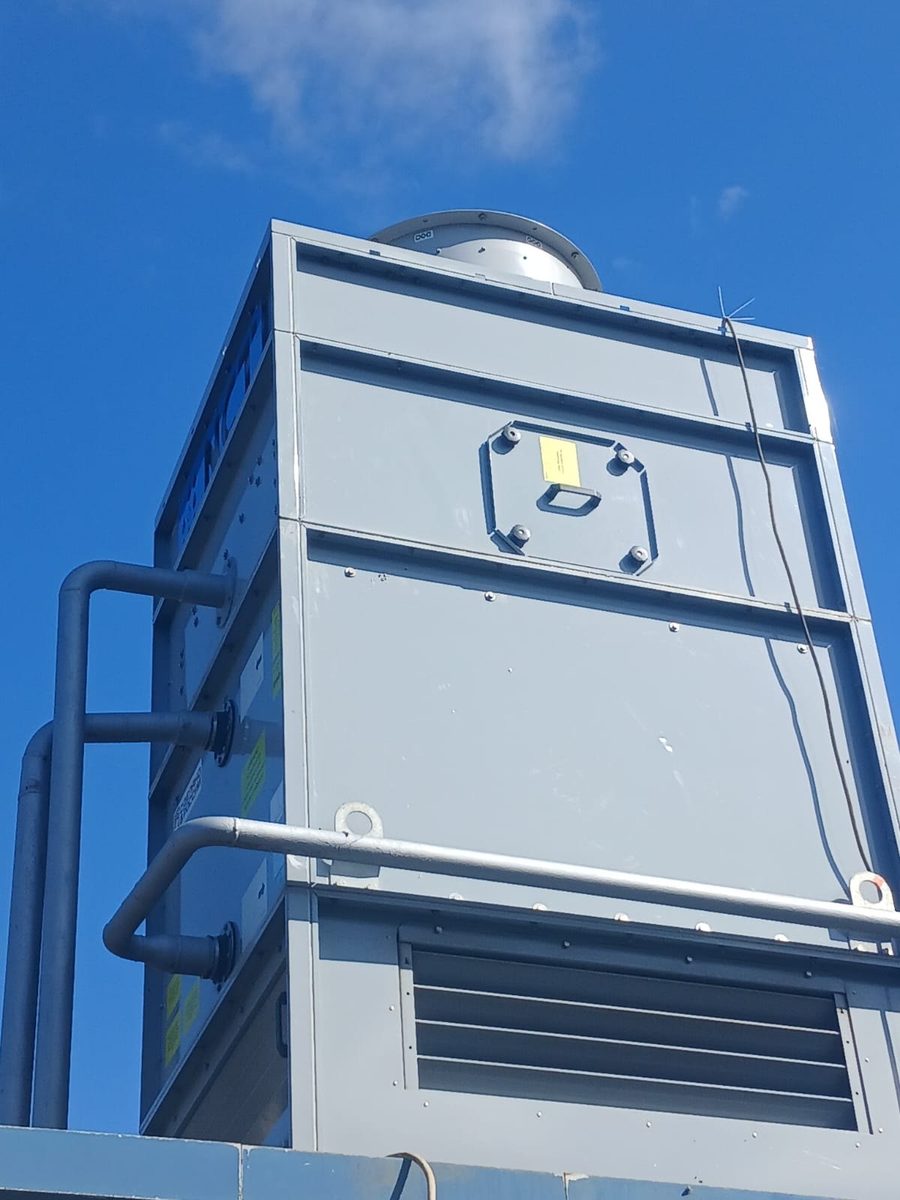
Process water cooling in summer runs into different limits: for an evaporative cooling tower it is the wet bulb of the inlet air, for a dry cooler the dry bulb. At a design wet bulb of 22 °C (a reference value for Moscow), an open cooling tower delivers water 4–5 K warmer, about 26–27 °C; a closed cooling tower gives 27–28 °C, and a dry cooler at +35 °C outdoors gives 40–46 °C. If the process needs colder water, a chiller is added to the loop: sized for the design load and the hot-weather duty, it holds +7 °C across the intended range of outdoor temperatures.
We select the scheme for your process and the site climate, manufacture NCT cooling towers, dry coolers and chillers at our own plant in Sertolovo. For cooling towers, we offer turnkey installation or installation supervision, and we commission the tower in either case. For a selection, fill in the cooling tower questionnaire (Word, in Russian) or send us the water flow and temperatures.
What water temperature can you get in summer?
The reference values are for a wet bulb of 22 °C and air at +35 °C dry bulb. These are two different quantities: the first limits a cooling tower, the second a dry cooler. The exact figures come from a selection for your city's climate.
| Scheme | Summer water, reference | What limits it | When it fits |
|---|---|---|---|
| Open cooling tower | 26–27 °C | wet bulb plus 4–5 K | compressors, furnaces, machine tools, condensers, if the equipment accepts circulating water |
| Closed cooling tower | 27–28 °C | wet bulb plus the coil inside the tower | a clean loop with no contact with air is required |
| Open tower with an intermediate heat exchanger | 28–30 °C | plus 1.5–2.5 K across the heat exchanger | a clean loop where an open tower is already installed |
| Dry cooler | 40–46 °C at +35 °C | air plus 5–11 K | no make-up water or it is expensive, and warm water is enough for the process |
| Dry cooler with adiabatic pre-cooling | colder than a dry unit; the exact figure comes from a selection | spray cools the air ahead of the coil, by about 5 °C in the Moscow example, but not below the wet bulb | extra capacity is needed in the hot hours with little water use |
| Chiller | +7 °C and below | sized for the load and the hot condensing duty; power consumption rises | water is needed colder than the wet bulb |
The main consequence: a cooling tower physically cannot cool water below the wet bulb. If the specification asks for 22 °C in summer at a wet bulb of 22 °C, no cooling tower solves it, however large. 24 °C means an approach of 2 K: a standard selection does not cover that point; we check it with a separate selection or consider trim cooling with a chiller.
Why does a tower that coped in spring miss its temperature in the heat?
Because the hot hours go beyond the design point. The design wet bulb is taken for the site's city under SP 131.13330.2025, with the probability level agreed with the customer in writing. The ASHRAE Handbook sets design values by the share of hours per year when the wet bulb is above the design value: 0.4% is about 35 hours, 1% about 88 hours, 2% about 175 hours. In those hours the water is warmer than design, and that is normal operation of a healthy tower.
How much warmer: for a tower on a 35 → 28 °C duty at unchanged flow and range, each degree of wet bulb above design adds about 0.7 K to the cold water. If the contractor took a climate 2 K milder than the real one, the water will be about 1.4 K warmer in the hottest hours, and neither a pump nor controls will fix that. Recirculation is assessed separately: a tower next to a wall draws in its own warm, humid exhaust, and the wet bulb at its inlet is higher than in the surroundings. In our example it rose from 22 to 23 °C, and the water became about a kelvin warmer. Maxim Krasnov explains the wet-bulb limit in his article on the wet-bulb temperature as the limit of cooling tower performance (in Russian).
So we first agree with the customer how many hot hours a year the process can run on water a degree or a degree and a half warmer. The answer sets the tower size and whether a chiller is needed.
What if the process needs water colder than the tower gives?
There are four working options, often combined.
1. Agree a different setpoint. If all consumers accept 27–28 °C, no chiller is needed: the loop runs on a cooling tower alone.
2. Trim with a chiller in hot weather. The tower runs all year, and the chiller switches on when the tower is not enough. This is how we built a local system for an induction furnace at a foundry: an open NCT VR cooling tower, a chiller for trim cooling at outdoor temperatures above +25 °C, water treatment and a pump group. More in the article on induction furnace cooling (in Russian).
3. Split the consumers. If consumers have different setpoints, tower water goes where the equipment datasheet allows it, and the chiller is sized only for the low-setpoint consumers, not the whole flow. An example is cooling of injection moulding machines (in Russian).
4. Make cooling from waste heat. If steam or hot water is left over at the plant in summer, an absorption chiller turns it into chilled water, and no new electrical capacity is needed for compressors. See Waste heat recovery.
When is a dry cooler enough in the heat?
When the process accepts water 5–11 K warmer than the air. A dry cooler cools only with air and cannot bring the fluid below the air temperature. At +35 °C outdoors that means 40–46 °C at the outlet. For part of a process — hydraulics, some compressors, a condenser loop — this is enough. On the other hand, a dry cooler uses no water for evaporation and runs on glycol in winter: we choose the concentration for the site's minimum temperature, allowing for possible standstill.
For a continuous process we do not size a dry cooler for average heat. In Moscow the warm-season design value under SP 131, at 0.98 non-exceedance probability, is 26 °C, while the absolute maximum is 38 °C. A dry cooler sized for 26 °C goes beyond its design point in a heat wave, and the fluid warms with the air: a unit rated for 40 °C at +30 °C will deliver about 48 °C at +38 °C and the same load. So we size the dry coil for a hot design point and treat adiabatic pre-cooling as a reserve for peak hours.
Adiabatic pre-cooling cools the air ahead of the coil with a water spray. In Moscow and St Petersburg it brings capacity in the hottest hours rather than annual savings: in our design example for Moscow, switched on above +28 °C, it runs about 88 hours a year. See NCT dry coolers.
What else costs degrees in the heat?
Apart from the climate, three things raise water temperature in summer, and we check them before buying new equipment:
- scale and sludge. By our estimate, a 1 mm layer of scale on the fill or coil takes 20–25% of capacity. Water treatment is selected from the make-up water analysis;
- grown load. After a workshop expansion the loop carries more heat than the design allowed for. Then we recalculate the system for today's peak load rather than replace the tower with an identical one;
- uneven load. A furnace or press switches on in steps, and the temperature jumps. A tank in the loop smooths the jumps; its volume depends on how much excess heat accumulates during the peak and how far the water may be allowed to warm.
If a tower is already installed and misses its duty in summer, we start with measurements: flow, inlet and outlet temperatures, the wet bulb on the day. Without them you cannot tell whether the tower, the load or the climate in the design is to blame.
Where do we cool process water in a hot climate?
Our projects include these plants and many others.
- A petrochemical plant in Shymkent. We supplied an NCT SVA-2 cooling tower designed for 70 m³/h of process water cooled from 40 to 28 °C, with a control panel, and carried out installation supervision and commissioning.
- A mining and metallurgical complex in Uzbekistan. To cool the oxygen plant compressors, we designed and manufactured an open NCT VR cooling tower with a winter package, a PU-330/50 pump group, a W2C water quality control system and a control panel.
- An oil refinery in Uzbekistan. An NCT VR cooling tower with a control panel cools a new process line; installation supervision and commissioning were done by our specialists.
Industry solutions are collected on the Petrochemicals page, and how we build the whole loop — cooling towers, pump stations, water treatment and controls — on the Recirculating water systems page.
How much does the equipment cost?
Per our catalogue as of November 2026: NCT cooling towers from RUB 560,000, dry coolers from RUB 500,000, chillers from RUB 900,000, pump groups from RUB 500,000. These are prices for the simplest version; the exact amount comes from a selection, which we do free of charge. Other items are in the catalogue (in Russian).
For a scheme with a chiller we compare equipment cost and electricity use against the option without one, taking into account how many hours a year the chiller is really needed. Sometimes it is enough to agree a setpoint one degree higher and manage with a cooling tower.
What to send for a selection?
1. Water flow and the inlet and outlet temperatures the process needs in summer.
2. What you are cooling: compressors, furnaces, machine tools, reactors, chiller condensers.
3. The site's city, or the design wet-bulb temperature, the climatic standard used and the associated probability level if the design already has them.
4. Open or closed loop, water or glycol, and whether the system runs in winter.
5. The make-up water analysis and any water limits at the site.
6. If a tower is already installed and cannot cope in summer, its datasheet and temperatures on hot days.
Frequently asked questions
The questionnaire asks for 25 °C water in summer, and in one item a guaranteed 20 °C at a wet bulb of 22.5 °C. Can a cooling tower do that?
Twenty, no: that is colder than the air's wet-bulb temperature, and no evaporative unit will deliver it. A closed unit will not reliably give 25 either; 27–29 is the figure to plan for. If 25 is mandatory, a trim cooler goes after it: cooling 600 m³/h of water from 28 to 25 °C requires about 2.1 MW of cooling capacity. A winter duty of 30/20 is achievable without compressors.
A new oxygen plant needs water no warmer than 25 °C, but in summer the water in its tank heats up to 35–44 °C. Cooling tower or chiller? And what about winter?
In a similar project we proposed a closed loop with make-up from the tank and an insulated tank in a modular building so that the water does not freeze in winter. We use the site climate, water temperatures and pipe length to determine whether the cooling tower alone is sufficient or a chiller is needed in summer.
A cooling tower is unavoidable in summer, but residents nearby complain about the white plume above it, and fire brigades get false calls. What can be done?
Order the tower with a plume abatement section. It is an NCT VR option: it makes the plume noticeably less visible, which matters especially in densely populated areas, and reduces complaints and false calls. On closed cooling towers it also saves water: in cool weather the unit switches to dry operation.
Send us the flow, temperatures and the site's city — contact us or call 8 (800) 333-49-96, and we will select a cooling scheme free of charge.
Watch: cooling towers (in Russian)
NCT VA cooling towers: review by Maxim KrasnovLet us size a cooling system for your site
An engineer will select the equipment and send you a calculation. Free of charge, no obligation.