
Reducing Chiller Power Consumption
In brief. To reduce a chiller's power consumption, its water-cooled condenser is served by an open cooling tower instead of a dry cooler, and an air-cooled packaged unit is replaced with a water-cooled chiller and a cooling tower. The condensing temperature drops from 45–55 to 35 °C, the coefficient of performance rises from 2.5–3.5 to 5.5–6.5, and 1,000 kW of cooling needs about 167 kW of electricity instead of 333 kW.
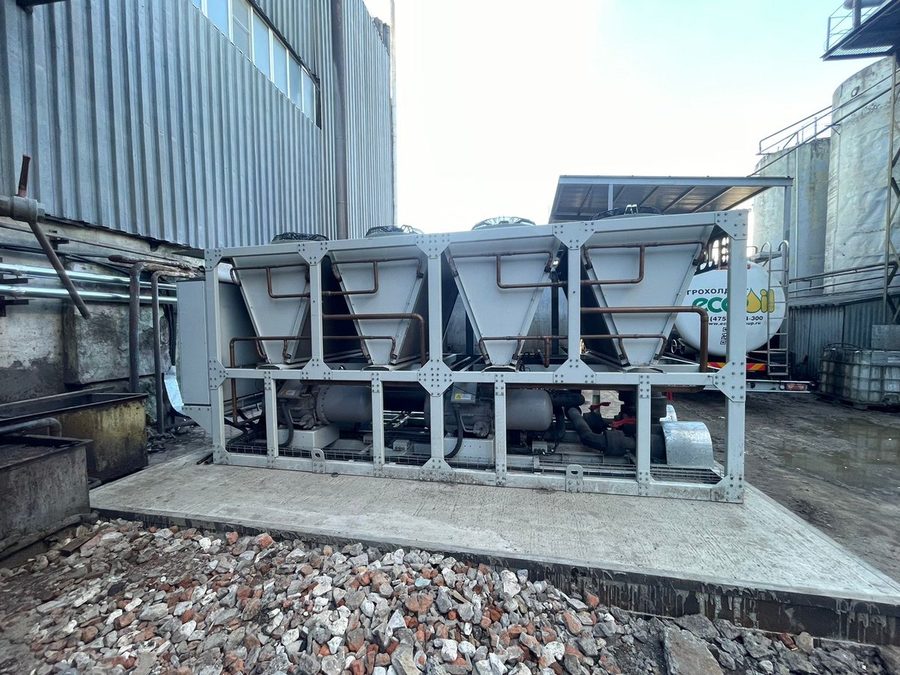
To reduce a chiller's power consumption, we propose cooling its condenser with an open cooling tower instead of a dry cooler (a dry fluid cooler), and replacing an air-cooled packaged unit with a water-cooled chiller and a cooling tower. The condensing temperature drops from 45–55 °C to 35 °C, and the refrigeration machine produces the same cooling with about half the previous electrical power.
Why does a chiller with air-cooled heat rejection consume a lot?
The energy efficiency of a refrigeration machine is shown by its coefficient of performance (COP): the ratio of cooling capacity to electrical power input. For vapor-compression machines with an air-cooled condenser, it is usually 2.5–3.5. This means that 1,000 kW of cooling needs about 333 kW of electricity (1,000 / 3.0 = 333 kW).
There are two air-cooled schemes. In a packaged chiller, outdoor air cools the refrigerant condenser directly. In a water-cooled chiller with a dry cooler, the condenser is cooled by water or glycol of a separate circuit, and the dry cooler rejects that heat to the outdoor air. In both cases the fluid cannot get colder than the air, so the condensing temperature stays high, at 45–55 °C. The higher it is, the more work falls on the compressor. The figures below are calculated for a packaged chiller with an air-cooled condenser; for replacing a dry cooler with a cooling tower, we make a separate comparison at the same load, including pumps and fans.
How does a cooling tower reduce consumption?
An open cooling tower cools water by evaporation, so the water for the condenser is colder than from a dry cooler. The condensing temperature drops to 35 °C, and the chiller's COP can reach 5.5–6.5.
| Parameter | Packaged chiller with an air-cooled condenser | Water-cooled chiller with an open cooling tower |
|---|---|---|
| Condensing temperature | 45–55 °C | 35 °C |
| Coefficient of performance (COP) | 2.5–3.5 | 5.5–6.5 |
| Electrical power per 1,000 kW of cooling | about 333 kW (at COP 3.0) | about 167 kW (at COP 6.0) |
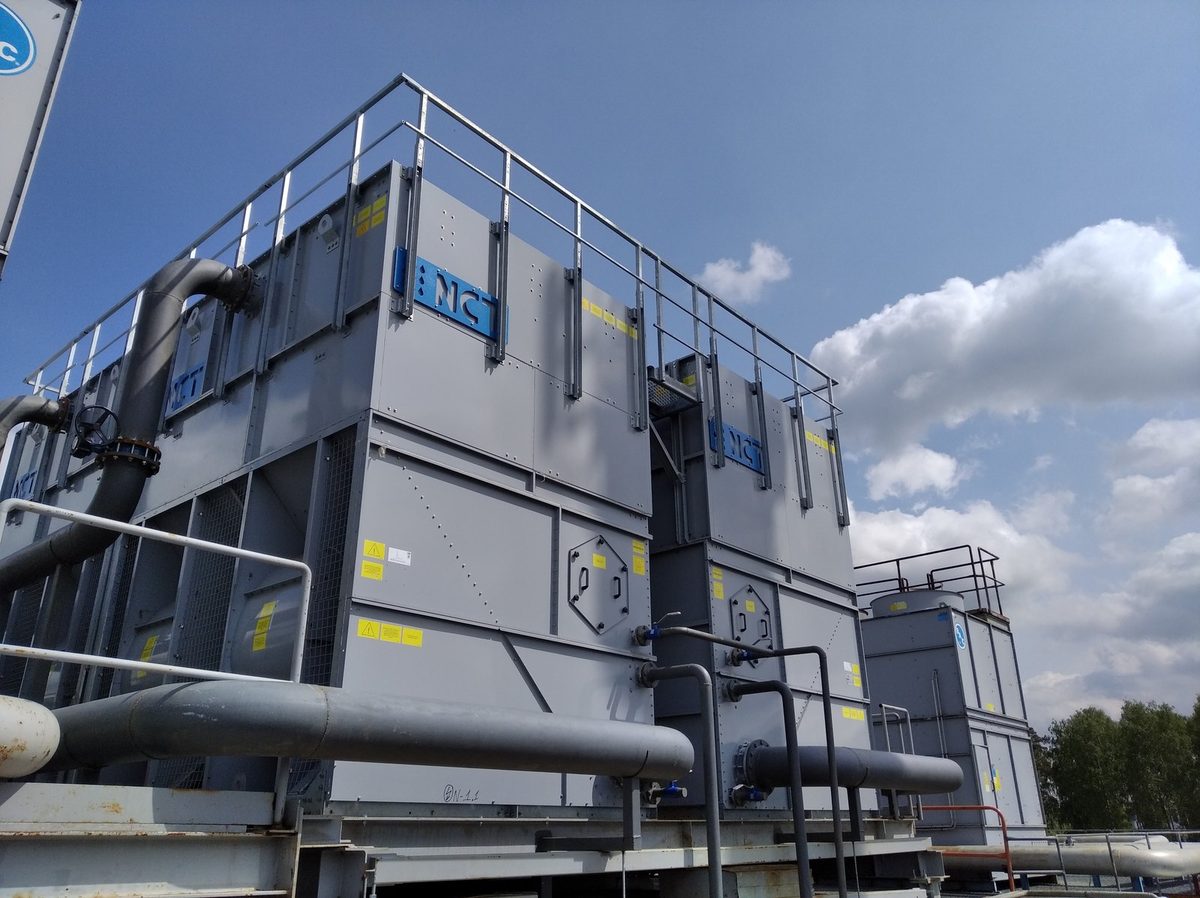
How does the scheme work, step by step?
- The chiller produces cooling for the consumer: the process or air conditioning.
- In the condenser, the heat of the refrigerant is transferred to the water of the condenser circuit.
- The heated water enters the open cooling tower and is cooled by contact with air and partial evaporation.
- The cooled water returns to the chiller's condenser, and the condensing temperature stays at about 35 °C.
The design of a cooling tower is described in detail in the article "Cooling tower: what it is, how it is built and how it works" (in Russian).
How much does it save?
With the same cooling capacity of 1,000 kW, the power input drops from 333 to 167 kW. In practice, this means the chiller's electricity costs are halved. Whether this also lowers the cost of the grid connection depends on the peak load of the whole facility and the connection terms, so we calculate it separately.
In rubles, from our calculation for 1,000 kW: 70% load, round-the-clock operation, about 6,250 hours a year, electricity at RUB 7 per kWh. A packaged chiller with an air-cooled condenser (COP 3) spends about RUB 14.5 million a year on electricity, a chiller with a wet cooling tower (COP 6) about RUB 7.25 million. The investment in the chiller, cooling tower and pump skid is almost the same as in the packaged unit: by the same calculation, about 5% more.
The guide "5 industrial cooling schemes: cut cooling power use up to 10 times", with this calculation and three more schemes (free cooling, an absorption chiller on waste steam, a cooling tower without a chiller), can be sent to you by email or Telegram: request it on the guide page.
What should be considered when switching to an open cooling tower?
- Make-up water. An open cooling tower loses part of its water to evaporation: for a 1,000 kW chiller, about 2 m³/h. We include the cost of make-up water in the operating cost calculation.
- Water quality. Water in an open circuit is in contact with the air, picks up dirt and fouls the chiller condenser, so for the recirculating circuit we supply NCT chemical water treatment systems.
- Winter operation. For winter operation, NCT cooling towers are fitted with basin heating, a variable frequency drive for the fan and a winter package.
The scheme is more complex than a packaged chiller, so it does not pay off everywhere: for sites below 700 kW, a standard scheme without a cooling tower is usually simpler. Centrifugal chillers almost always use wet cooling towers, and absorption chillers usually use wet ones; a dry cooler replaces the cooling tower only if the chilled water leaving the absorption chiller is warmer than 17 °C.
We compare the options with all cost items included at the engineering concept (in Russian) stage.
What equipment do we supply?
- NCT open cooling towers, made at our own plant. More details are on the Buy a cooling tower page and on the NCT website (in Russian).
- NCT chillers: on the Buy a chiller page.
- Pump skids, chemical water treatment systems and cooling tower control panels.
If the facility has waste heat, cooling can be produced without large electricity consumption at all, with an absorption chiller. See Heat recovery.
Which projects have we completed?
- International tobacco company (in Russian), Leningrad Region: two NCT VR cooling towers in 2019 and two more in 2021 for chiller cooling, with control panels and variable frequency drives. Supply, installation supervision and commissioning.
- Armyansky Filial Pargev dairy (in Russian), Yerevan: an NCT SVA-2S cooling tower for condenser cooling.
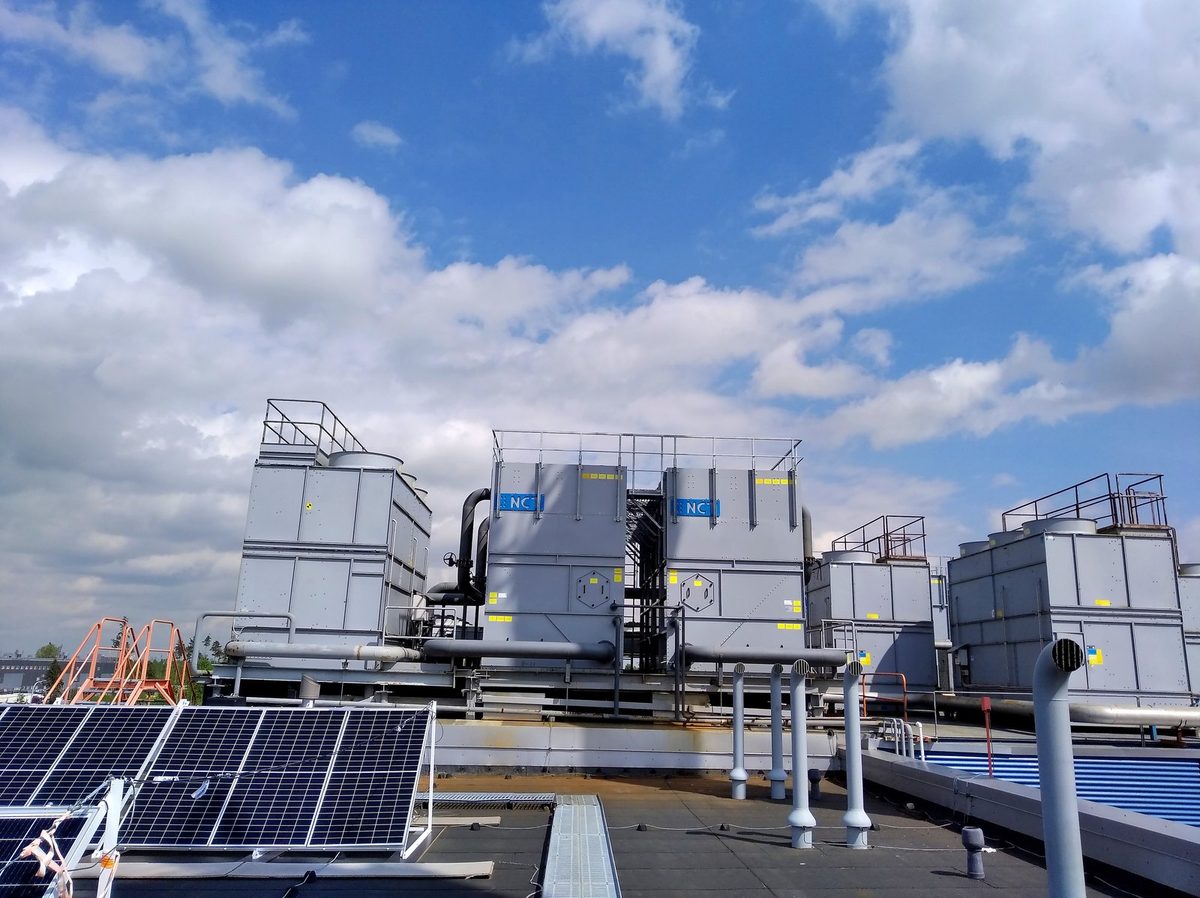
Selected projects are in the Projects section, and customer reviews are on the Reviews (in Russian) page.
Cooling schemes
Typical schemes we use in this industry. The numbers on the diagram are the piping components; the key is under each diagram.
NCT water-cooled chiller + NCT dry cooler
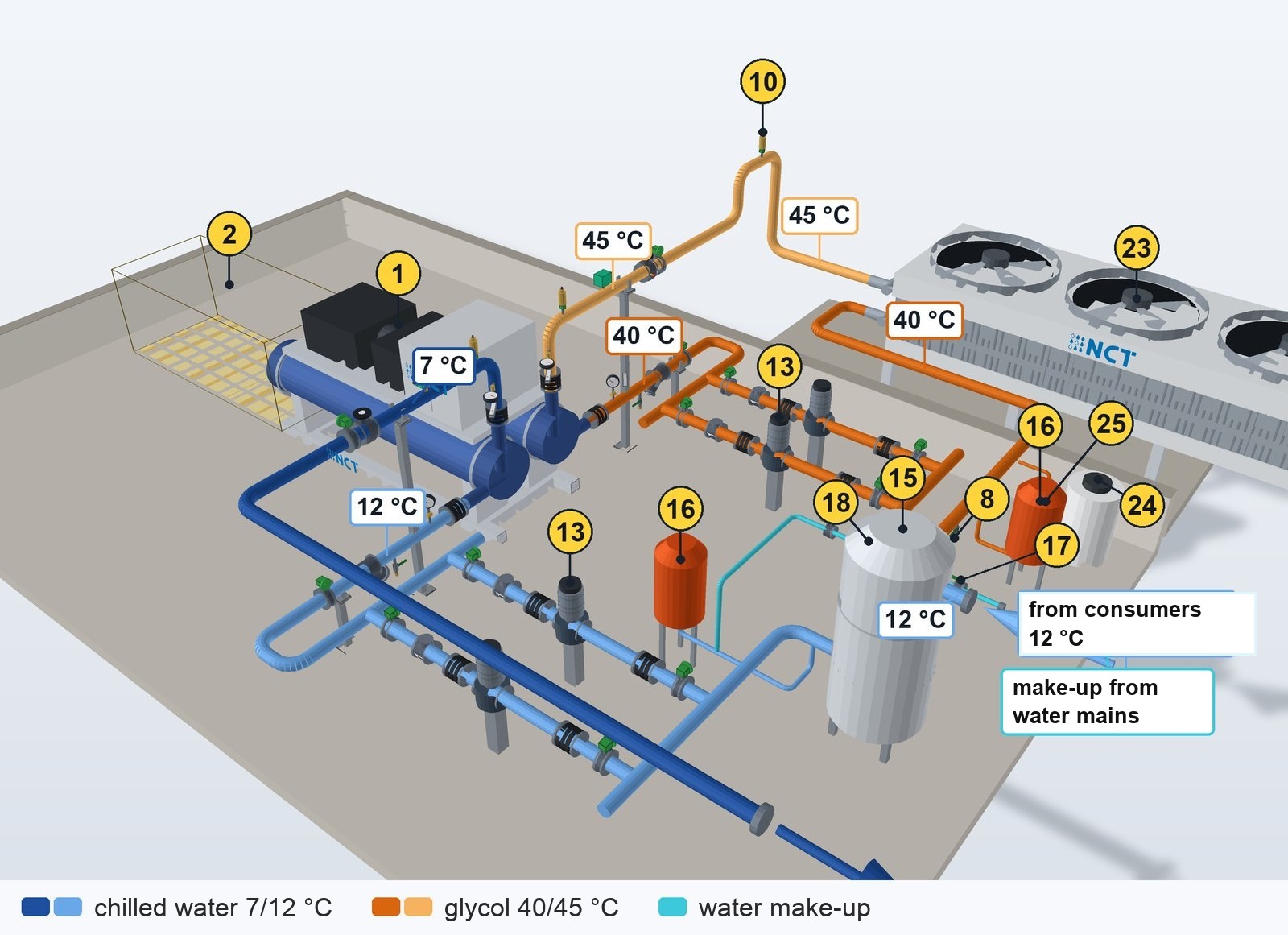
The condenser is cooled not by cooling tower water but by glycol in a closed circuit: the dry cooler rejects the heat to the air, and the tank and make-up are separate, for glycol.
Key to the numbers on the diagram
| No. | Component | Purpose |
|---|---|---|
| 1 | NCT water-cooled chiller | the evaporator takes heat from the water, the condenser gives it to the glycol |
| 2 | Tube pull zone (keep clear) | free space the length of the unit at its end: tube cleaning and replacement |
| 3 | Butterfly valve | isolates the machine and pumps for repair and flushing; installed in pairs, inlet and outlet |
| 4 | Y-strainer | catches scale and debris before the unit's tubes; on the INLET only |
| 5 | Flexible connector (vibration isolator) | right at the nozzle: damps vibration, does not transfer the pipe's weight and misalignment to the nozzle |
| 6 | Thermometer in a thermowell | inlet and outlet temperature: the difference shows the load |
| 7 | Pressure gauge with a valve | pressure before and after: the pressure drop = flow and tube fouling |
| 8 | Drain valve | drains water from the unit and the circuit; at the lowest point |
| 9 | Pipe support | carries the weight of the pipe and valves: the machine's nozzle is not loaded |
| 10 | Automatic air vent | at the highest point: releases air (noise, corrosion, pump cavitation) |
| 11 | Flow switch | no flow means the machine is not allowed to start; a paddle switch needs straight runs of ≥5 DN |
| 12 | Balancing valve | sets the design flow through the unit; the test points are for the instrument |
| 13 | In-line pump | circulates water through the circuit; in a pair, duty + standby |
| 14 | Check valve | prevents water from flowing back through the idle pump |
| 15 | Buffer tank | a reserve water volume: the machine does not cycle on and off often |
| 16 | Diaphragm expansion tank | takes up the expansion of the fluid when heated and holds the pressure at the pump suction |
| 17 | Make-up assembly: valve | circuit make-up; the valve is for manual shut-off |
| 18 | Make-up assembly: backflow protection (shown on the drawing as a check valve for simplicity) | the circuit fluid must not get into the drinking water supply: one ordinary check valve is not enough; a double check valve, a reduced pressure zone (RPZ) valve or an air gap is needed; with glycol or chemicals, only an RPZ valve or an air gap; the type is set by the water utility's technical conditions |
| 23 | NCT dry cooler (dry cooling tower) | cools the glycol with outdoor air through finned tubes; no water evaporation |
| 24 | Glycol make-up assembly: solution tank | make-up only with ready-mixed glycol solution; not with water, or the solution will be diluted |
| 25 | Make-up pump + check valve | pushes the solution into the circuit up to the working pressure; the glycol does not flow back |
Hybrid scheme: dry in winter, wet in summer
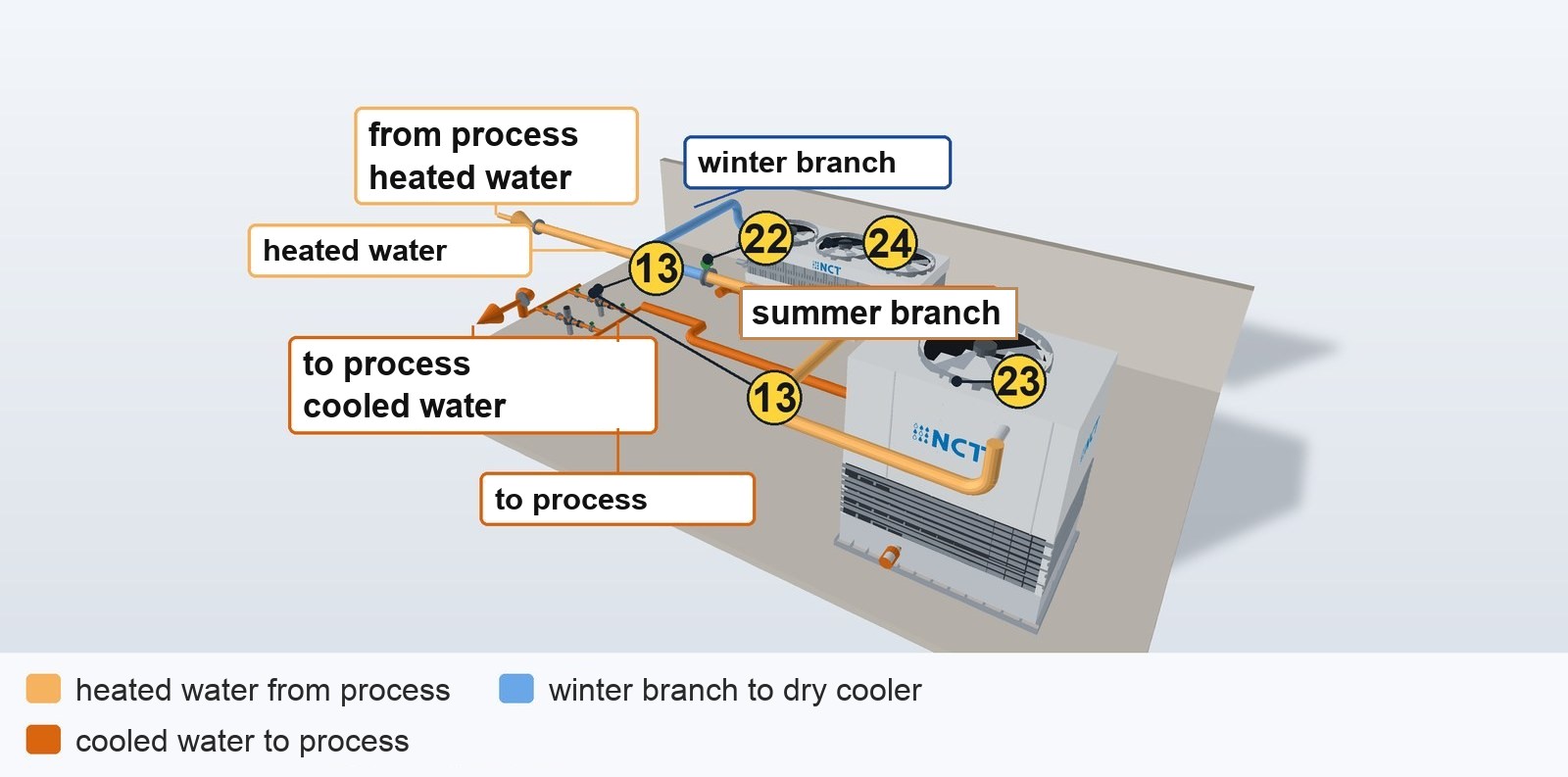
In the cold months, the dry cooler removes the heat and no water is consumed; the evaporative stage is switched on only in hot weather.
Key to the numbers on the diagram
| No. | Component | Purpose |
|---|---|---|
| 3 | Butterfly valve | isolates the machine and pumps for repair and flushing; installed in pairs, inlet and outlet |
| 5 | Flexible connector (vibration isolator) | right at the nozzle: damps vibration, does not transfer the pipe's weight and misalignment to the nozzle |
| 13 | In-line pump | circulates water through the circuit; in a pair, duty + standby |
| 14 | Check valve | prevents water from flowing back through the idle pump |
| 22 | Cooling tower three-way bypass valve | sends part of the water past the cooling tower: the water to the machine is not overcooled (for an absorption chiller, there is a risk of crystallization) |
| 23 | NCT cooling tower: summer stage | switches on when dry cooling is no longer enough |
| 24 | NCT dry cooler: dry stage | works without water: no blowdown, no chemicals, no icing |
Frequently asked questions
Which is better in terms of investment and operation: open cooling towers, closed-circuit cooling towers or adiabatic dry coolers?
In terms of investment, an open cooling tower is almost always cheaper. In terms of operating costs, everything depends on the price per cubic meter of water. For a 5,000 kW data center, the wet scheme saves about 13.8 kWh per cubic meter, so at RUB 10/kWh it pays off as long as water costs less than RUB 138. If make-up and discharge are expensive or not available, a closed circuit and a dry cooler are compared over 15 years. Over a short period, the cheap option wins; over a long period, it is often the other way around.
Will a chiller without a variable frequency drive on the compressor do if the technical specification calls for smooth control?
First ask the author of the specification what they meant: a variable frequency drive or a control range. These are different requirements, and the dispute is best settled in writing before the contract. In terms of money, look not at the data sheet but at the part-load conditions: according to IPLV, a machine runs at half load 45% of the time and at full load only 1%. So compare the annual consumption in kWh under the same selection conditions.
We want to replace only the compressor or the heat exchanger, not the whole unit. Will electricity costs decrease?
Hardly, if the scheme stays the same. Take a 1 MW load, 4,380 hours per year and RUB 10/kWh: even a new machine of the same type will save about RUB 0.4 million per year, while moving from air cooling to a centrifugal machine with a cooling tower will save about RUB 7.3 million. The money lies around the unit: free cooling (in Russian), variable frequency drives, clean water. On NCT and Thermax machines, the repair itself may be quite reasonable if a fault inspection confirms it; we do not repair other brands.
We will calculate the system for your facility free of charge: submit a request or call +7 (800) 333-49-96.
Watch: chillers (in Russian)
NCT NARA monobloc chiller reviewLet us size a cooling system for your site
An engineer will select the equipment and send you a calculation. Free of charge, no obligation.