
Glass plant cooling: furnace, forming, compressors
In brief. At a glass plant, water cools the furnace electrode holders, float bath coolers, compressors and liquid-cooled molds. The furnace loop is closed and redundant on NCT closed-circuit towers, NCT dry coolers serve loops that can take warmer water, and replacement is timed for the cold repair.
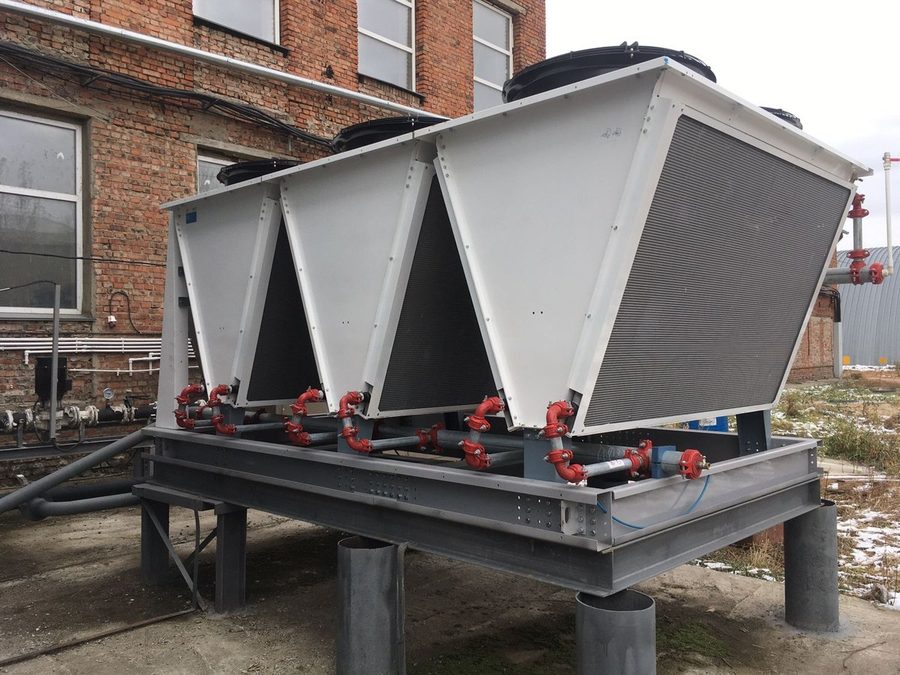
A glass melting furnace runs around the clock and stops only for repair between campaigns, and a campaign lasts many years, sometimes 16 years or more. The furnace components are put on a closed loop with redundancy and an emergency water supply, cooled by NCT closed-circuit cooling towers. The float bath and liquid-cooled molds also go on a closed loop. NCT dry coolers serve the compressor and float line loops that can take water warmer than the outdoor air, and where the water must be colder than a cooling tower delivers in summer, NCT chillers are installed.
What does water cool at a glass plant?
The furnaces, compressors and forming machines of a glass plant release a lot of heat, and most of it is removed with water.
| Area | What the water cools | Loop |
|---|---|---|
| Glass melting furnace | electric boosting electrode holders, the glass level measuring system, other equipment next to the furnace | closed, closed-circuit cooling tower |
| Float bath (flat glass) | cooler tubes that run across the molten tin bath through the side walls | closed, closed-circuit cooling tower |
| Forming machines (container and tableware glass) | liquid-cooled molds; most molds are cooled by air | closed, closed-circuit cooling tower; where the temperature requirement is strict, a chiller |
| Compressor house | the compressors supplying the compressed air that drives the forming machines | closed loop on a dry cooler if the water temperature allows, or recirculating water |
| Glass discharged to cullet | molten glass that bypasses forming | recirculating water |
| Glass processing | autoclave | recirculating water, open cooling tower |
The main hazard for furnace components is an interruption in the water supply. The water in an electrode holder cools the electrode itself and the glass around it: the glass stiffens and does not leak out through the entry point. When the supply stops, the glass at the entry point heats up and the seal of solidified glass is lost. That is why the supply to these components is made redundant, and the water comes from a closed loop filled with treated water. Float bath coolers can have separate circuits, which lets the edges of the glass ribbon be cooled more strongly than the center.
Why is the furnace loop closed and redundant?
An NCT closed-circuit cooling tower cools the furnace water inside a coil, and that water does not contact the air. Dust, batch material and salts from evaporation do not enter the loop.
Redundancy is built in at several levels:
- Cooling tower sections. Stopping the furnace to clean a tower is not an option, so a standby section is added on top of the calculated number: while one is serviced, the rest hold the temperature.
- Pumps. A duty and a standby pump in each pump skid.
- Emergency supply. If the main system fails, the furnace components receive water from an emergency source, for example the fire or city water main. Flow meters and sensors send an alarm to the control system when the flow drops below the minimum.
NCT closed-circuit cooling tower, cutaway
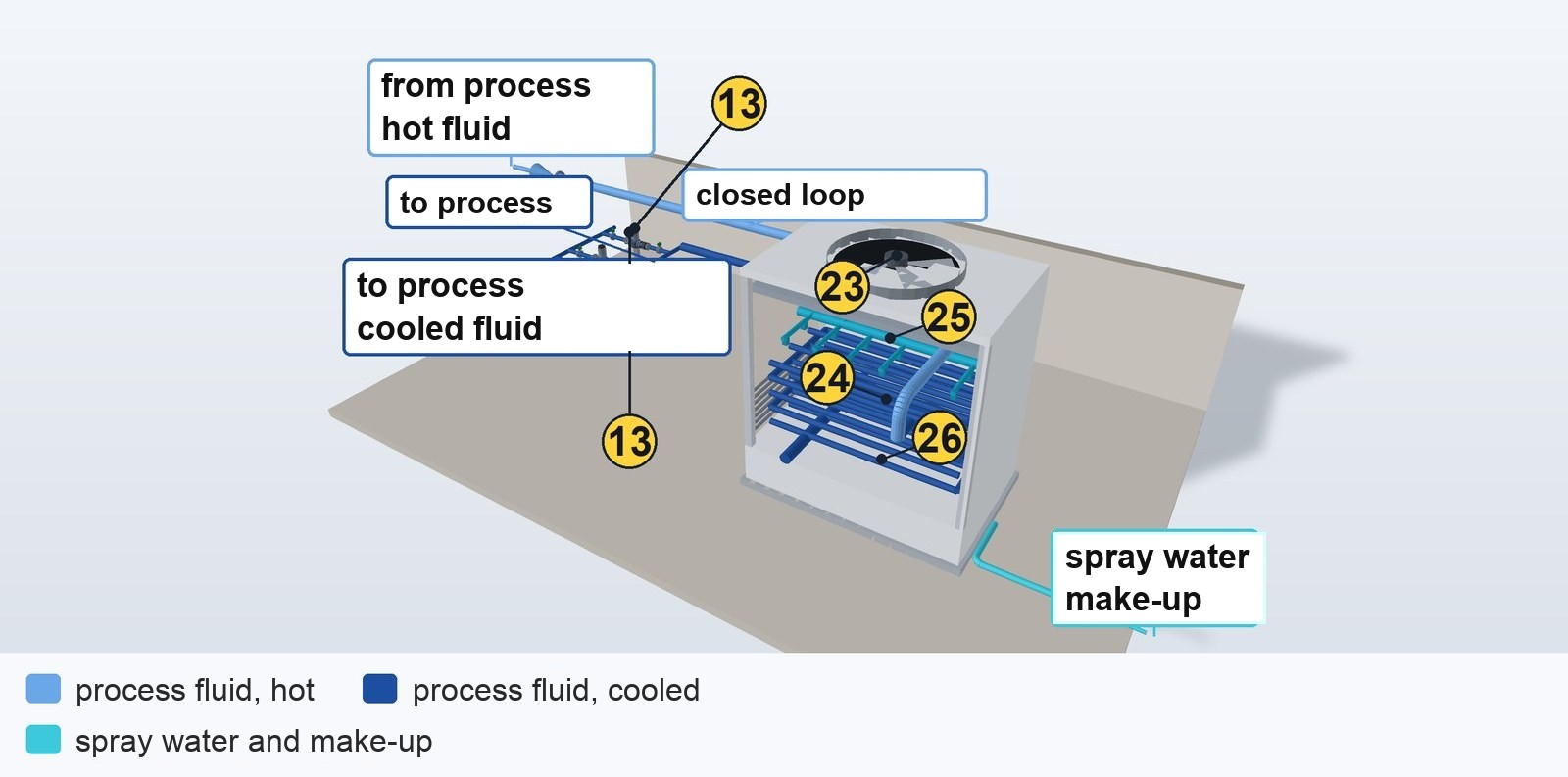
Key to the numbers on the diagram
| No. | Component | Purpose |
|---|---|---|
| 3 | Butterfly valve | isolates the machine and pumps for repair and flushing; installed in pairs, inlet and outlet |
| 5 | Flexible connector (vibration isolator) | right at the connection: dampens vibration and does not transfer the pipe's weight and misalignment to the connection |
| 13 | In-line pump | circulates water through the loop; in pairs, duty + standby |
| 14 | Check valve | prevents backflow through an idle pump |
| 23 | NCT e-VRC series closed-circuit cooling tower | the casing is shown with a cutout so you can see inside |
| 24 | Coil: process fluid inside the tubes | it does not contact the air, is not lost to evaporation and does not get contaminated |
| 25 | Spray water outside the coil | water pours over the tubes and evaporates, carrying heat away: this is a separate loop, and it is the one that is consumed |
| 26 | Spray water basin | regular makeup, blowdown and water treatment are needed only for the spray loop; the fill quality of the inner furnace loop is set by the equipment manufacturer |
What equipment do we install at a glass plant?
- NCT closed-circuit cooling towers for the furnace, float bath and forming machine loops. Modular VRC, e-VRC and SVAC towers are assembled from sections, and the standby section goes into the same row. The e-VRC tower with a finned coil runs without spray water in cold weather: no makeup, no blowdown and no icing of the spray nozzles. In VRC towers the centrifugal fan and motor sit at the bottom, in a dry compartment, and do not ice up in winter.
- NCT dry coolers for closed loops that can take water a few degrees warmer than the outdoor air: compressors and some of the float line loops. NCT dry coolers with pump skids already cool the closed loops of flat glass float lines. At the design summer temperature, adiabatic pre-cooling of the air holds the outlet temperature, if the selection confirms it.
- NCT open cooling towers, VR and SVA series, for recirculating water in areas where the water may contact the air.
- NCT chillers when the water must be colder than a cooling tower delivers in summer and must not change with the weather.
- NCT pump skids for circulation in the consumer loop; water treatment to keep the spray and recirculating water within specification.
If the plant has steam or hot water from furnace heat recovery, cooling for the process and air conditioning can come from a Thermax absorption chiller: the machine takes its main energy for producing cooling from steam or hot water.
Why is cooling replacement planned around the furnace cold repair?
Between campaigns the furnace is shut down and cooled for repair. A short cold shutdown can take about 30 days, a full furnace rebuild takes several months. This window can also be used to replace auxiliary systems. For example, the phased furnace repair program at the Pilkington plant in Ottawa, Illinois, in 2005 included a new furnace cooling water system, together with a new site power supply. On a running furnace the water supply to its components is never interrupted, so the loop switchover is left for the shutdown.
The delivery of the cooling equipment has to fit into the repair window:
- closed-circuit cooling towers: manufacturing takes 16–18 weeks;
- dry coolers: manufacturing takes 10 weeks;
- open cooling towers and chillers: from stock if available, otherwise 10–12 weeks; SVA-1 mini cooling towers with standard parameters: from stock, about 2 weeks.
A closed-circuit tower takes longer to manufacture than a short cold shutdown lasts, so it is ordered as soon as the furnace shutdown date is known. A new module can be installed next to the old tower in advance, while the old one is still running, and only the piping is switched over in the repair window. A module is assembled on site in 1–2 days.
What mistakes are made when choosing cooling?
-
Feeding furnace components directly with water from an open cooling tower. In an open loop the water evaporates, salts concentrate and deposit in narrow channels, and the water temperature changes with the weather. Furnace and forming machine components need a closed loop: a closed-circuit tower, or an open tower through a heat exchanger.
-
Selecting a dry cooler without accounting for the summer air temperature. As a guideline from our brochure, an open cooling tower cools water to the wet-bulb temperature plus 3–5 °C and a closed-circuit tower to the wet-bulb temperature plus 4–5 °C; the loop temperature is confirmed by the selection. A dry cooler cools water only to a temperature above the outdoor air. The selection order: if the dry cooler cannot deliver the required temperature in design heat, a closed-circuit tower is installed; if that cannot either, a chiller.
-
Not planning for dust removal. Glass and batch dust is carried by the air into the spray water of closed-circuit towers and into open towers. The basin and the outside of the coil are cleaned on a schedule; open towers have a removable basin strainer and removable fill for this.
Where our equipment works at glass plants
Cold Energy's 780+ projects include flat glass, container glass, insulating glass and glass microsphere plants:
| Site | Equipment | Task |
|---|---|---|
| Container glass plant, Omsk | two NCT VRC0-6 closed-circuit cooling towers, 30 m³/h each, 50 → 30 °C, with VFD control panels | furnace cooling; deliveries in 2020 and 2021 |
| Insulating and tempered glass plant, Leningrad Region | an NCT SVA-1 mini cooling tower of 500 kW, a pump skid, a control panel | autoclave cooling |
| Glass microsphere plant, Vladimir Region | an NCT open cooling tower with a VFD control panel | recirculating water for production |
| Glass plant, Vologda Region | NCT DC dry coolers | dry cooling of a closed loop |
Among many other sites are glass plants in Mordovia, Udmurtia and St. Petersburg.
Building materials: cement, silicate products, thermal insulation
At building materials plants, heat is removed from compressors, machine tools and process lines.
- Cement plants: NCT cooling towers with pump skids for recirculating cooling of compressor equipment.
- The Minsk silicate products plant: an NCT SVA-1 mini cooling tower cools machine tools; it was assembled and installed in one day.
- The Agidel thermal insulation plant, Blagoveshchensk, Bashkortostan: two NCT SVA cooling towers cool the line producing stitched basalt wool mats.
FAQ
An open cooling tower is cheaper. Why use a closed-circuit one on the furnace loop?
The open tower is cheaper as a machine, but on the furnace loop it needs a plate heat exchanger and a second pumping loop, and these also have to be bought, installed and maintained. An NCT VRC closed-circuit cooling tower replaces this set with one machine and cools clean water with a range of up to 60 °C in a single stage.
Is a hot standby motor an unnecessary cost if there is already a standby section?
A hot standby covers a motor failure, while the standby section remains available for maintenance. In VR and VRC towers of the appropriate design, each section has a standby electric motor with its own drive, which starts automatically when the main one fails. SVAC towers, except SVAC1, have several fans with separate motors in each section, and a full-size standby motor is available as an option. A motor failure then does not take the section out of service. Section and pump redundancy for the loop is calculated separately.
A dry cooler costs more than a cooling tower. Why pay more?
On a closed loop, a dry cooler is compared with a closed-circuit cooling tower. In dry mode it needs no makeup water, blowdown or water treatment, and the glycol in the loop does not evaporate: it is filled once, and after that its concentration is checked. With adiabatic pre-cooling, water is used only in the hot hours.
We have closed-circuit towers from another manufacturer. Do you service them?
We do not repair or service other brands of cooling towers, but we sell spare parts for them and replace them with NCT units. For the old location we select a series that fits the area, height, weight and connection positions; whether the old foundation can carry the new weight is checked separately.
Send us the data for selection: the flow, the water temperatures and the furnace shutdown date: submit a request or call +7 (800) 333-49-96.
Watch: cooling towers (in Russian)
NCT VA cooling towers: review by Maxim KrasnovLet us size a cooling system for your site
An engineer will select the equipment and send you a calculation. Free of charge, no obligation.