
Compressor cooling for industrial gas production, nitrogen plants and LNG
In brief. At air separation units, nitrogen and oxygen plants and LNG facilities, compressor heat is rejected to cooling water. We make open and closed-circuit NCT cooling towers, dry coolers and a cooling tower, pump skid, control panels, tank and water treatment package, with design documents and factory acceptance.
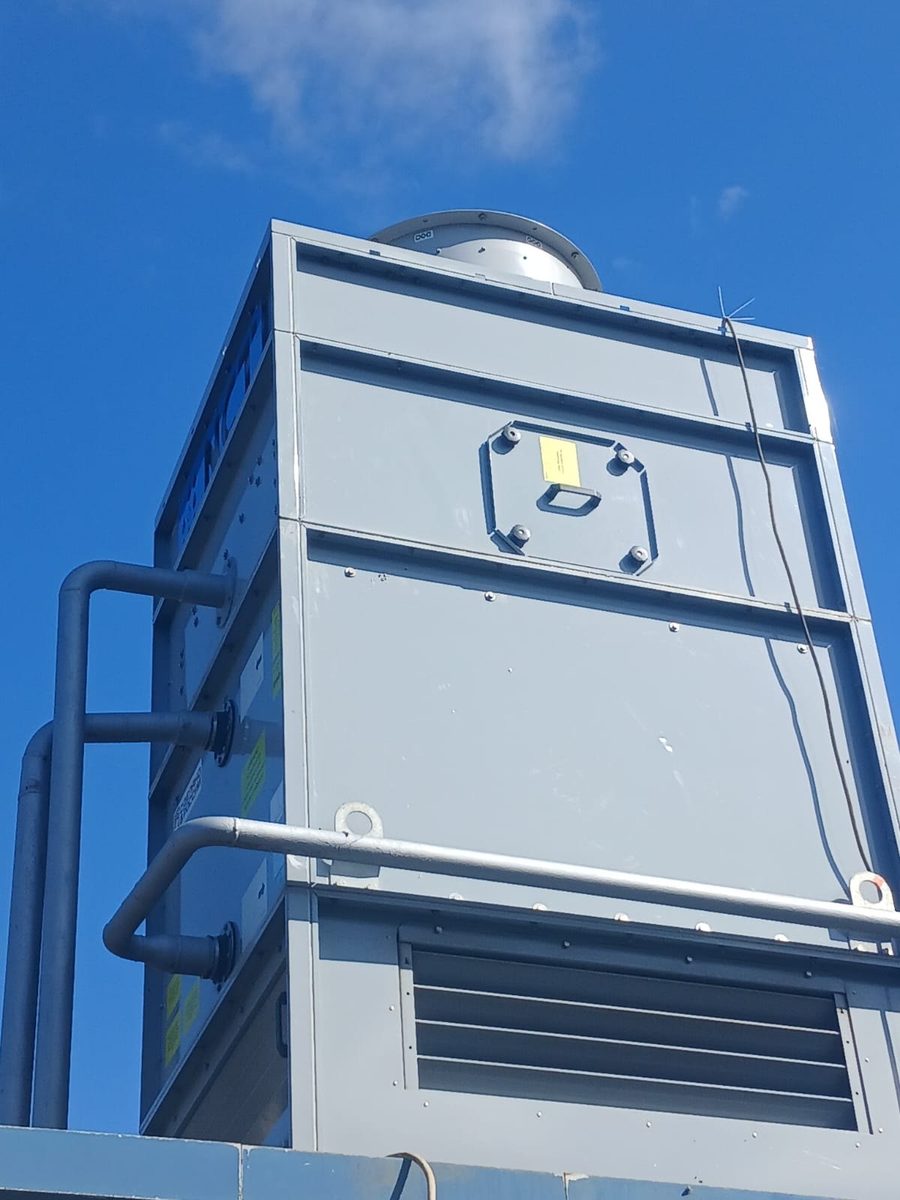
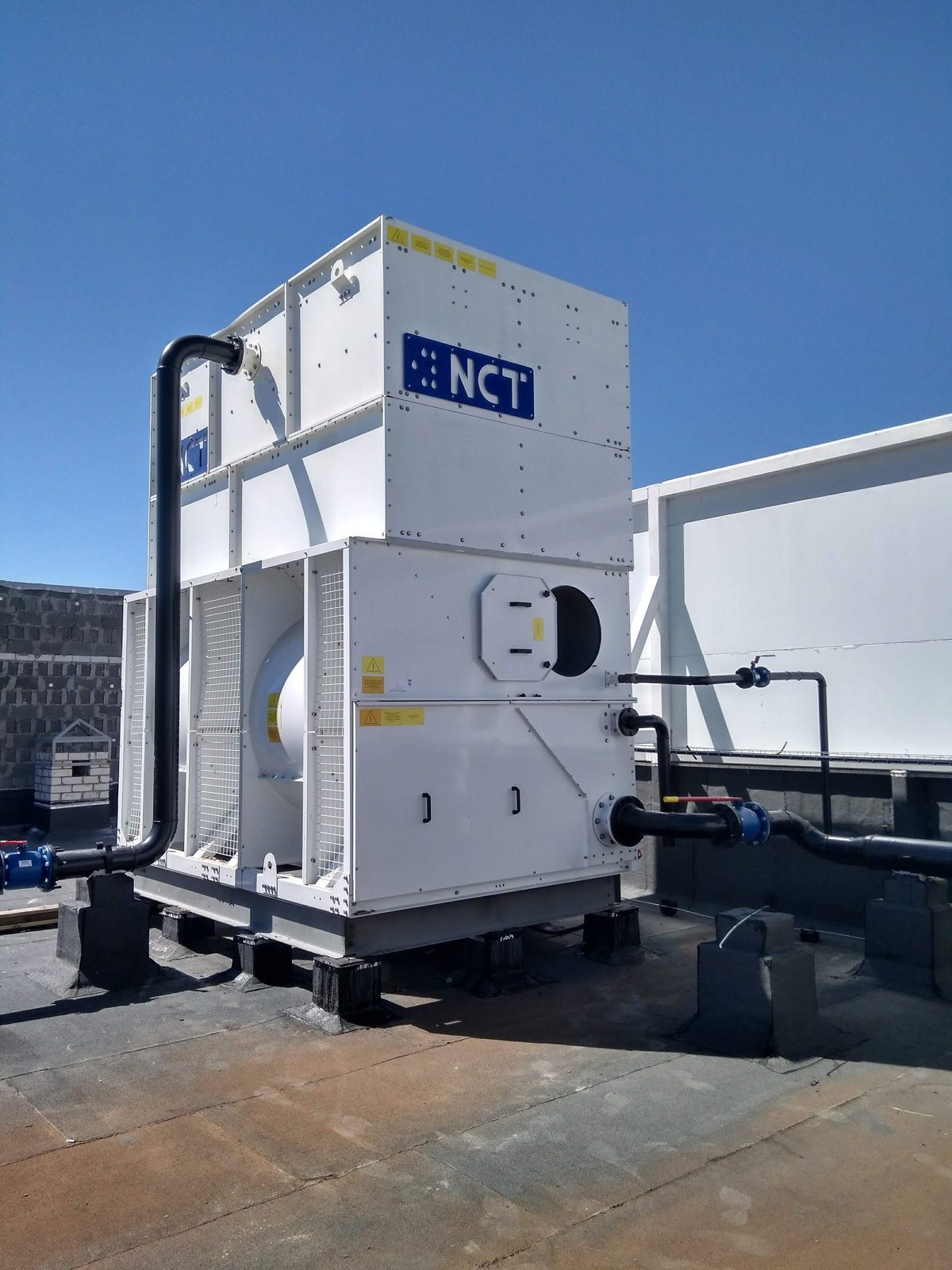
An air separation unit, a nitrogen plant or a gas liquefaction train shuts down when the compressor oil or the water in its intercoolers overheats. That is why heat rejection from the compressors is part of the gas production process. For this system we select and manufacture open and closed-circuit NCT cooling towers, NCT dry coolers for sites without water, NCT chillers for precooling, pump skids, control panels and water treatment. The cooling package is often ordered not by the plant itself but by the supplier of the compressor or nitrogen plant or by the general contractor, so a separate section below covers what we provide for the design and the cost estimate.
What is cooled in industrial gas production?
Air separation unit compressors
The main air compressor of an air separation unit (ASU) compresses air in several stages. Between the stages the air is cooled in intercoolers, after the last stage in the aftercooler, and this heat goes into the recirculating water from the cooling tower. According to Ecolab (Nalco Water), air compression is the main energy cost of an ASU, and fouling and corrosion in the intercoolers and aftercoolers reduce compressor performance by 2–3%. That is why the cooling tower is sized for the load of all compressor stages, and water quality is maintained by water treatment.
Air precooling at the ASU
After the aftercooler, the air is cooled further before the molecular sieve adsorbers, which remove moisture and CO₂ from it. This is usually done in a direct contact column with chilled water. The water for it is chilled in an evaporative cooler against dry waste nitrogen or by a chiller. A chiller holds the set water temperature in any weather, while a cooling tower cannot deliver such water in summer: its water is never colder than the wet-bulb temperature.
Nitrogen plants
Pressure swing adsorption (PSA) and membrane nitrogen generators run on compressed air, and the plant's heat is removed from the compressor: from the oil cooler and the aftercooler. A PSA generator needs clean, dry air: Atlas Copco specifies 4–13 bar and 10–25 °C at the inlet, so a dryer and filters are installed between the compressor and the generator. In a membrane generator, nitrogen output and purity depend on the feed air temperature, which is held by the compressor aftercooler and a heater. If the plant's compressors are water-cooled, their heat is rejected by a cooling tower. Examples of nitrogen and oxygen plants are in the projects section below.
LNG plant compressors
At an LNG plant, heat is removed from the refrigeration cycle and gas compressors: from intercoolers, aftercoolers and refrigerant condensers. Large onshore plants more often reject this heat with air-cooled heat exchangers. Water cooling achieves a closer approach between the refrigerant and the cooling medium than air coolers, and the cooler the refrigerant, the less power it takes to compress it. However, it requires a cooling tower, pumps and water treatment. That is why the method is chosen in the design based on the climate and water availability at the site.
If you need cooling from waste heat, for example for condensing light fractions at a refinery, see the Petrochemicals page, which covers Thermax absorption chillers. Gas turbine inlet air cooling is described on the Gas turbine and gas engine inlet air cooling page.
What equipment do we use, and why?
| Task | NCT solution | When it fits |
|---|---|---|
| Oil coolers and intercoolers of compressors at ASUs, nitrogen and oxygen plants | open cooling tower with a pump skid and water treatment | large recirculating water flow, make-up water available, the compressor accepts recirculating water; guideline from our brochure: water 3–5 °C above the wet-bulb temperature, the exact temperature comes from selection |
| Coolers that need clean water, glycol loops | closed-circuit cooling tower: the fluid flows inside the coil | clean loop without an intermediate heat exchanger, year-round operation. In summer, with spray water, the guideline from our brochure is fluid 5–8 °C above the wet-bulb temperature; the loop temperature is confirmed by selection. In winter, dry mode without spray water |
| Site without water or with expensive make-up water | dry cooler | water or glycol is cooled to 5–7 °C above the air temperature: in hot weather 8–12 °C warmer than after a cooling tower; the compressor must accept such water |
| Water colder than a cooling tower can deliver: precooling of air before the adsorbers, of gas or of refrigerant | chiller with a cooling tower or a dry cooler on the condenser | set temperature in any weather |
Closed-circuit cooling tower for compressors
In a closed-circuit cooling tower, the cooled fluid flows inside the coil and does not come into contact with air. Dust and spores from the air do not enter the loop, and the compressor heat exchangers do not foul. One unit replaces the combination of "open cooling tower, plate heat exchanger, second pump", leaving no heat exchanger in the plant room that has to be dismantled and flushed.
For northern sites the loop is filled with glycol: an emergency pump stop in frost will not freeze the coil or the process loop. In winter the spray water is switched off, and the tower runs in dry mode with no make-up, blowdown or chemicals. The outdoor temperature at which this becomes possible is calculated from the seasonal load of the site. VRC and HRC towers have several fans: if one motor fails, the others keep running. We make the coils ourselves, and radiographic inspection of the welds is done at the customer's request. VRC models less than 3.5 m wide are supplied in two factory-assembled blocks.
More on choosing a scheme for compressors is in the article "Compressor cooling: cooling tower, closed loop or dry cooler" (in Russian).
What do we provide to integrators for the design and the cost estimate?
The compressor cooling package is usually purchased against the project specification. The customer needs a working package under one contract and documentation for the design review.
For the design:
- selection with the design point at your site's wet-bulb temperature, with the duty fixed in the proposal;
- general arrangement drawing, connection points, load and noise data;
- data sheets, typical piping diagrams and BIM models (Revit) on request, see the For design engineers (in Russian) page;
- cooling, automation and electrical work in one scope, with design inputs for other disciplines;
- technical support in resolving review comments on the design, with the scope fixed in the contract.
The "cooling tower, pump skid, control panels, tank, water treatment" package:
| Component | What it includes |
|---|---|
| NCT cooling tower | open or closed-circuit, series chosen by flow, temperature range and climate; winter package |
| Pump skid | duty and standby pumps, piping assembled and hydrotested at the factory; the pump brand is selected to the customer's requirements |
| Tank and make-up skid | tank of bolted hot-dip galvanized sections, dimensions and nozzles to the design; make-up skid sized for the site's make-up flow |
| Control panels | for the cooling tower and the pumps, variable frequency control, status and alarm transmission via Modbus or Ethernet |
| NCT W2C water treatment | conductivity sensor, automatic blowdown, inhibitor and biocide dosing |
| Spare parts kit | to a separate specification, shipped together with the package |
Acceptance and delivery. The factory test program is agreed in advance, and customer inspection at our plant before shipment is standard practice. Marking and packing follow the customer's procedure, and we ship in lots to match the construction schedule. If installation is postponed, our service team can handle equipment preservation.
Lead times. An open cooling tower or a chiller may be in stock; if not, 10–12 weeks. A closed-circuit cooling tower takes 16–18 weeks, a dry cooler 10 weeks.
Credentials. Production complies with GOST R ISO 9001-2015, and we have passed a Gazprom audit. We are a member of the Cooling Technology Institute (CTI, USA): acceptance testing of the cooling tower to CTI code ATC-105 can be written into the contract. The standard warranty is 12 months; up to 5 years with a service contract with a certified partner and mandatory water treatment. We install the equipment ourselves or supervise the customer's crew, and commissioning is carried out by our engineers.
Which selection mistakes cost the most?
-
Open recirculating water in coolers that need clean water. Evaporation concentrates salts, and they deposit in the compressor intercoolers. If the compressor specifies water quality, a closed-circuit cooling tower or a heat exchanger is designed in from the start.
-
Sizing without the site's wet-bulb temperature. Without it, proposals from different suppliers cannot be compared, and a temperature shortfall is expensive. In an Ecolab case study, the approach (the difference between the water temperature and the wet-bulb temperature) of a main air compressor's cooling tower was 8 °C above design, and the compressor's power consumption rose by 3% over two years.
-
Expecting water colder than a cooling tower's limit. The limits of open and closed-circuit cooling towers and of dry coolers are in the table above. If the compressor or the precooling stage needs colder water, a chiller is added to the scheme from the start instead of an oversized cooling tower.
-
A unit designed for a temperate climate at a northern site. In winter it ices up where more air is supplied than needed. For a cold climate we include variable frequency fan control, a bypass, basin heating during shutdowns, and dry mode for closed-circuit towers.
-
The hazardous area is not stated in the technical specification. The motor and control design and the layout are agreed with the design engineer before manufacturing. For refineries and petrochemicals we make closed-circuit cooling towers with explosion-proof (ATEX) motors; for other hazardous sites, in the design agreed with the design engineer.
Where do our cooling towers work in gas production?
We have completed 780+ projects. Examples of sites where our cooling towers serve ASU, nitrogen and oxygen plant compressors and an electrolyzer:
- Navoi Mining and Metallurgical Combine (in Russian), Uzbekistan: for the oxygen plant compressors we supplied an open NCT VR cooling tower with a winter package, a PU-330/50 pump skid and a W2C water quality control system.
- Industrial gas producer, Western Siberia: NCT closed-circuit cooling towers on the ASU compressors replaced a tower from a European manufacturer; glycol loop, winter package.
- Gas distribution station, Volga Federal District: an NCT closed-circuit cooling tower with a winter package and variable frequency control cools the ASU compressors; commissioning by our engineers.
- Producer of liquid and gaseous oxygen and nitrogen, Northwest Russia: an open NCT cooling tower cools the air compressor year-round.
- Beverage plant, North Caucasus: an open NCT cooling tower with basin heating cools the nitrogen plant compressors. The plant came back with a repeat order.
- Technical gas production (in Russian), Yekaterinburg: an NCT SVA-1 mini cooling tower rated at 323 kW is installed indoors and cools an electrolyzer.
All projects are in the Projects section. Absorption chillers on waste heat for fertilizer production are on the Fertilizer plants page.
How does a compressor cooling project run?
- Input data: heat load per loop, the compressor's water requirements, make-up water analysis, site climate and logistics.
- Comparison of schemes by electricity, water and total cost of ownership.
- Selection, layout, documentation for the design.
- Manufacturing, factory acceptance, delivery, installation or installation supervision, commissioning and staff training.
Cooling schemes
Typical schemes we use in this industry. The numbers on the diagram are the piping components; the key is under each diagram.
NCT closed-circuit cooling tower, cutaway view
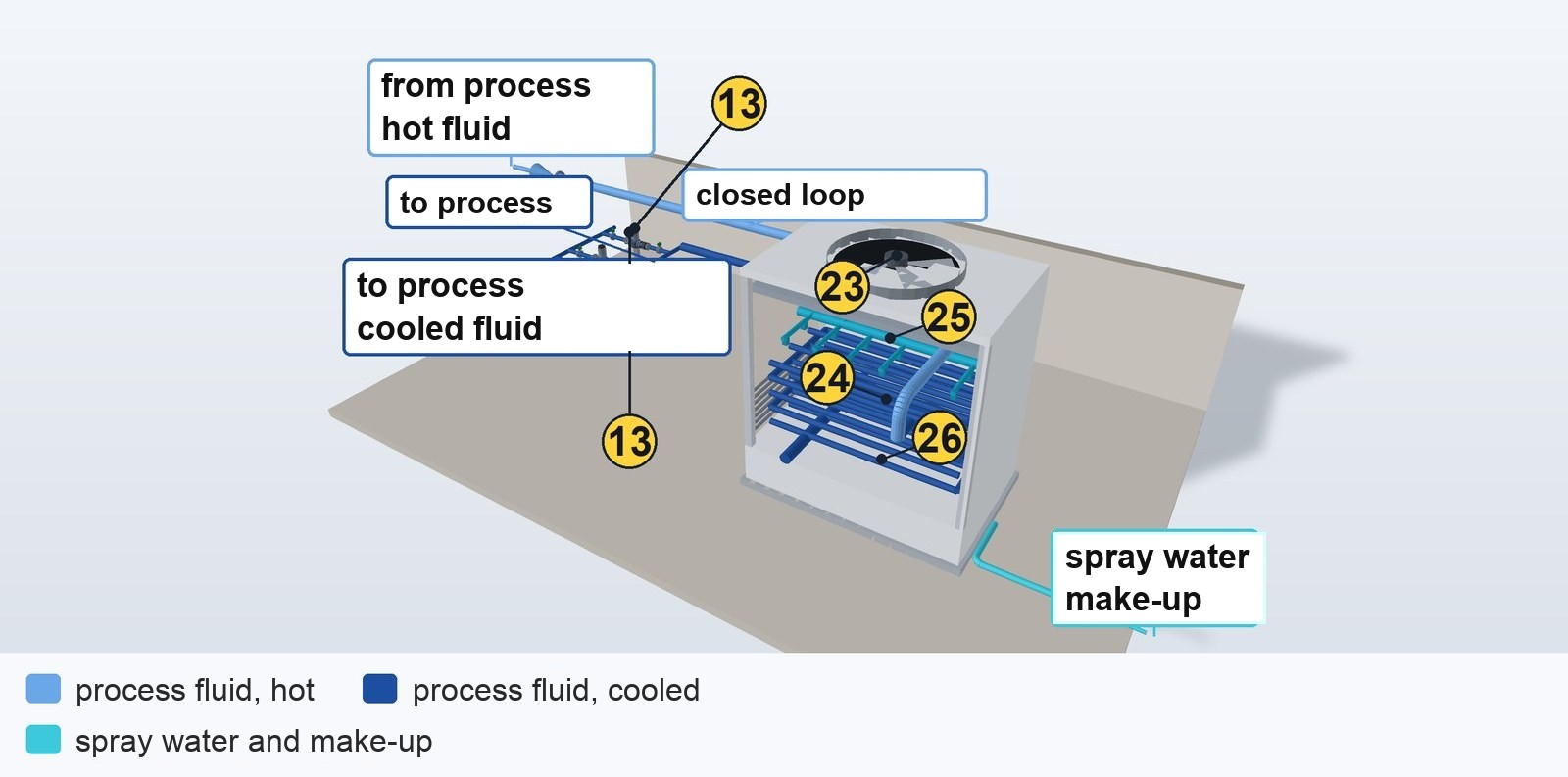
The process fluid flows inside the coil and the spray water flows outside: the circuit stays clean and the heat transfer fluid is not lost.
Key to the numbers on the diagram
| No. | Component | Purpose |
|---|---|---|
| 3 | Butterfly valve | isolates the machine and pumps for repair and flushing; installed in pairs, inlet and outlet |
| 5 | Flexible connector (vibration isolator) | right at the nozzle: damps vibration, does not transfer the pipe's weight and misalignment to the nozzle |
| 13 | In-line pump | circulates water through the circuit; in a pair, duty + standby |
| 14 | Check valve | prevents water from flowing back through the idle pump |
| 23 | NCT e-VRC series closed-circuit cooling tower | the casing is shown with a cutout so the inside is visible |
| 24 | Coil: process fluid inside the tubes | it does not come into contact with air, is not lost to evaporation and does not get contaminated |
| 25 | Spray water outside the coil | water pours onto the tubes and evaporates, carrying away heat: this is a separate circuit, and it is the one that is consumed |
| 26 | Spray water basin | only this water needs make-up, blowdown and water treatment |
Open recirculating cooling loop
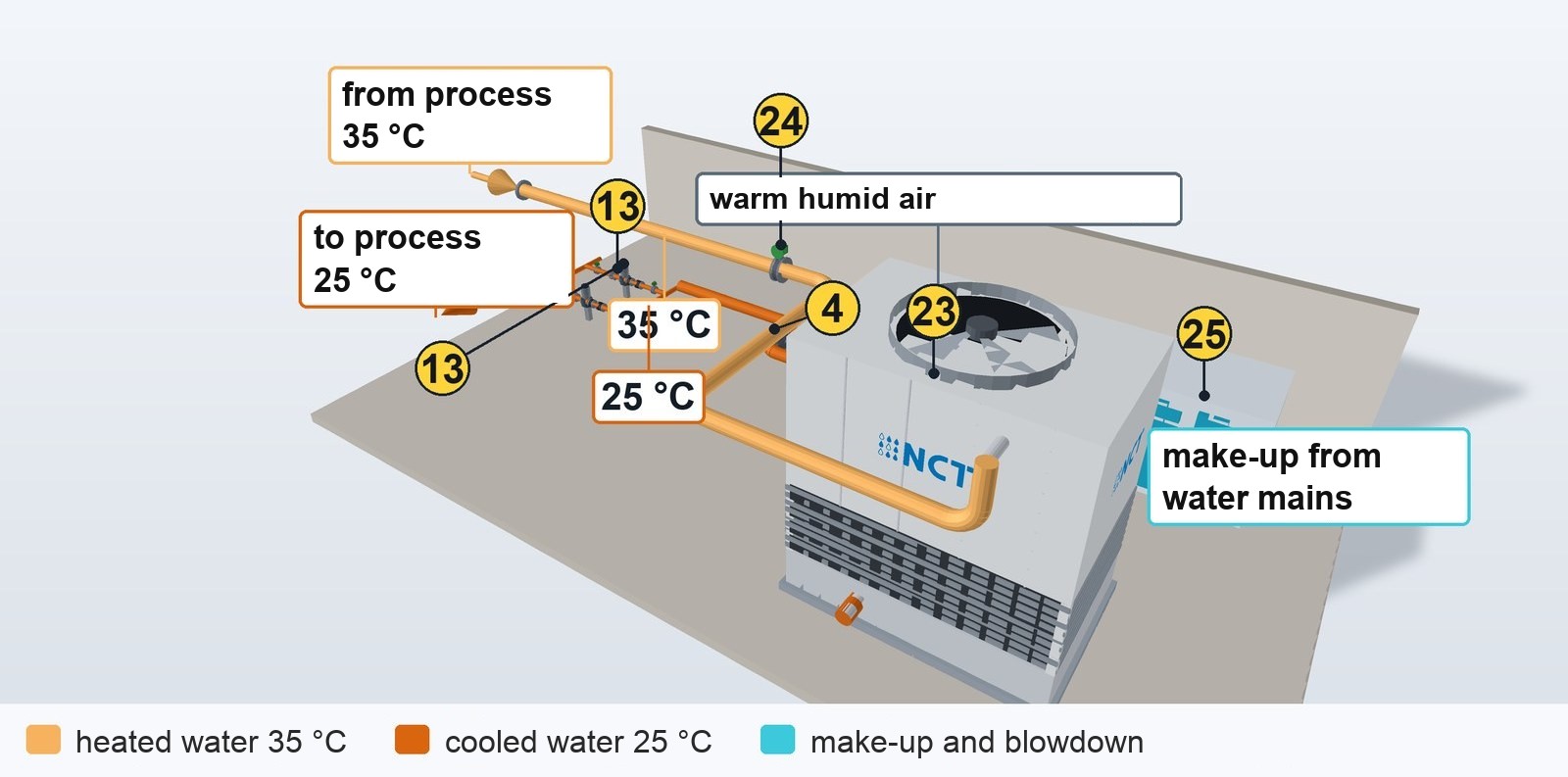
Heated process water is cooled in the cooling tower by evaporation and returns to the process; water is consumed only for make-up and blowdown.
Key to the numbers on the diagram
| No. | Component | Purpose |
|---|---|---|
| 3 | Butterfly valve | isolates the machine and pumps for repair and flushing; installed in pairs, inlet and outlet |
| 4 | Y-strainer | catches scale and debris before the unit's tubes; inlet only |
| 5 | Flexible connector (vibration isolator) | right at the nozzle: damps vibration, does not transfer the pipe's weight and misalignment to the nozzle |
| 13 | In-line pump | circulates water through the circuit; in a pair, duty + standby |
| 14 | Check valve | prevents water from flowing back through the idle pump |
| 23 | Open NCT cooling tower | water gives off heat to the air by evaporation: the cheapest way to reject megawatts |
| 24 | Butterfly valve on the supply line | isolates the cooling tower for repair without stopping the other sections |
| 25 | Water treatment and automatic blowdown | reverse osmosis or dosing: without it, scale eats away heat transfer and blowdown runs blind |
Frequently asked questions
The compressor will only arrive in eight months. When should we order the cooling tower?
Don't put the purchase on hold: the design already needs the cooling tower's dimensions, connection points and loads. Manufacturing takes less than eight months, so the delivery date in the contract is tied to site readiness. Count the delivery schedule back from compressor start-up: by that day the pipes are connected, the loop is filled and the pressure is checked. Early delivery is not a problem if the equipment is preserved. In winter, water in the spray pump is a hazard: at one site it got inside and froze, the unit failed before commissioning, and its manufacturer's service centre ruled it a non-warranty case. Before a winter shutdown, the pump is drained.
We need a remote panel: remote start and stop, and all alarms in one place. But the package has several control panels. How do we combine them?
Each panel in the package can be connected to the plant's monitoring system: start on an external signal, with status and alarm signals transmitted via Modbus or Ethernet. The signals are then brought into the plant control system or onto a common panel. Agree the signal list and protocol with the general designer before the panels are manufactured: adding inputs and outputs after shipment is harder and more expensive.
Why does the contract require us to check the coil pressure with a gauge on acceptance and to draw up a report if the coil has lost pressure?
The coil of a closed-circuit cooling tower is tested at the factory: the bends are pressure-tested before assembly, the assembled coil is held under pressure for at least 12 hours, then it is galvanized and shipped charged with nitrogen. That is why on acceptance, before unloading, the buyer records the gauge reading and the condition of the packaging; if there is no pressure, the buyer draws up a report with photos and video and sends it to the supplier. The same clause is in chiller contracts. It does not apply to an open cooling tower: it has no pressurized circuit.
Send us the data for selecting the cooling package: submit a request or call +7 (800) 333-49-96.
Watch: cooling towers (in Russian)
VR-1-6-U cooling tower: customer reviewLet us size a cooling system for your site
An engineer will select the equipment and send you a calculation. Free of charge, no obligation.