
Cooling for metallurgical plants and foundries: installation during a scheduled shutdown, operation on dirty water
In brief. Rolling mill, furnace and compressor water is cooled by open NCT VR towers with filtration, induction furnace and mold loops by closed-circuit towers or open towers through a heat exchanger, +7 °C water by chillers or steam-fired Thermax absorption chillers. A tower module is assembled in 1–2 days.
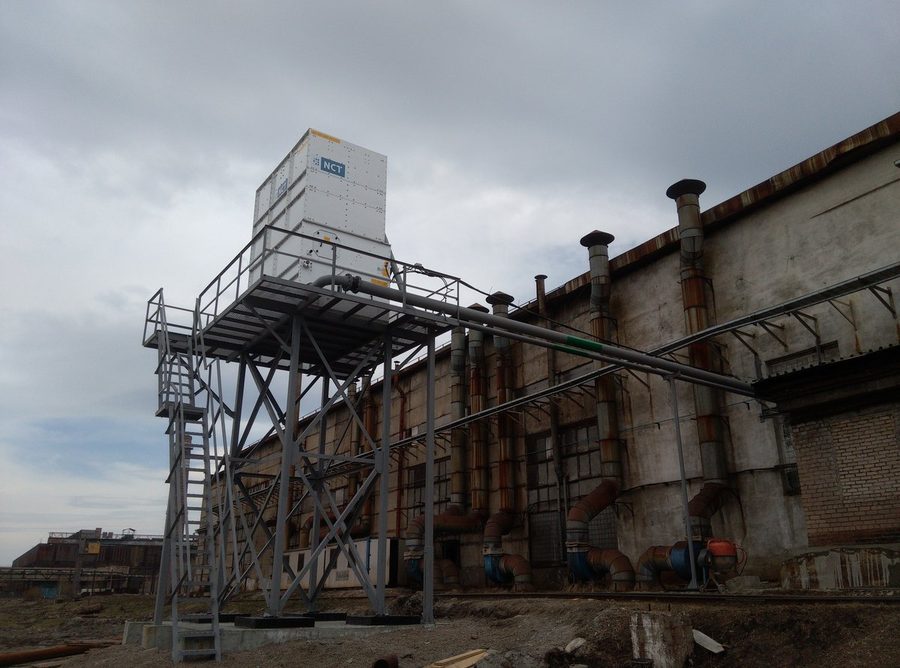
A metallurgical plant or foundry runs several cooling loops with different water requirements. Rolling mill water carries scale and oil, induction coil water flows through a small-bore copper tube, and the air conditioners of control cabinets and control rooms need +7 °C water in any weather. We design, manufacture, install and commission the whole system: open NCT VR cooling towers with pump skids for recirculating water, NCT closed-circuit cooling towers and dry coolers for closed furnace loops, NCT chillers, and Thermax absorption chillers running on steam and hot water.
What needs cooling at a metallurgical plant or foundry?
If all loops are combined into one system, the most demanding consumer sets the parameters for everyone. So the calculation starts by sorting the consumers: how much heat each one rejects, what water it needs and what it puts into the water.
| Consumer | Return → supply, °C | Water requirements | How we cool it |
|---|---|---|---|
| Induction furnaces, coils, frequency converters | 40 → 30 °C | treated water in a closed loop, quality per the furnace data sheet | closed-circuit cooling tower, open tower through a heat exchanger, or a dry cooler if the furnace accepts warm water; a trim chiller if colder water is needed |
| Electric arc furnaces: water-cooled panels, roof, off-gas duct; furnace transformer | as specified by the furnace manufacturer | high flow without interruption; the transformer on a separate closed loop | open cooling tower with a pump skid and standby pumps; the closed loop through a heat exchanger or a closed-circuit tower |
| Continuous caster molds | 45 → 35 °C | clean closed loop: the water touches neither air nor metal | closed-circuit cooling tower, or open tower through a heat exchanger |
| Caster secondary cooling zone, rolling mills, rolls | 45 → 35 °C for rolling mills | contact water that picks up scale, oil and suspended solids | open cooling tower in a recirculating loop after the scale pit and filters |
| Quench tanks and spray quenching | 60 → 30 °C at one of our sites | large cooling range; if the quenchant is oil, it is cooled in an oil cooler and only water goes to the tower | open VR cooling tower, cooling range up to 40 °C |
| Hydraulics, oil coolers, compressor and oxygen stations | 40 → 30 °C | the equipment heat exchanger must not foul; sectional redundancy | open tower in a recirculating loop, or a closed loop on water or glycol |
| Control cabinets, control rooms, amenity buildings | 12 → 7 °C | constant temperature regardless of weather | chiller, or absorption chiller on steam or hot water |
| Steam and hot water from furnace heat recovery | hot water from 95 °C, steam at 0.8 MPa | an energy source for cooling | a Thermax absorption chiller turns this heat into cooling |
The temperatures are a guide from our Russian-language industry brochure on metallurgy and foundries (2026); the exact values come from the data sheets of the furnaces, mills and machines. Melting runs in cycles, so the system is sized for the peak load at the end of a cycle, or for a peak smoothed by a buffer tank.
How is recirculating water cooled for rolling mills, furnaces and compressor stations?
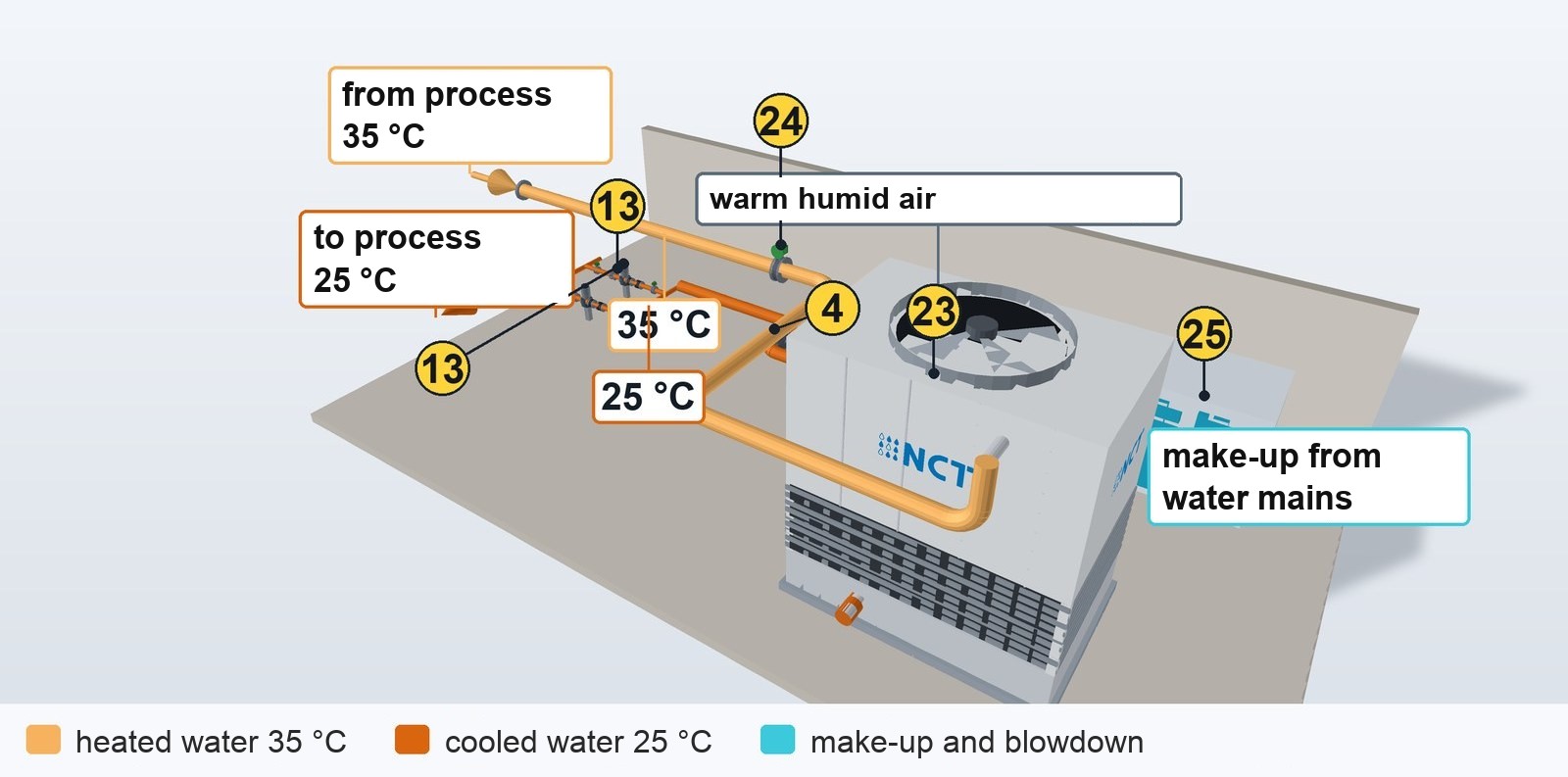
Recirculating water from a rolling mill, an arc furnace or a compressor station is cooled by an open evaporative cooling tower. An open cooling tower uses 0.02–0.06 kW of electricity for fans and pumps per 1 kW of heat rejected. The limit of an open tower is the site's wet-bulb temperature. The water leaves 3–5 °C warmer than that: a typical duty is 35 → 25 °C at a design wet bulb of about 20 °C. In central Russia an open tower cannot deliver water colder than 24–26 °C in summer.
NCT VR cooling towers handle 33–5000 m³/h of water with a cooling range of up to 40 °C in a single tower, subject to selection, so they also suit quenching, where the water comes back hot. For large flows there is the VA series (in Russian) with one large low-speed fan per section.
Water with scale and oil calls for a different approach to the tower and the loop:
- Cleaning first, then the tower. Water from the rolling mill and the secondary cooling zone passes through the scale pit, an oil skimmer and filters before it reaches the tower. A strainer is installed upstream of the tower pumps, and pipe velocities are chosen so that solids do not settle.
- Separate loops. If the water contains a lot of oil emulsion, the dirty loop is separated by a gasketed plate heat exchanger, and the tower works on clean water.
- Removable fill. Fill mounted on plastic studs with a 19 mm gap between sheets is taken out, washed and put back. If the loops cannot be separated, splash fill or fill with wide channels is used; this is a non-standard design that costs more and takes longer to manufacture.
- Nozzles and basin access. The nozzles drain themselves and do not clog, and hatches and removable louvers give access to the basin: sludge is removed without dismantling the tower.
- Water treatment based on a water analysis. Evaporation concentrates salts. The NCT W2C system monitors dissolved solids and doses inhibitors and biocides, and NCT W0C automatic blowdown discharges water by conductivity rather than by guesswork.
We assemble the NCT pump skid at our plant: duty and standby pumps, variable frequency drives and a control panel, with the pump brand selected with the client's requirements in mind and agreed in the specification. More on the Pump skids and Recirculating water systems pages.
How are induction furnaces and caster molds cooled?
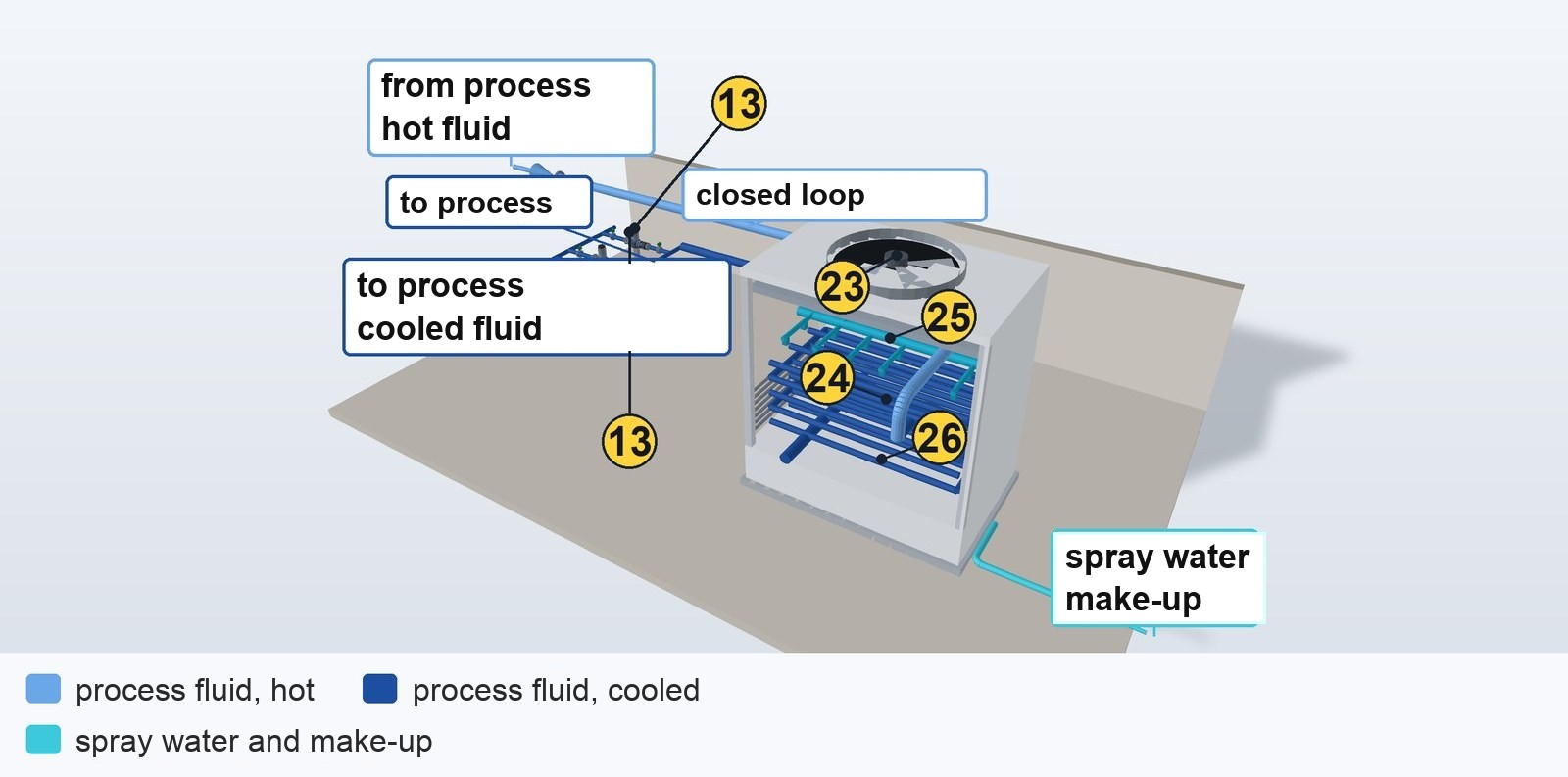
An induction furnace and a continuous caster mold are cooled by a closed loop: open cooling tower water is not sent into the copper tube of the coil or into the mold wall. Deposits in a narrow coil channel lead to local overheating and coil burn-through, and induction equipment manufacturers specify the water quality in the data sheet, recommend a separate closed loop and warn that connecting plant water directly may void the warranty.
The closed furnace loop follows one of three schemes:
- Closed-circuit cooling tower. The furnace water flows through a coil and never meets the air; site dust stays in the small spray-water loop. As a guide, the outlet water is 5–8 °C above the wet bulb and 2–3 °C warmer than from an open tower, because heat has to pass through the tube wall. The temperature of a specific loop is confirmed by the selection. In winter the spray is switched off and the tower runs dry. Series VRC, e-VRC, SVAC and HRC are on the NCT cooling towers page.
- Open cooling tower plus a plate heat exchanger. The furnace loop is sealed, with its own pump and expansion tank; the heat exchanger adds 1.5–2 °C to the water temperature. This pays off at high flow rates and where the furnace already has its own heat exchanger.
- Dry cooler. A glycol loop runs without using water; the fluid leaves 3–5 °C or more above the outdoor air temperature. It suits furnaces that accept warm water. If summer air is warmer than the required temperature, an adiabatic dry cooler (in Russian) is used: it sprays water only during the hottest hours. The control panel is part of the standard scope of an NCT dry cooler.
If the furnace data sheet requires water colder than the tower can deliver in hot weather, a trim chiller is added to the tower and runs only in the hottest hours. With water at about 20 °C, the dew point in the shop is checked, otherwise condensate will form on the coil. A comparison of schemes by temperature and electricity costs is in the article Induction furnace cooling (in Russian).
When is a chiller needed, and when a steam-fired absorption chiller?
A chiller is needed when the water must be +7…+12 °C in any weather: control cabinets, control rooms, amenity buildings, areas with a tight temperature duty. On glycol, an NCT chiller goes down to −10…−15 °C; the limit depends on the concentration and the compressor.
If the site has steam or hot water from furnace heat recovery, +7 °C chilled water comes from a Thermax absorption chiller. It has no compressor and no synthetic refrigerant: the refrigerant is water, the absorbent is a lithium bromide solution, and the energy comes from 0.8 MPa steam or hot water. The 3 MW absorption chiller itself needs about 17 kW for pumps and controls; a compressor chiller of the same capacity needs about 670 kW for the compressors alone. The cooling tower and condenser water pumps of an absorption scheme are larger, but at an operating plant without spare capacity it often avoids a new grid connection.
Absorption has two limits:
- The payoff depends on the price of steam. The scheme pays off when the steam is the plant's own or the heat is waste heat. With purchased steam a chiller may cost less to run, so we calculate both options at the plant's tariffs.
- A larger cooling tower. An absorption chiller rejects more heat than a compressor chiller of the same capacity, so its cooling tower is selected larger.
The standard setpoint of an absorption chiller is +7 °C; on steam or gas it goes down to −5 °C. Deep sub-zero temperatures come only from a compressor machine.
How can cooling be installed during a scheduled shutdown?
A metallurgical shop cannot be stopped to build a cooling tower, so replacing or expanding cooling is tied to the scheduled shutdown. Almost everything is done before it:
- Manufacturing to the shutdown schedule. Open cooling towers may be in stock; if not, manufacturing takes 10–12 weeks, and closed-circuit VRC, SVAC and HRC towers take 16–18 weeks. A closed-circuit tower is ordered at least 4–5 months before the shutdown so that the equipment arrives in time.
- Preparation while the shop runs. While the tower is at our plant, we prepare the foundation or frame, tie-ins, shut-off valves and cables. If the new tower stands next to the old one, we install it in advance, and the shop only waits for the loop to be switched over.
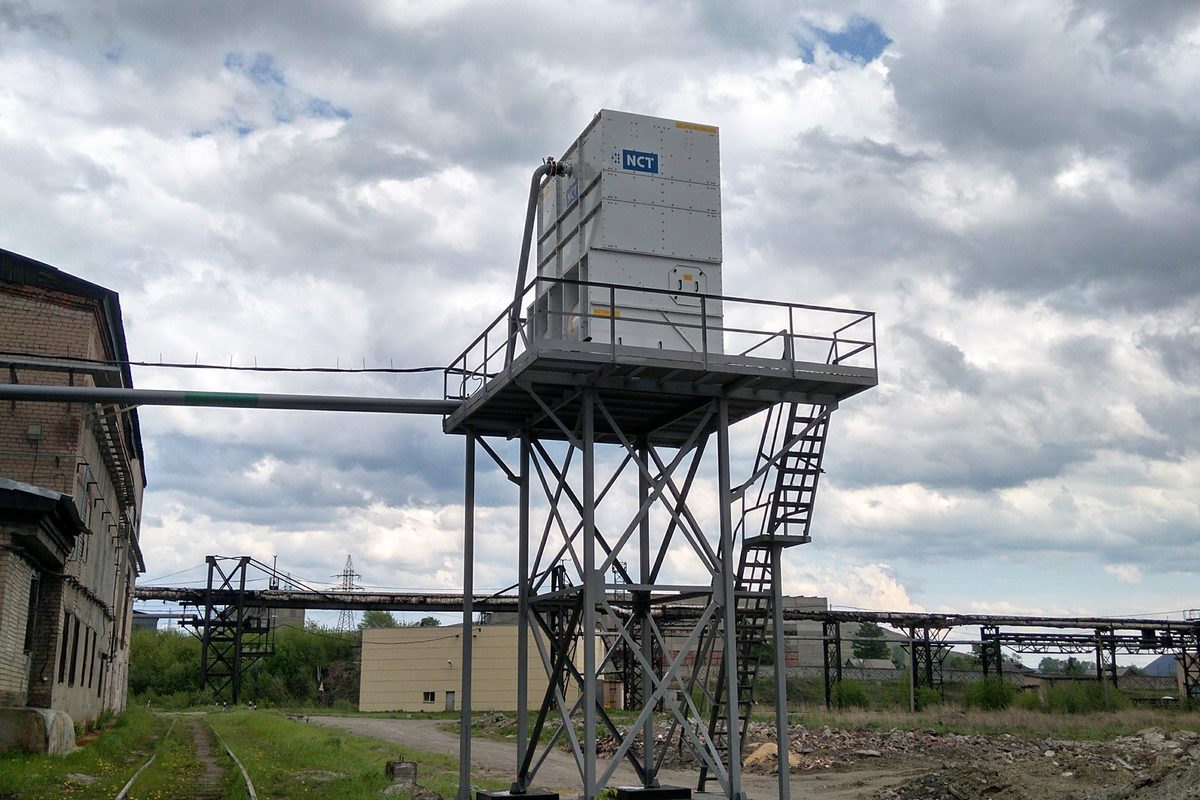
- Installation in blocks. A modular cooling tower arrives in factory-assembled blocks and is assembled on site in 1–2 days without construction work. A closed-circuit VRC narrower than 3.5 m travels in two factory blocks without an escort vehicle. A VA tower is assembled from blocks in a day, without a concrete basin under it.
- The whole unit and the start-up. Pump skids, tanks and panels are shipped as one set with documentation. We install it ourselves or supervise the customer's crew; our engineer runs the start-up and trains the shift.
The sequence of work at an operating plant is in the article Cooling tower replacement at an operating plant, assembly and start-up on the Cooling tower installation page.
Which cooling mistakes cost metallurgical plants the most?
| Mistake | What it leads to |
|---|---|
| All consumers combined in one loop | Dirty loops contaminate clean ones |
| Sizing for the shift-average load | The water overheats at the end of every melt |
| Open tower water fed directly into the coil or the mold | Deposits in the channel, local overheating, failure |
| An open cooling tower on a glycol loop | Glycol is lost with evaporation and drift |
| No filtration and water treatment on scale-laden water | Fill and heat exchangers foul within a season |
| Selection without a fouling margin and for average summer weather | Capacity shortfall in the first hot summer |
| No winter package: variable frequency control, bypass, basin heating | Icing of the fill and louvers |
| A single-section tower | Fill repair only with a shop shutdown |
| Compressor chillers where the site has steam | Extra electrical capacity and grid connection fees |
Why do metallurgical plants work with us?
- Our own plant. We manufacture NCT cooling towers, dry coolers, chillers, pump skids, tanks and panels in Sertolovo; lead times depend on our workload, not on an importer's queue.
- One contract. Design, manufacturing, supply, installation, commissioning and service: one company and one party responsible for the outlet water temperature.
- A calculation you can check. We are a member of the Cooling Technology Institute (CTI, USA), which sets the test and acceptance methods for cooling towers: actual performance is verified on site by these methods.
- Warranty. The basic warranty is 12 months. The extended warranty of up to 5 years requires a service contract with a certified partner and mandatory chemical water treatment.
Where does our equipment work in metallurgy?
Absorption chillers and dry coolers:
- A metallurgical complex in southern Russia: steam-fired Thermax absorption chillers cool a new rolling plant, supplied with NCT pump skids and tanks;
- A powder metallurgy plant in central Russia: a steam-fired Thermax absorption chiller cools the electrolyte, NCT cooling towers reject the heat, and the system runs automatically;
- A non-ferrous metallurgy plant in Russia: NCT dry coolers with adiabatic cooling keep a glycol loop at full capacity in summer heat;
- Volzhsky Pipe Plant (in Russian): two hot-water Thermax absorption chillers of 1,650 kW each cool the control systems; they replaced machines that had run for 25 years.
NCT cooling towers:
- Navoi Mining and Metallurgical Combine (in Russian), Uzbekistan: a VR tower with a winter package, a PU-330/50 pump skid and a W2C system for the oxygen plant compressors;
- Stupino Metallurgical Company (in Russian): two VR0 towers with a pump skid and a tank for the steelmaking furnace of a new shop;
- Beloretsk Leaf and Coil Spring Plant (in Russian): a 2,793 kW VR0 tower cools a quench tank, 60 → 30 °C, with W0C automatic blowdown;
- Tatprof (in Russian), Naberezhnye Chelny: VR towers cool the quenching of aluminum profiles; the first two towers of 2,910 kW each under a 2016 contract, followed by deliveries in 2018 and 2021;
- Pamir steel foundry (in Russian): a closed-circuit VRC tower with a winter package and a pump skid for induction furnaces;
- NPP Tekhnologiya (in Russian), Chelyabinsk: a VR0 tower with a remote basin, 75 m³/h, 50 → 25 °C, for induction furnaces and transistor frequency converters;
- Svelen (in Russian), Saint Petersburg: a 314 kW SVA mini cooling tower, 35 → 26 °C, for the induction furnaces of a copper products plant;
- Novolipetsk Steel (in Russian): an SVA tower for an induction furnace in a new shop;
and many others: 780+ projects in total. Customer reviews.
What should you send for a calculation?
- The heat load of each consumer, peak at the end of a melt and average, and the temperature schedule.
- The water requirements of the furnace, mill or machine manufacturer: supply temperature, conductivity, hardness.
- The flow rate and composition of the fluid, and the operating pressure.
- The site: city, installation level, size and noise limits, dates of scheduled shutdowns.
- A make-up water analysis: hardness, chlorides, suspended solids, pH.
- Parameters of steam, hot water or flue gases, if available.
- Redundancy requirements.
From this data our engineer will select the scheme and equipment with the design wet-bulb point of your site.
Frequently asked questions
Our water is dirty. Should the furnace be connected to the plant's common recirculating system, or should it get local cooling?
If the furnace data sheet requires treated water and the common system holds the required temperature in summer, the furnace is connected to it through a heat exchanger, keeping the closed coil loop. Often it does not: its towers were sized for the whole plant, not for the furnace data sheet. Then local cooling is built. That was the case at a foundry in Tver. The shop's central tower could not cope with an OTTO JUNKER induction furnace, and we built a separate system for the furnace: a VR tower, a pump skid, water treatment, a chiller that switches on above +25 °C outdoors, and a remote tank that protects the water from freezing. The piping was laid without stopping the main production.
Why open cooling towers with a heat exchanger rather than glycol dry coolers?
Under Moscow summer design conditions, with dry air at 26–27 °C and a wet bulb of about 20 °C, an open tower with a heat exchanger delivers about 27 °C to the furnace, a dry cooler on glycol about 32 °C. A dry cooler also uses more electricity: 0.10–0.13 kW per kilowatt of heat against 0.03–0.05 kW. On the other hand it needs no make-up water, blowdown or chemicals, so it is chosen where water is scarce, if the furnace accepts 32 °C.
Can the tower fill be replaced without stopping the shop?
Yes, if the tower is sectioned and access to the fill is built into the layout: one section goes out for repair while the others carry the load. Sectioning is hard to add to a finished tower, so it is written into the technical specification for any supplier, together with the requirement to replace the fill without dismantling the unit.
Send us the data for selection: submit a request or call +7 (800) 333-49-96.
Watch: metals (in Russian)
NCT VR cooling tower at an aluminum rolling plant (Rostov region)Let us size a cooling system for your site
An engineer will select the equipment and send you a calculation. Free of charge, no obligation.